
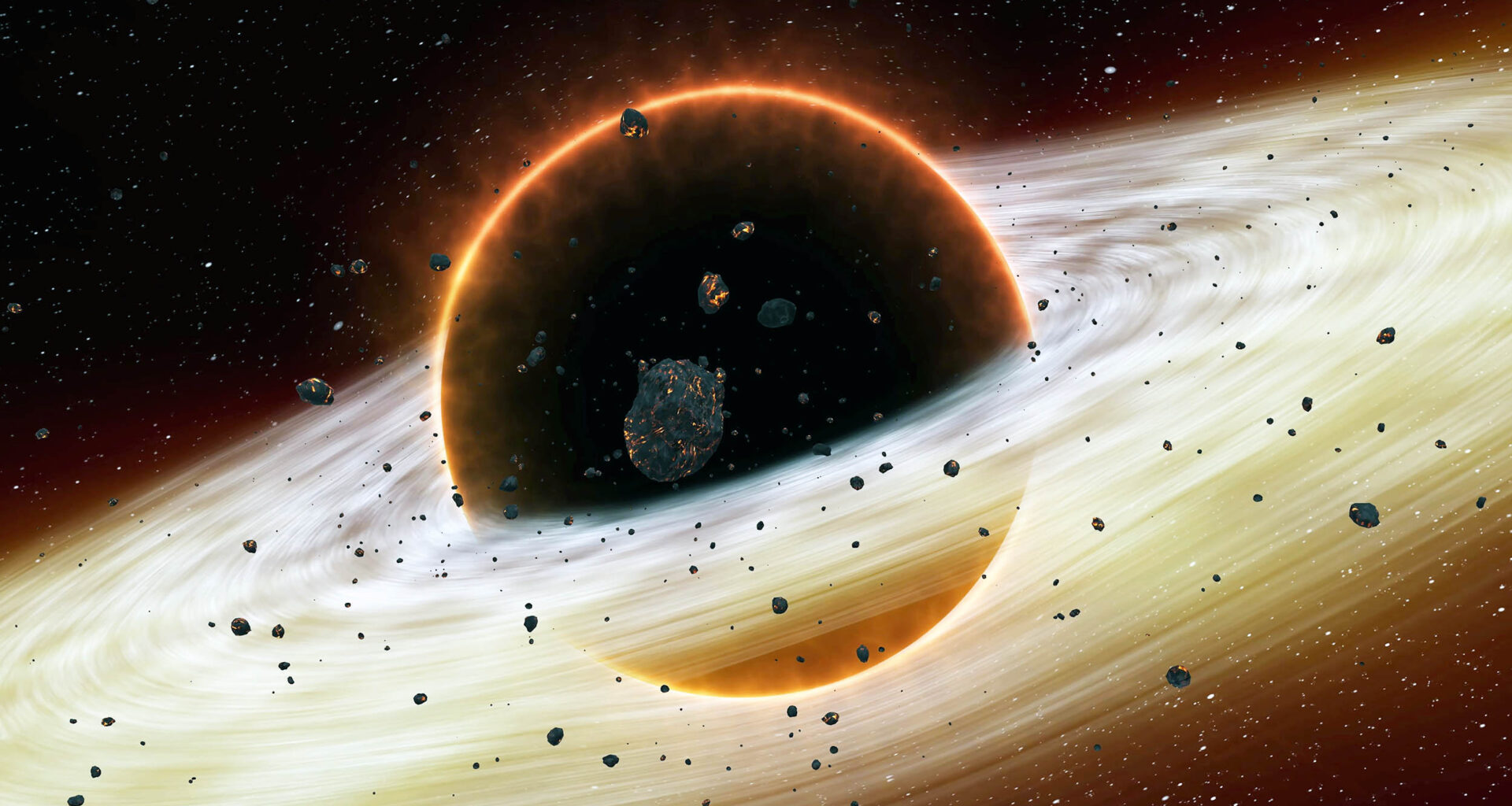
One of the universe’s earliest known black holes may have outgrown its galaxy for good. New observations of the quasar ULAS J1120+0641 reveal a system so deeply unbalanced that even future galaxy mergers are unlikely to fix it.
Despite being surrounded by potential neighbors, the host galaxy still falls far short – raising the possibility that some black holes raced ahead in the early universe and never slowed down enough for their galaxies to catch up.
Finding ULAS J1120+0641

Around ULAS J1120+0641, James Webb Space Telescope (JWST) images revealed a crowded field of neighboring early near the overgrown black hole.
Working from those observations, Meredith Stone at the University of Arizona showed that even this richer environment leaves the host galaxy permanently outmatched.
The team identified 22 nearby sources, but their projected future mass still failed to bring the system back into proportion.
That limit closed off an easy rescue for the galaxy and set up the broader question of how such an imbalance formed in the first place.
Black holes and galaxy balance
A supermassive black hole, a giant containing millions to billions of suns, usually grows in step with its galaxy over cosmic time. ULAS J1120+0641 is a quasar – a brilliantly feeding black hole – seen as it existed 12.9 billion years ago.
Its light left when the universe was 770 million years old, before many mature galaxies had formed. Such an early giant forces astronomers to explain how one center raced ahead within the same small system.
Faint neighbors finally revealed
JWST caught faint neighbors that earlier Hubble images mostly missed because older cameras detected less stretched light from such great distances.
Young galaxies revealed themselves through oxygen glow because hot, newborn stars energize oxygen atoms within surrounding gas.
Some candidates looked clumpy, but their matching colors showed they were likely connected systems, not random overlaps from the same early period.
That richer census gave the galaxy its best possible rescue plan on paper, but the mass budget still failed.
Cosmic fuel starts disappearing
A Penn State University survey of 1.3 million galaxies and 8,000 growing black holes traced a broader slowdown across the universe. Fast-growing black holes produce X-rays – high-energy light from extremely hot matter – as gas heats while falling inward.
“It appears that black holes’ consumption of material has greatly slowed down as the universe has aged,” said Niel Brandt, an astronomy and physics professor at Penn State.
During cosmic noon – the universe’s busiest growth era – galaxies held far more cold gas than they do today. That gas fueled both star formation and black hole growth.
Over billions of years, however, supernova blasts, galactic winds, and earlier waves of star formation steadily drained those reserves.
That broader shortage helps explain why even rich neighborhoods may not fix a badly mismatched galaxy through mergers alone. J1120+0641’s surroundings may look crowded, but crowding cannot create fuel that has already been spent.
The growth problem
Stone’s team estimated stellar mass, the amount of matter locked in stars, for the host and surrounding galaxies.
Their central estimate suggests the host could grow to about 60 billion suns if nearby galaxies eventually merge through gravity. Even then, the black hole would still account for about 2.5 percent of the galaxy’s stellar mass today.
Nearby galaxies usually sit at a much smaller ratio, leaving J1120+0641 about 25 times too black-hole-heavy.
Mergers won’t restore balance
A separate analysis found the host already merging with a bright companion galaxy in the same early system. Such collisions can add stars and gas, as merging galaxies stir material into denser, star-forming regions near their cores.
Still, the companion carries only a few billion suns of stellar material compared to the oversized center. One merger helps the galaxy grow, but by itself, it cannot erase a mismatch that formed so early.
Some faint neighbors could also be missing, since even JWST struggles to detect the dimmest galaxies at extreme distances. Hidden gas might later form new stars, but only part of any supply typically converts before heat and winds push the rest away.
More distant galaxies in the surrounding field likely sit too far away to merge with the host, even over billions of years. Together, these limits leave room for small adjustments, but not for a full return to the usual balance between galaxy and black hole.
Lessons from ULAS J1120+0641
The most unsettling possibility is that this black hole simply grows quiet inside a modest galaxy after its bright quasar phase ends.
Without a steady supply of fresh gas, the center would fade, since feeding is what drives the intense light that makes it visible in the first place.
In that scenario, a dormant giant could linger inside a faint galaxy and slip past surveys unless it lies close enough for careful measurement – suggesting the local universe may still hide rare misfits rather than lacking them entirely.
ULAS J1120+0641 ties these ideas together, showing that some early black holes grew rapidly before cosmic fuel became harder to find.
Future observations, especially sharper maps of hidden gas and faint companion galaxies, will help determine whether this system is truly fading out or simply unfinished.
The study is published in The Astrophysical Journal.
—–
Like what you read? Subscribe to our newsletter for engaging articles, exclusive content, and the latest updates.
Check us out on EarthSnap, a free app brought to you by Eric Ralls and Earth.com.
—–