
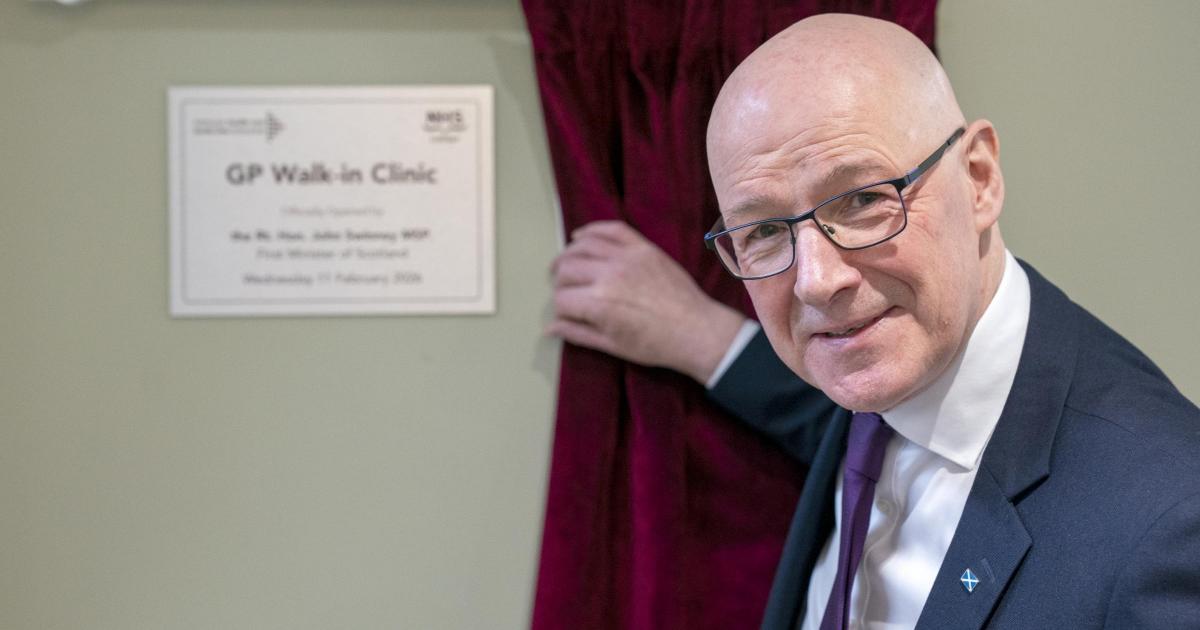
First Minister John Swinney said the clinics would end the 8am scramble for a doctor’s appointment – but the new figures cast doubt on that claim.
The British Medical Association (BMA) in Scotland has repeatedly warned the investment made to set up the walk-in clinics could be used to tackle the root causes of delays in the health service.
New figures obtained by the Scottish Conservatives showed the longest wait at the Edinburgh walk-in clinic was six hours and 20 minutes – or 380 minutes – between February 2026 and March 2026.
A total of 987 patients attended the GP walk-in clinic in NHS Lothian, where the average wait to be seen was 42 minutes.
The statistics revealed that just one GP and two nurses were working at the walk-in clinic on each shift.
Dr Al Miles, deputy chair of the BMA Scottish GP committee, said the services offer a fraction of a standard GP surgery but at a much greater cost.
But the top medic told The Herald these figures show the walk-in clinics are unlikely to improve or end the 8am rush.
“BMA Scotland has warned that from what we know from the experience of walk-in centres used elsewhere in the UK, there is no convincing evidence they reduce pressure on GP practices, out of hour services, or emergency departments,” he said.
“General practice in Scotland is hugely stretched and we recognise patients can currently face a struggle to access services in a timely way.
Reception area of the first GP walk-in clinic at Wester Hailes Healthy Living Centre in Edinburgh. (Image: Jane Barlow)
“However, as these figures suggest, it is highly doubtful the introduction of these walk-in centres will have a significant impact on improving access or ending the ‘8am rush’ for appointments.
“Walk-in centres offer a fraction of the services of a standard GP surgery, at a much greater financial cost. We cannot afford to be directing funds into projects which have already been unsuccessfully tried in England for over 15 years – this funding would be far better targeted at existing GP services, which we know will deliver the best care for patients.”
Miles Briggs, the Scottish Tory candidate for East Lothian Coast and Lammermuirs, said: “These damning figures are proof that John Swinney’s GP walk-in centre gimmick is simply not working in reality.
“Patients in Edinburgh are still experiencing ridiculously long waits before being seen.
“GPs repeatedly warned Swinney that these simply were not the answer to beat the 8am rush for appointments, but he ploughed ahead anyway.
“If walk-in centres were the magic bullet he claims, Swinney has had nearly two decades in government to roll them out.
“Patients across Edinburgh and the Lothians deserve a proper plan to fix the crisis in our NHS.”
Two new walk-in clinics opened last month – one at Lochee medical centre in Dundee and the other in Benbecula in the Western Isles.
Walk-in clinics also opened in Stranraer, in the south-west of Scotland, while more are expected to open in Lerwick, the Shetland Isles, and Hawick in the Borders.
The centres will be open from noon till 8pm seven days a week and have been introduced in a bid to make it easier for people to see a GP.
Initially, 15 clinics were announced, but the SNP used its national conference last year to announce the clinics would be doubled.
The units treat people with urgent but non-emergency medical problems, where patients need to be seen on the same day but do not require hospital care.
It is thought more than a million more GP and nursing appointments will be provided as a result.
Emma Harper, SNP candidate for Galloway and Dumfries West: “Under John Swinney’s leadership, the SNP is relentlessly focused on improving Scotland’s NHS and our plan is working – waiting times are down, operation numbers are up and we have more GPs.
“While we are opening GP walk-in clinics all over Scotland to help people get the treatment they need, all the Tories and Labour can do is talk down our NHS.
“The Edinburgh clinic was the first to open as a pilot before clinics were rolled out across the country. The Tories are so focused on finding negatives that they completely ignore the fact that all 987 patients who attended the clinic in its first month received a medical assessment.”