
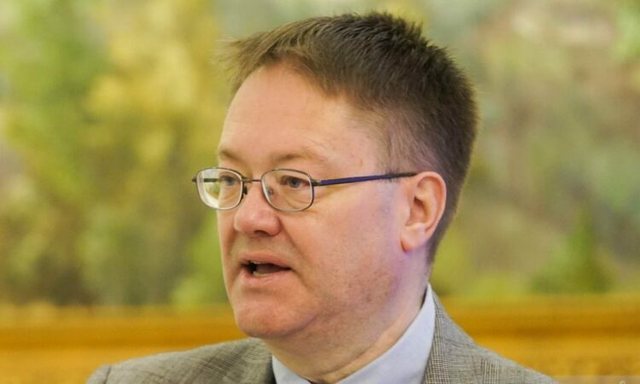
British Ambassador: The largest group of convicts in the United Kingdom are Albanians
News

Express newspaper
26/04/2026 21:16
A few days ago, the Albanian Ambassador to the United Kingdom, Uran Ferizi, in a letter to the newspaper “The Guardian”, criticized the attitudes of British officials towards Albanian immigrants. He stressed that mentioning Albanians as a community with problems with the law creates stereotypes and targets them.
In a reaction to this issue, the British Ambassador to Tirana, Nicholas Abbott, stated in an interview with Euronews Albania that caution should be exercised with statistics and the way they are interpreted.
The British diplomat stressed that the majority of Albanians in the UK live normally, work and contribute to the economy. However, he acknowledged another reality: “Albanian nationals are the largest group of foreign nationals sentenced to prison in the UK. This is a fact that cannot be ignored,” he said. /Euronews albania
Excerpt from the interview:
Nicholas Abbott: I would very much agree with Ambassador Farizi that we need to be very careful with statistics, with the numbers that people use and with the reality behind them. I think he is absolutely right to raise this issue. So he and I have a long conversation about the question of who you would consider to be Albanian in the UK. That would include those who have emigrated from Italy or Greece but who have an Albanian ethnic identity. As a government, we do not do that. We consider Albanian citizens to be those who have an Albanian passport and enter the UK with it. So it is not that simple. The majority of Albanians who live in the UK live normal lives, quite normal lives, like people here. They have jobs. They contribute to the economy. They have children who go to school. They may have family members living in Britain and receiving medical treatment. But there is also a reality that the government cannot ignore. Albanian nationals are the largest group of foreign nationals sentenced in UK prisons. This is a reality. It is not intended to demonize anyone at all. And I think my message, whether I speak to Ambassador Farizi, whether I speak to members of the diaspora in the United Kingdom, or to those who come here, is the same. I recently had a visit from a group of successful businessmen who live in London. I am not talking about people who run big companies. They are family companies. But they have been there for almost 30 years. They have been successful. They have settled there with their families. They were asking me: what can we do now for our country? How can you help us here in Albania? And I laugh a little, because it seems to me that now I have a kind of Albanian electorate that I represent.
So, Ambassador, do you disagree with Prime Minister Edi Rama when he says that crime has no nationality?
Nicholas Abbott: Yes. I think it’s more complicated than that. You have to look at the way crime exists within different societies, and how it works. What has happened is that Albanian criminal groups have managed to establish themselves and take control of certain areas of crime in the UK. As far as I understand, in Germany, France or the Netherlands, there are other groups. That’s it. So, no one is saying that behind the crime in Western Europe there is an Albanian mind that runs everything. But there is a reality: Albanian criminal groups are heavily involved in the trafficking of cocaine, in cannabis, in the UK, but also in Western Europe and beyond. These are issues that need to be faced head on. Because to do that, you need cooperation to stop them. And I think this is not something that is solved once and for all. There will not come a day when this ends. What you are trying to do is manage the risks to your society, so that they do not have a devastating impact on society itself. This also applies here, in Albania. No one would want to see this here.