
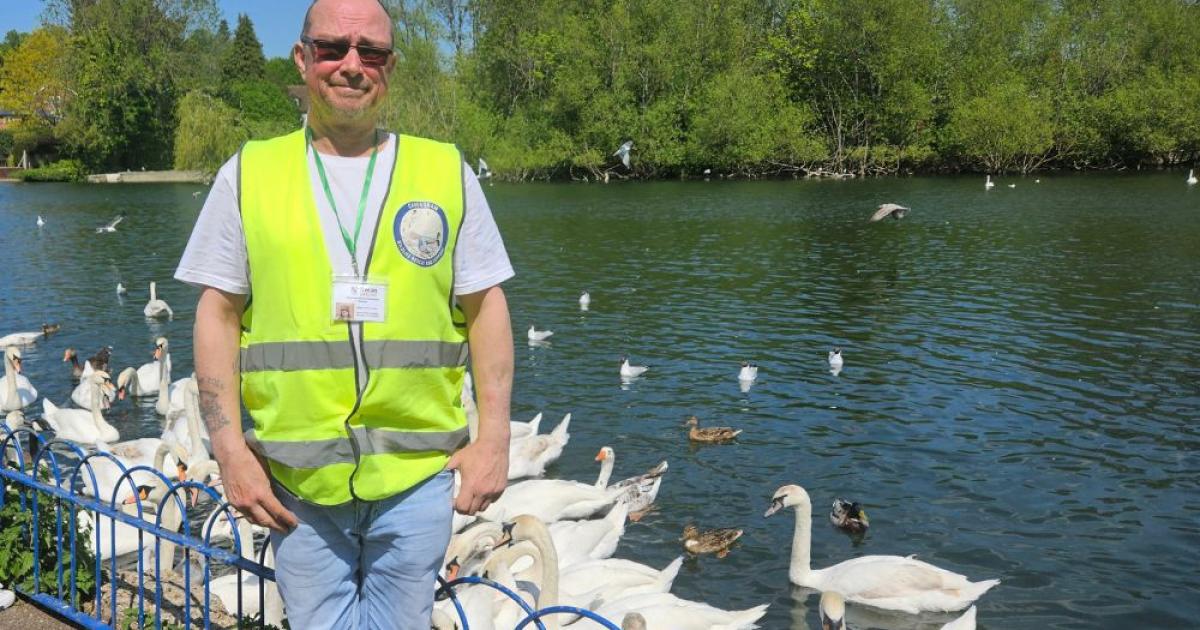
Caversham Wildlife Rescue and Support (CWRS), based in Reading, is urging the public to stop throwing mouldy bread into rivers after swans began to show signs of “Pink Feather Syndrome.”
The condition is caused by a fungus called Chrysonilia sitophila, which grows on decaying mouldy bread in the water and affects birds that eat it.
Graham Neale, a member of the charity, said: “When it goes into the swans it turns them pink.”
It causes feathers to become brittle and waterlogged, which can impact the swans’ ability to float.
More:Prominent building to rising from two to six storeys with 14 flats and shops
Swans with mouldy bread (Image: Caversham Wildlife Rescue and Support)
The syndrome can lead to hypothermia and in severe cases, death.
CWRS has placed signs along Thames Promenade warning people of the dangers.
The charity contacted Thames Valley Police, but was advised to report the issue to environmental authorities.
It has since notified the Environment Agency and Reading Borough Council.
Mouldy food found in river (Image: Caversham Wildlife Rescue and Support)
Lauren Ayres, 34, who also works with the group, said: “It would be nice to have a bit more information out there on how to support the river because it is a home.
“It is our duty as residents to help look after it.”
More:TOTAL closure of M4 coming after horror 24 hours of crashes
As part of a broader appeal for people to take greater care around wildlife, Mr Neale also shared that on the morning of Monday 27 he found the body of a baby goose that looked like it might have been run over by a bike.
He said: “Normally they all come running because they know I have their breakfast for them.
“It had just gotten its flying feathers in.”
CWRS was established six months ago and is sponsored by Bridges Estate Agents.
Mouldy food found in the river (Image: Caversham Wildlife Rescue and Support)
The group partners with Swan Lifeline, a charity specialising in the treatment and care of swans.
Both Mr Neale and Ms Ayres thanked the Caversham community for their ongoing support.
An Amazon Wishlist set up by the charity has enabled residents to donate towards essential supplies, including better feed and equipment for swan care.
Mr Neale said: “They have helped us to grow and to save more animals.”