
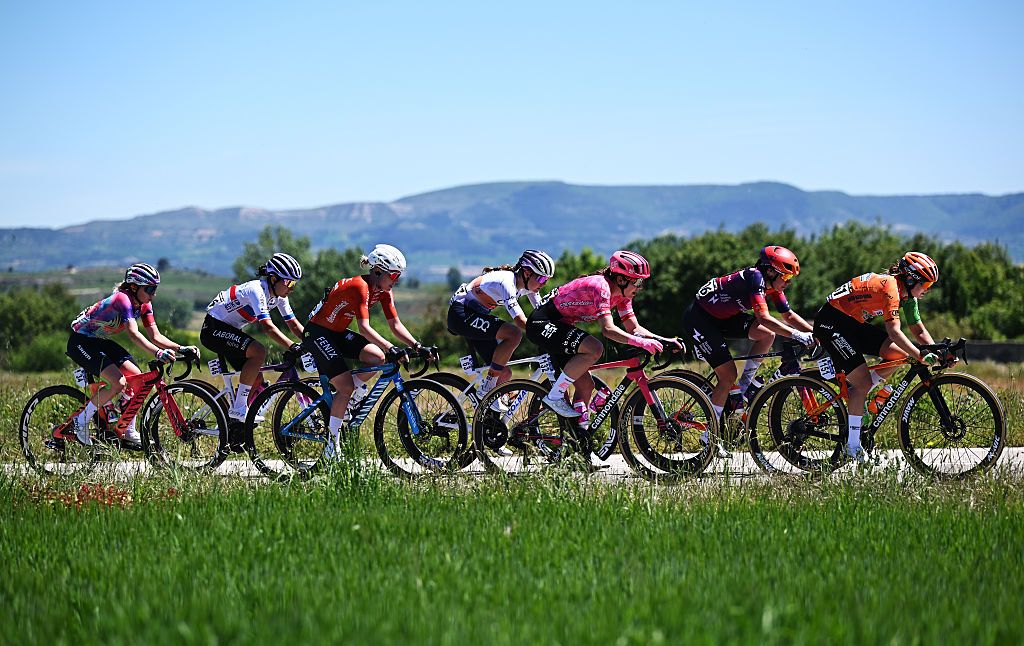
At the start of May, the Women’s WorldTour pivots away from the one-day races, which have dominated since February, and moves into the stage race season. Rather than the frantic racing of the Classics, we’ll see the long-game strategies play out on the brutal, steep-sided valleys of the three-day Itzulia Women, through the sprints and mountain top finishes of the Vuelta a Burgos, and before that La Vuelta Femenina by Carefour.es.
Kicking off this weekend, the 2026 Vuelta Femenina is set to be the hardest yet. Offering little for the pure sprinters, every day is lumpy, the week concluding with two mountain top finishes, including the fearsome Angliru, where the winner of the year’s first women’s Grand Tour will be crowned.
Article continues below
You may like
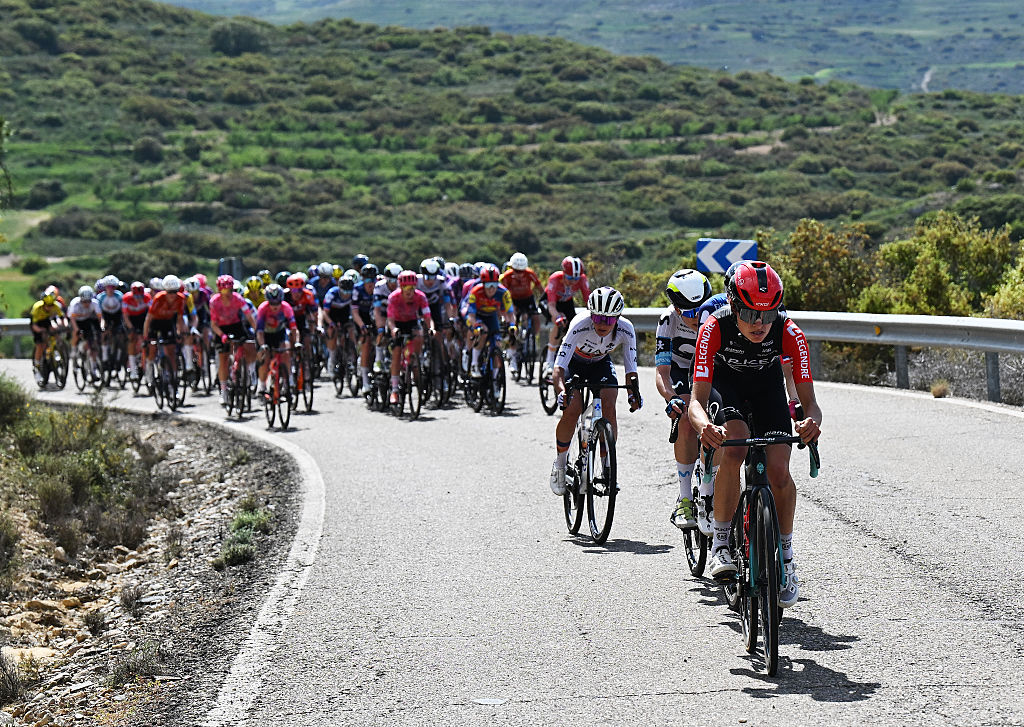
The peloton racing at La Vuelta Femenina (Image credit: Szymon Gruchalski/Getty Images)
The Madrid Challenge made its debut as a flat one-day criterium. Reflecting La Course by Le Tour de France, itself the precursor to the Tour de France Femmes avec Zwift, the peloton raced on the finish circuit of the final stage of the men’s Vuelta.
While it initially seemed to be an afterthought to the men’s race, the Madrid Challenge developed steadily over the years, organisers adding a time trial in 2018, an extra road stage in 2020, increasing year-on-year to five days in 2022. The following year, it became La Vuelta, was extended to a week, and was moved from September to May, creating the Spanish block we have now.
There can be little doubt that these three races, and the Vuelta in particular, reflect, and even inspired a huge growth in women’s cycling in Spain. As they grew in international importance, other races sprang up around them, and the number of women’s UCI teams exploded. So surely the Spanish sport is in good health? Not quite.
Fewer teams means fewer opportunities
In the last three years, the number of Spanish-registered UCI teams has atrophied alarmingly, going from a high of nine in 2023 to just two this year. Such a reduction has severely dented access to international racing for young Spanish women.
When the Madrid Challenge first materialised in 2015, the current three-tier hierarchy of women’s teams was yet to be created; UCI Women’s Teams were the only international outfits. Spain had three of those squads and, while their numbers initially dropped, by 2021, nine UCI teams called Spain home, including Movistar Women, which had taken its place as one of the recently created first division, WorldTeams.
But when Laboral Kutxa-Fundación Euskadi moved to ProTeam level last year, only Eneicat-CMTeam remained, and after their main sponsor pulled out, even Eneicat were forced to revert to national Club team status. This ensures that only Movistar and Laboral Kutxa will compete at the country’s three biggest races, with no home Continental teams existing to hold a place among the wildcard picks.
What to read next
The number of Spanish riders competing in those early editions of the Madrid Challenge has followed a similar trend. Starting from the mid to high teens, leaping to 35 in 2021, when all nine Spanish teams rode the four-day 2021 Madrid Challenge, before dropping away as the number of teams fell. Just eight and nine Spanish women, respectively, have ridden the last two editions of the national tour.
So why has the number of teams dropped so drastically?
“They basically killed the movement,” Eneicat-Be Call rider Alessia Missiaggia told Cyclingnews. “The problem is that they put a minimum salary for Conti teams that is too high for teams. At the same time the salary for Conti teams is a national rule, so every country is going its own way, resulting in clear discrimination.”
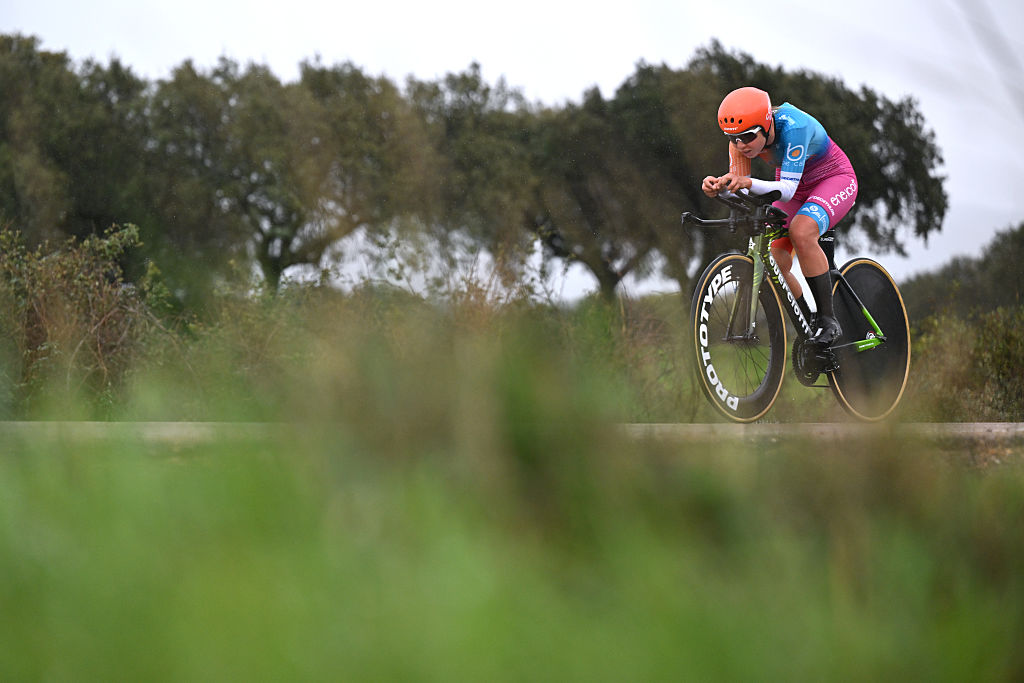
Alessia Missiaggia racing in Spain (Image credit: Getty Images)
Missiaggia is referring to the Spanish minimum wage, which the Royal Spanish Cycling Federation (RFEC) announced it would apply to Continental teams in 2022 and which came into force at the start of 2024.
“We decided to do the same: become a UCI team in order to compete UCI races,” Eneicat-Be Call team manager and former professional racer, Eneritz Iturriaga told Cyclingnews.
“It was a UCI regulation. However, in 2024, Spain implemented the minimum wage requirements for continental status, and we could only participate for two years, as our budget ballooned to €400,000. It affected us because sponsors had to increase their investment by almost 100 per cent, which is why, after two years, they didn’t continue.
“Right now, there are none [Continental teams] because a club can’t raise €400,000 to become a Continental team in Spain, while in other countries, there are no financial conditions. And besides, that status doesn’t prevent you from being able to safely compete in UCI races.”
The UCI’s regulations pertaining to both men’s and women’s Continental teams state: “A UCI Continental team or UCI women’s continental team will comprise riders who may or may not be professional.” And though the RFEC is simply working to a higher standard, as the same regulations allow them to, the policy meant that the eight Spanish Continental teams competing in 2023 became two in 2024 and is now zero. The timing is no coincidence.
“We are simply asking UCI teams to regularise the situation of their female employees in accordance with the law,” the RFEC explained in a statement to Cyclingnews.
“They cannot be left without pay, in precarious situations, or without job security. Our duty is to fight for the dignity of female cyclists and all workers in this sport, and if a team cannot meet the minimum requirements established by law, we understand that it is not a professional structure.”
It’s difficult to argue with that, especially when the current minimum salary is only €1,424.50 per month (approx. £1,238 or USD1,680), hardly a fortune.
It should be noted that men’s Continental Teams are not a common thing in Spain, perhaps because they’ve been required to pay the minimum wage since 1998. This year, Movistar’s Academy team is the only one, and there have not been more than two since 2010, so it could be argued that the country maintaining seven women’s Continental teams was a little unbalanced.
More races, fewer opportunities?
For years before the creation of the Madrid Challenge in 2015, Euskal Emakumeen Bira was the only Spanish race ever present on the women’s UCI race calendar. One of the most coveted stage races on the entire season, it offered some serious Basque Country climbing and was often immediately preceded by the 1.2-level Durango-Durango Emakumeen Saria.
In line with the expansion of the Madrid Challenge and Vuelta, the Spanish calendar has ballooned from seven days in 2015 to 33 days across 15 events this season. Certainly good news for the sport in Spain?
“Regarding the women’s Vuelta a España and its introduction to the national calendar, it forced several organisers to change their dates, moving them to less attractive times for the international peloton. I believe this explains the impact the Vuelta had,” said Ángel Lopez Medi, President of the Club Ciclista Eibarrés, which organises the GP Ciudad de Eibar. Their race began life in 2018 as a national event, rising through the ranks, becoming a second tier 1.Pro race in 2024. This year, however, it has dropped back down to 1.1.
“Due to the saturation of the calendar in May, we opted to move to October, as the Vuelta a Andalucía did. But events proved once again that this was not the most suitable date for the race. Low participation, coupled with most teams being on break, forced us to find another date, even dropping down a category this year to improve participation in the race.”
The lack of coordination in allocating race dates is clearly an issue for events trying to attract the kind of quality riders which, in turn, bring media attention and sponsorship. The Vuelta a Andalucía could be seen as a cautionary tale.

Laboral Kutxa-Fundacion Euskadi (Image credit: Getty Images)
Beginning life in 2022, for the first three editions, it took place in May, but moved to October because of the crowded calendar. However, after attracting only 51 riders, they moved the 2026 race to the final week of April, only to cancel it; they will return when circumstances allow.
“This has affected sponsors and collaborating institutions,” said Joaquín Cuevas Huguet, the race’s Director General. “Furthermore, the event’s dates at the end of April coincided with other sporting and cultural events in Andalucía, meaning we did not have sufficient security personnel.
“The growing number of races on the women’s calendar has contributed to a greater concentration of competitions in certain periods of the year. This situation complicates the availability of equipment, resources, and media coverage, directly impacting the viability of events of this kind.”
Continuing the run of low rider numbers, only 70 riders were on the start line for this year’s GP Ciudad de Eibar, and of the 11 participating teams, just two were UCI registered: ProTeam and local squad Laboral Kutxa-Fundación Euskadi, along with Italian Continental outfit Vini Fantini-BePink.
“The regulations, as you can see, aren’t working,” Iturriaga asserts. “Seventy girls are going to those races, because there are only 15 WorldTour teams and seven ProTeams, and they can’t do all the races. If the big teams aren’t attending all the races, and many are only showing up with four or five riders, we should look into what’s going on. In my opinion, too many big steps are being taken in this sport when there are really many shortcomings.”
A lack of big teams might not be good for the race, but it does provide opportunities for Club teams like Eneicat. Nine started in Eibar, with Eneicat’s new signing, former WorldTour pro, Sandra Alonso, taking third place behind Laboral Kutxa’s former Spanish champion, Usoa Ostolaza.
While club teams can ride .1 and .2 races, the fly in the ointment for rider development is where the majority of Spain’s international races sit in the hierarchy. Of the 33 UCI race days this year, 21 are either WorldTour or ProSeries level, at which Continental teams can ride, but clubs rightly cannot. If club teams are to be allowed to ride UCI races, surely it is at the fourth tier .2 races, but for the last two seasons, there have been none in Spain, creating an inverted and imbalanced pyramid.
So, where can they take those steps up the ladder?
“Talented young cyclists are finding opportunities, either directly within professional teams or through club structures where they can hone their skills,” Aitor Galdos, manager of Laboral Kutxa, said.
“Spain boasts an extensive WorldTour calendar, but it also features .Pro, 1.1, and 2.1 category races, as well as the national calendar, such as the Spanish Cup and regional competitions. This ecosystem offers a sufficiently diverse competitive environment for the development of cyclists at all stages of their careers.
“There is a sufficiently broad and well-structured calendar that allows for the progressive development of young riders,” Galdos concluded.
The Vuelta – a positive influence
As we look forward to the Vuelta Femenina and the other Spanish stage races coming over the next three weeks, there can be no doubt that they have positively influenced women’s racing in Spain.
The Federation tells us the creation of the Vuelta is at least partially responsible for a tripling in the number of female race licence holders, an increase in women riding Spanish Cup races and other lower-level events. They point to their active elite and age group national squads, which race regularly, developing talents like Paula Ostiz, who now rides for Movistar after winning last year’s Junior World and European road titles, as well as the European TT title.
“We consider it fundamental for the development and growth of Spanish women’s cycling that one of the three most important stage races on the professional women’s road cycling calendar is held in our country,” the RFEC statement said of the Vuelta.
“The Vuelta is the competition that gives women’s cycling the greatest media attention and impact in our country and, therefore, is key to popularising cycling among women.
“The existence of the Vuelta also gives young cyclists in training a benchmark and a dream for the future: to race in the Vuelta a España, a very important aspect, since young cyclists need to be offered an attractive professional and sporting horizon.”
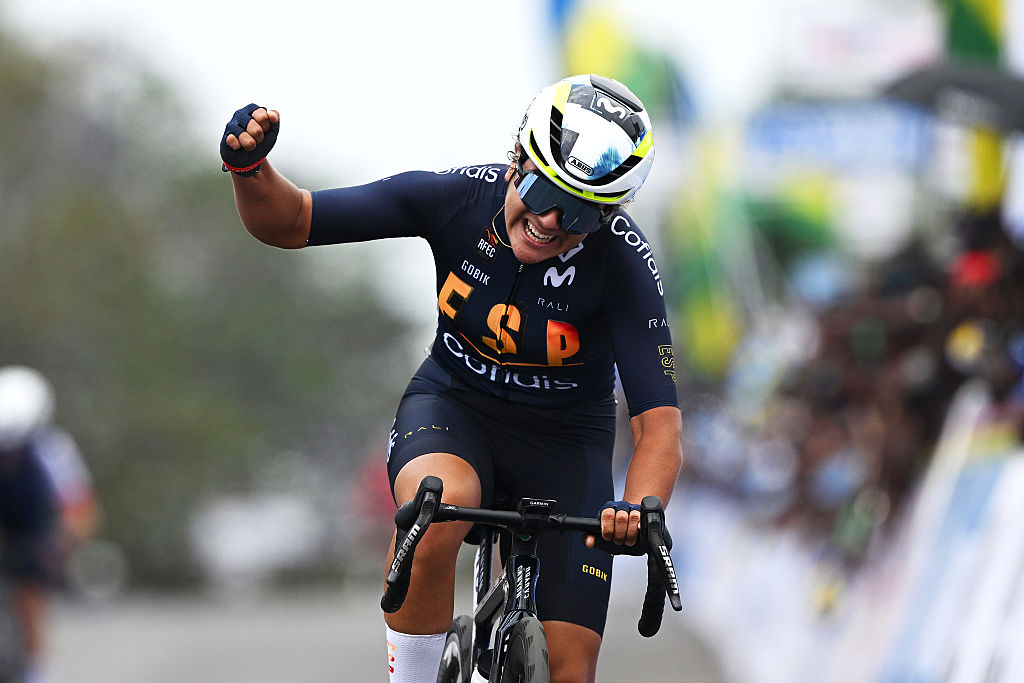
Paula Ostiz (Image credit: Getty Images)
But here’s the rub. There are only 14 Spanish women riding across all 21 World and Pro teams, so even if they’re all selected for this year’s Vuelta España Femenina, there will be far fewer home riders to inspire those young Spanish girls watching at the roadside or on TV.
And perhaps the saddest irony is that those Continental-level riders at the Vuelta handing bottles to Spanish kids, wide-eyed with wonder and adulation, will be from foreign teams working to different rules.
The RFEC’s decision forcing Continental teams to pay their riders the national minimum wage is not just one born from what they claim is a legal imperative, but arguably from moral righteousness too: why shouldn’t elite international cyclists be paid? But the policy has killed off all the teams. Combine that with the disjointed calendar, and there are issues which must be addressed before Spain can take its rightful place at the top table of women’s sport.
Subscribe to Cyclingnews for unlimited access to our La Vuelta Femenina coverage as the likes of Pauline Ferrand-Prévot, Kasia Niewiadoma-Phinney and others battle it out. Don’t miss any of the breaking news, reports, and analysis from one of the biggest women’s stage races of the season. Find out more.