
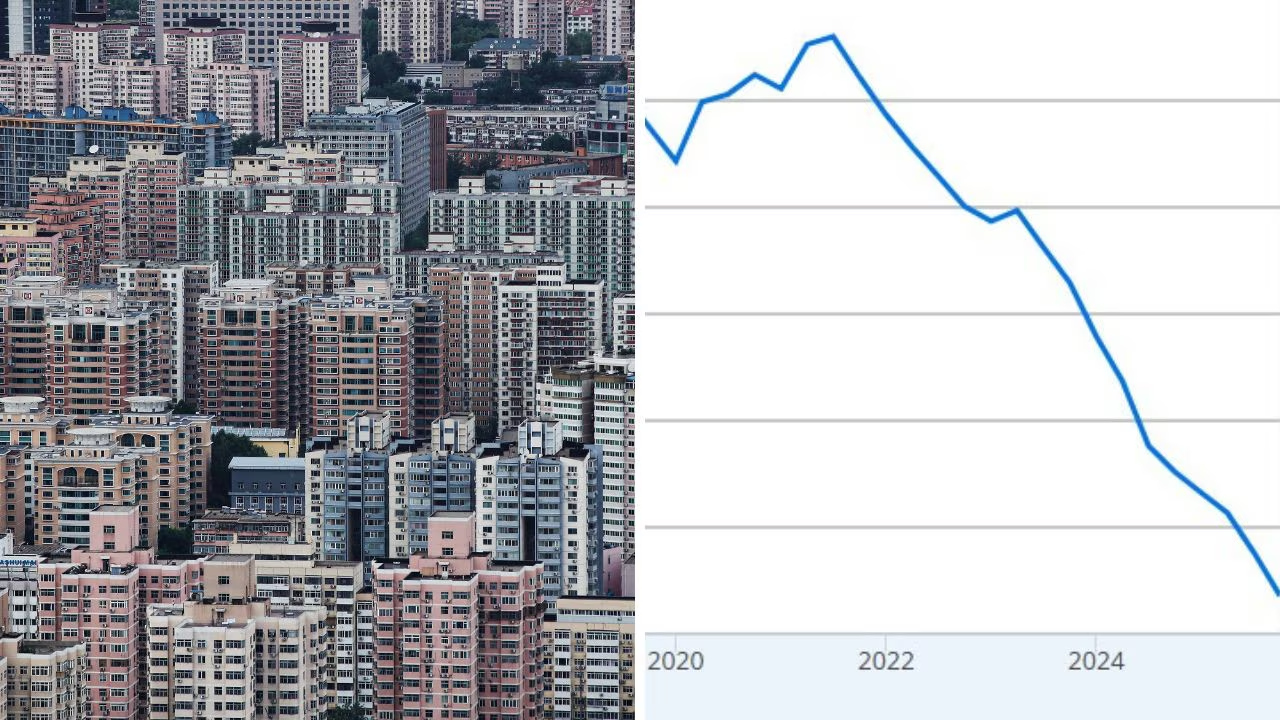
Chinese house prices have crashed to their lowest level in 20 years, with homeowners who bought in 2005 now in the red as a debt crisis and oversupply wreak havoc on the market.
Real residential house prices in China have been in free fall since Q3 2021, declining 23 per cent from their peak, according to data from the Bank for International Settlements (BIS).
In the world of property, losing nearly a quarter of real value in less than five years amounts to a major crash.
For comparison, the US property crash during the 2008 financial crisis was significantly deeper in terms of total percentage lost: nearly 40 per cent.
But China’s current crash is arguably worse in terms of long-term wealth destruction.
In Q4 2025, prices dipped below levels not seen since Q2 2005, when recording began.
While the American market lost 11 years of real gains during the GFC, China’s market has lost at least 20 years of real gains. And unlike the US, it hasn’t recovered.
The crash is an ominous development for Australia, because China is the largest buyer of the nation’s top export, iron ore – turning it into the steel that fuels residential construction.
“China’s real estate market has been defining the shape of Australian prosperity for 20 years,” Martin Eftimoski, a former China real estate analyst at the Reserve Bank of Australia (RBA), told news.com.au.
“The RBA forecast many years ago that the decline in urbanisation in China would eventually lead to declining iron ore demand.”
Australia’s iron ore export earnings are forecast to drop from $116 billion in 2024–25 to $107 billion in 2026–27, according to the Department of Industry, Science and Resources.
RBA figures show that China’s demand for steel peaked in 2020, with a fall since then driven by real estate, although demand from infrastructure and manufacturing have held up well.
Reduced demand for iron ore means the commodity fetches lower prices, and that directly hits the federal government’s company tax revenue.
Treasury calculated last year that every USD $10 fall in the price of iron ore would wipe out AUD $500 million in revenue.
Singapore Exchange iron ore futures, a key proxy for the global benchmark, were trading around USD $107 per tonne on Thursday. They’re down more than 50 per cent from a May 2021 peak, mirroring China’s property market.
AMP Chief Economist Shane Oliver said China’s housing crash was “certainly worrisome,” but the Chinese economy had proven surprisingly resilient.
“The slump has been going for four years now and yet the overall Chinese economy is still recording solid economic growth, and the iron ore price is still around USD $100, which is well above most forecasts including the government’s,” Mr Oliver said.
“I suspect if it continues to slump then it could become more of a problem – but so far China has been able to boost exports of eerything from EVs to solar panels and this is providing an offset, along with ongoing demand for our commodities.”
China is also unifying its purchasing of iron ore under one state-owned CMRG to boost its bargaining power, and financing an alternative to Australian supply at Simandou in West Africa; creating further headwinds for Aussie exports.
But Mr Eftimoski said the Australian economy was slowly adjusting to the new reality of reduced iron ore demand and prices.
“We have had a golden run with iron ore. But now we will need to work harder and smarter to achieve the same outcomes we did,” he said.
He argued the nation still wielded immense power over China, where Western Australian ore remained a staple that was not easily replaced.
“If Australia stopped all iron ore exports tomorrow it would cause a recession in China.
“Not at all unlike the Strait of Hormuz, Australia is an overwhelming power in the price of steel.”
How China’s property market crashed
“The bubble in real estate in China really began as a response to the GFC,” Mr Eftimoski explained.
“To save the economy, they overstimulated the real estate market. A lot like the (Coalition government’s 2020) HomeBuilder policy.
“And China has spent the last 15 years dealing with the consequences of that decision.”
When demand for Chinese exports dried up during the GFC, China poured money into infrastructure and real estate, keeping GDP numbers artificially high.
Housing became a bubble inflated by speculative demand; one symptom was the “ghost cities” of empty apartments that Chinese speculators bought but never used.
Rather than waiting for a market-led crash, the Chinese Communist Party (CCP) deliberately popped the bubble in 2020.
Its “three red lines” policy included new lending rules, cutting off overleveraged developers like Evergrande from credit and leaving them unable to finish apartments people had already paid for.
The CCP also put a cap on the number of mortgages banks could issue, further choking off demand, while excess supply from years of overbuilding, and slowing population growth, have also weighed on prices.
The result has been devastating for the Chinese middle class which rose out of the property boom.
Though the CCP successfully curbed speculation, it also had the unintended effect of leaving many Chinese families feeling poorer, with consumer spending slowing.
“Most of the middle class in China stored their wealth in real estate, and when I mean stored their wealth, I mean their whole wealth,” Mr Eftimoski said.
“Its collapse has crushed their consumer confidence and is a major contributor to deflation there, and civil unrest.
“Consumer confidence is yet to recover in any meaningful way. People have been trying to buy gold instead of real estate to store their wealth.”
Could China’s housing collapse happen here?
China’s property crash was driven by a unique set of circumstances unlikely to be replicated here, according to Metropole founder Michael Yardney.
“Australia won’t ‘catch’ China’s property crash, but we remain closely tied to its economic cycle, and that’s where the real risk sits,” Mr Yardney said.
“The direct impact on our housing market is much more limited than many assume.”
He said the main consequence for Australia was economic, with reduced steel demand feeding through to commodity prices, national income, and government revenues.
And he believed buyers from China were unlikely to turn to the Australian market for capital gains.
“Chinese buyers have already pulled back significantly over recent years, due to capital controls and local restrictions, so they’re no longer a major force shaping house prices in Australia.”
Instead, our housing market was driven by domestic fundamentals such as strong population growth, chronic undersupply and tight rental markets.
Read related topics:China