
“It is an issue that has always been prevalent,” said Geoff Pearson, a law professor at the University of Manchester who is an expert in policing and crowd regulation at football.
“I wrote an appendix for the Baroness Casey inquiry and pointed out that Wembley has always had this issue. It goes right back to the first match that was ever played there in fact. Tens of thousands of people without tickets got into the FA Cup final in 1923, the game that became known as The White Horse Final.
“The Euro 2020 final was the highest profile instance of mass jibbing there has been in modern times. Over 6,00 people tried to get in without paying and over 2,000 people managed to get in. But it is a problem for any game which has a large number of away fans, any match where the demand for tickets outstrips supply.”
Read more:
That supporters have been forcing their way into stadiums and causing overcrowding in stands for over a century now underlines just how challenging the dangerous practice is to tackle.
It also goes a long way to explain why so many people were able to get in to the Broomloan Stand at Ibrox by tailgating through turnstiles, by using counterfeit tickets and by forcing open disabled access gates at the Scottish Gas Scottish Cup quarter-final at Ibrox back in March.
But the trouble which flared at the end of that encounter – police officers and stewards were helpless to prevent large numbers of Celtic fans from invading the pitch to celebrate after the penalty shootout out or hundreds of Rangers followers storming onto the playing surface to confront them – also showed that it needs to be addressed.
The Taylor Report, published in the wake of the Hillsborough Disaster in 1989, may have led to every Premiership ground in Scotland and many in the leagues below becoming all seated and senior football becoming far more family-friendly environment than it was in years gone by.
However, Professor Pearson stressed that major concerns about crowd safety still remain.
Police officers arrested a man at the Euro 2020 final at Wembley (Image: SOPA Images)
“It’s much more difficult to get the sort of overcrowding that leads to mass fatalities now that the old terraces with perimeter fencing have been done away with,” he said. “But there are still risks.
“Bringing in safe-standing sections has helped to alleviate many of the problems. I was a member of the team that recommended to the government that safe standing should be introduced.
“We observed larger safe standing sections in other countries to look for potential problems. So we were very informed about the different types of strategies that have been used to prevent the dangers associated with standing in seated areas.
“Overcrowding in seated areas where there isn’t rail seating is considerably more dangerous than overcrowding where there are rails. The rails stop progressive crowd collapse. That is one of the reasons why they were introduced.
“But in the areas where you don’t have the rail seating there is a danger that people will fall over if you get overcrowding. That can lead to serious injuries and even fatalities. If you don’t have rails, then the risk is that when there’s a goal or another exciting moment, somebody will trip over the lip of a seat, fall into the people in front of them and cause a collapse.
“If you’ve got an away end that is two thirds full and people are gathered in the middle of that section, then you’ll have a situation where, even if there are empty seats at the front and sides of the stand, an area will be overcrowded. It’s far more likely for a progressive crowd collapse to happen if you are stood by your seat.”
Read more:
Professor Pearson continued, “Overcrowded grounds are far less safe than grounds that are only filled to capacity. It can affect evacuation procedures and getting out of the ground. It can cause problems in terms of the police going into the stands to make arrests or medics going in there to treat somebody that’s having a heart attack.
“Overcrowding in concourses at half-time can be a massive problem. That can be quite dangerous as well. When overcrowding occurs, you also see aisles getting blocked and that can cause progressive crowd collapse. So there are risks even though the threat of that mass collapse has diminished.
“Where you have overcrowding, you are going to inevitably get blocked gangways and stairwells and that is dangerous as well. Even in away ends which aren’t overcrowded, a lot people with tickets end up standing in aisles. That creates those same risks.”
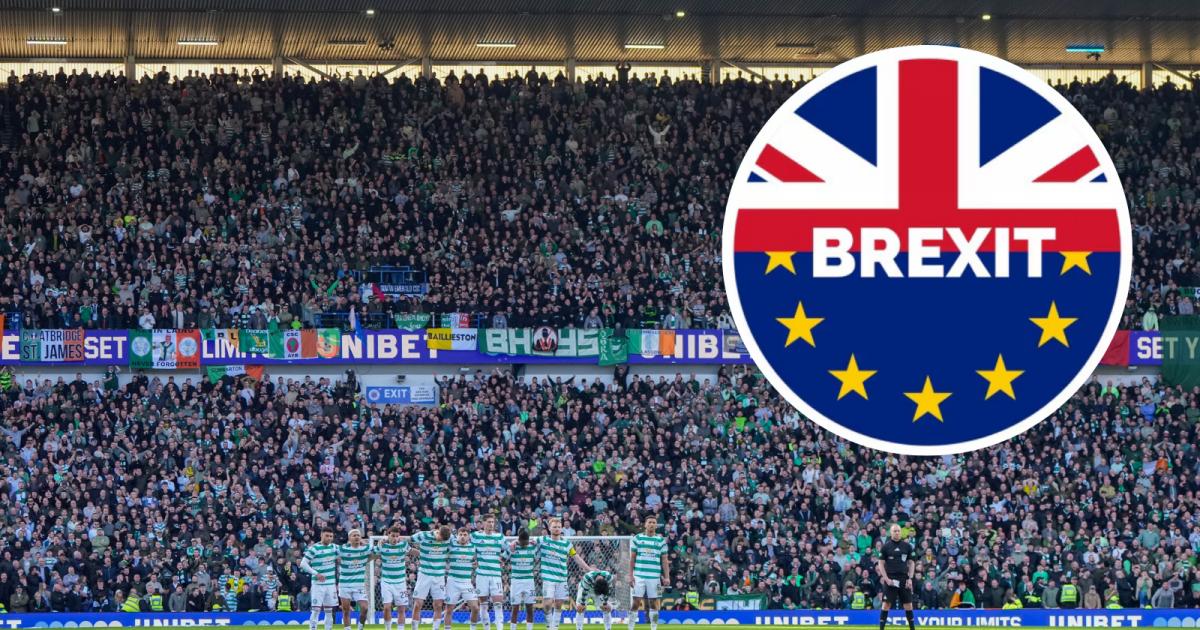
Professor Pearson explained that preventing overcrowding and fan disorder has become a far greater challenge in British football in the last few years as a direct result of both the Covid pandemic and Brexit – and the quality of stewarding decreasing dramatically.
“When you get a group of fans congregating in one area of a stand it requires very, very good stewarding,” he said. “Unfortunately, one of the problems we have in the United Kingdom at the moment is the security industry is struggling to get both the right amount of people into it as well as the right amount of expertise.
A flare is thrown into the Celtic end at Ibrox last month (Image: Stuart Wallace / Shutterstock)
“With the combination of both Brexit and Covid, a lot of the really good security people left the country or got different jobs. Without their know-how, it’s far more difficult for security operations to stop people congregating in certain areas and aisles getting blocked. That is when overcrowding and the risk of progressive crowd collapse happens.
“When Brexit happened, a lot of good security people went back home. Then there was Covid and a lot of them got made redundant because there weren’t any events for them to steward. They got jobs as delivery drivers and what have you and thought, ‘This is a lot better than standing outside and being abused’. A lot of them didn’t return to stewarding when restrictions were lifted. That is still a huge problem.
“A lot of experienced safety people have been lost. I’ve spoken to a lot of stadium safety officers in England and Wales. They always say, ‘We appoint more stewards than we need because we know that on the day a large number of them won’t turn up’. They’ll appoint 120 per cent of what they require and quite often they’re still under what they need.”
Professor Pearson added, “Ultra culture has developed more in Scotland than it has in England and Wales. We don’t really have the equivalent of the Green Brigade or the Union Bears south of the border. Their behaviour, particularly gathering in one area of a stand in large numbers, demands a good stewarding operation.
“If they try to grab the central sections in stands, stewards have to intervene early on. It is at that point the steward has to say, ‘Right, let’s have a look at your seat number’. If a person isn’t in their allocated seat they either turf them out of the ground or make sure they have evidence of who the individual is so they can be banned from getting future tickets. That is possible, but you need the right security there.
“Of course, the other solution is that you work together with those ultra groups. If you decide they are good for atmosphere, you allocate them a block in the centre of that section and make sure there aren’t people from outside of the groups in amongst them.
“There are crowd management benefits from that. A club can train their CCTV cameras on those sections. So there are two solutions. But I would suggest the second one, working with those fan groups, is the better one.”
Read more:
The Unauthorised Entry to Football Act 2026, which was passed by MPs at Westminster back in January, made it a specific criminal offence to enter a football stadium without a ticket in England and Wales but not Scotland. A fine of £1,000 and a five year banning order can now be issued to anyone found guilty.
Hopes are high down south that the legislation, which was introduced as a direct result of the overcrowding at the Euro 2020 final, will act as a deterrent in the same way that the Football (Offences) Act 1991, which was brought in after the Taylor Report and made throwing missiles, indecent and racist chanting and invading a pitch designated crimes, has.
“It is certainly something that you could consider in Scotland,” said Professor Pearson. “Ultimately, we will have to see whether it has any impact in England and Wales. The argument against this law is that it’s already a criminal offence to break into a stadium when you’ve not got a ticket.
“However, if it is a specific criminal offence the authorities can advertise that and it might deter that kind of behaviour. That’s arguably what has happened when it comes to invading the pitch. We don’t know for sure, but that is quite possibly what’s happened.
Police officers at Ibrox last month (Image: Shutterstock)
“The other argument for the legislation is that if it is a defined criminal offence it makes it easier to secure a Football Banning Order as it goes on to the list of scheduled offences. A clear line has been drawn by the authorities.”
Professor Pearson has seen how changes to how big matches are policed has also led to a reduction in tailgating and overcrowding since the Euro 2020 final and is hopeful it will become less of an issue in the seasons to come than it has been.
“High-profile events in England and Wales now have external ticket checks,” he said. “Before a fan even gets to a turnstile, they’ve already been through a ticket check. That certainly happens at high-profile European games where they are large numbers of visiting supporters.
“Following the Baroness Casey review, a far more rigorous external ticket check has been introduced at Wembley to try and reduce the risk of people being able to tailgate. If somebody doesn’t have a ticket outside the ground they are told to be on their way. There is a heavy police present in case a dispute between security staff and a fan occurs.”