
The rock split open to reveal not the plant impression the McGill University field team was searching for, but the delicate outline of a wing. In a place where tyrannosaurs and horned dinosaurs dominate the fossil record, a student had just uncovered something that should not have been there.
That fossil, a dragonfly wing no larger than a human hand, is now confirmed as the first dinosaur-aged dragonfly ever found in Canada. The specimen is 75 million years old and so unlike any known dragonfly that researchers created a new family to contain it.
The team had been conducting a field course under Professor Hans Larsson in Dinosaur Provincial Park, a UNESCO World Heritage site in Alberta. They were splitting sedimentary rock in search of leaf fossils. Before that day, the total insect record for the entire Dinosaur Park Formation consisted of a single microscopic aphid locked in amber. No one expected to find a dragonfly impression fossil in the same layers that have yielded some of the most complete dinosaur skeletons on Earth.
A Wing That Didn’t Belong
The fossil is an impression, a shadow of the original organism pressed into fine-grained stone. Such fossils are fragile and easily overlooked, which helps explain why insects have remained invisible in a formation that paleontologists have searched for more than a century. This wing survived because it settled into sediment that captured its shape before scavengers or decay could erase it.
Alexandre Demers-Potvin, a postdoctoral fellow at McGill and co-author on the study, said the find doubles the total number of known insect fossils from the formation. “We’ve now started finding more insect fossils by expanding where and how we search,” he said. “The diversity of insect life during this time was likely much greater than we thought.”
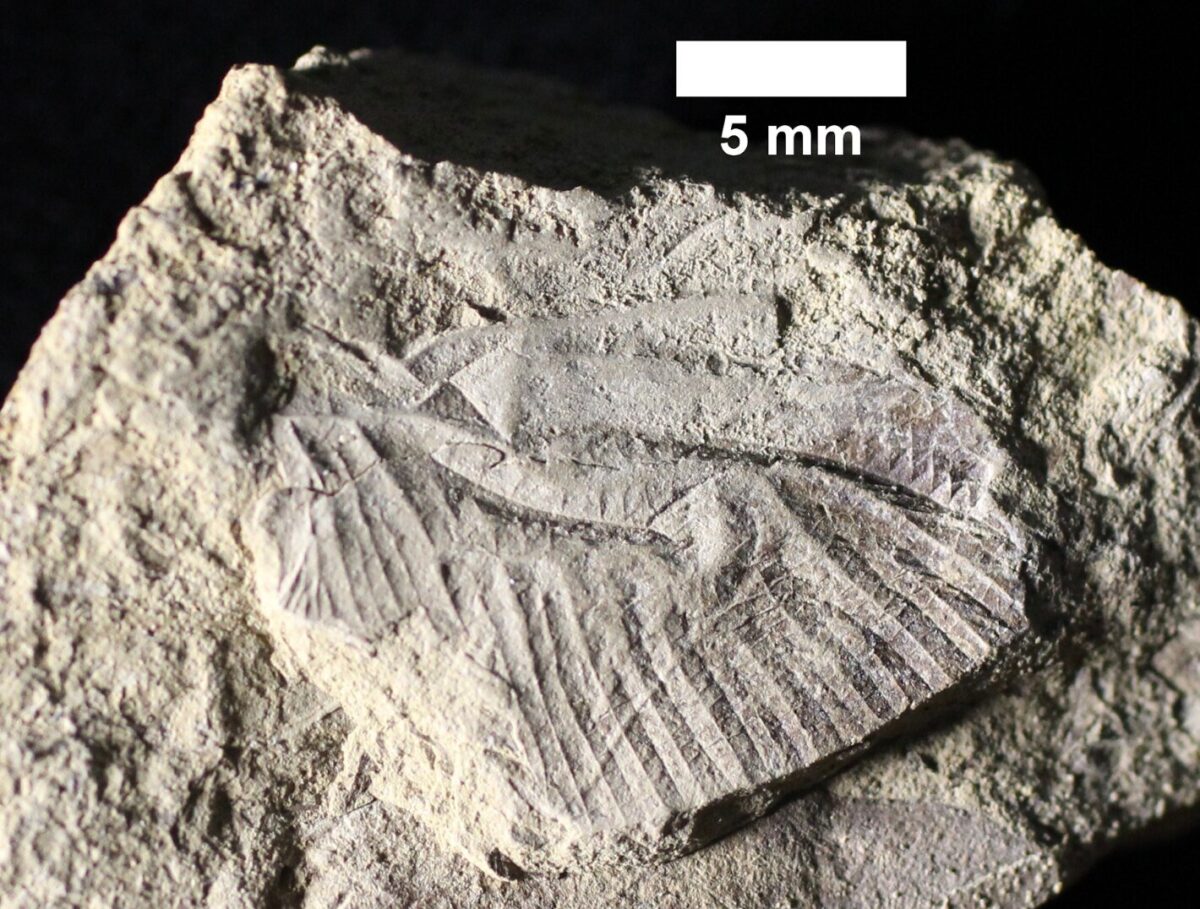 Fossil of a dragonfly preserved in rock, showing wing structures and body details that helped identify the species. Credit: McGill University
That single observation reshapes the ecological picture of one of the world’s most studied fossil sites. Dinosaur Provincial Park has produced more than 350 articulated dinosaur specimens, including over 150 complete skeletons from at least 44 species. But the insects those dinosaurs ate, the pollinators that moved between plants, the airborne prey snagged by smaller theropods, have remained almost entirely undocumented.
What the Wing Reveals About Flight
Under close examination, the wing yielded more than identity. The venation pattern, the network of veins that stiffens and shapes a dragonfly’s wing, showed adaptations for gliding flight. Gliding lets an insect cover distance with minimal energy, a trait linked to migratory dragonflies alive today.
“The wing anatomy tells us this species was adapted for gliding, a trait associated with migratory dragonflies today and possibly a key to their success,” said Larsson, who holds the Canada Research Chair in Vertebrate Paleontology at McGill’s Redpath Museum.
These structural details place the fossil within an evolutionary group called Cavilabiata. Until now, no North American member of the group had been documented from this geological period. The specimen fills a 30-million-year gap in the known fossil record of dragonflies, an insect lineage that stretches back more than 300 million years but has left a patchy trail of physical evidence.
A New Name and a Missing Piece
The species was formally named Cordualadensa acorni. The genus name captures specific traits of the wing, while the species name honors John Acorn, an entomologist and lecturer at the University of Alberta. The wing’s distinct structure required erecting an entirely new insect family, Cordualadensidae.
Mueller described the living insect plainly: its wingspan stretched roughly the width of a human palm. In the Late Cretaceous landscape of what is now Alberta, it would have skimmed across rivers and wetlands. “While small, it would have been an important part of the Cretaceous ecosystem, a tasty raptor snack, no doubt,” Mueller said.
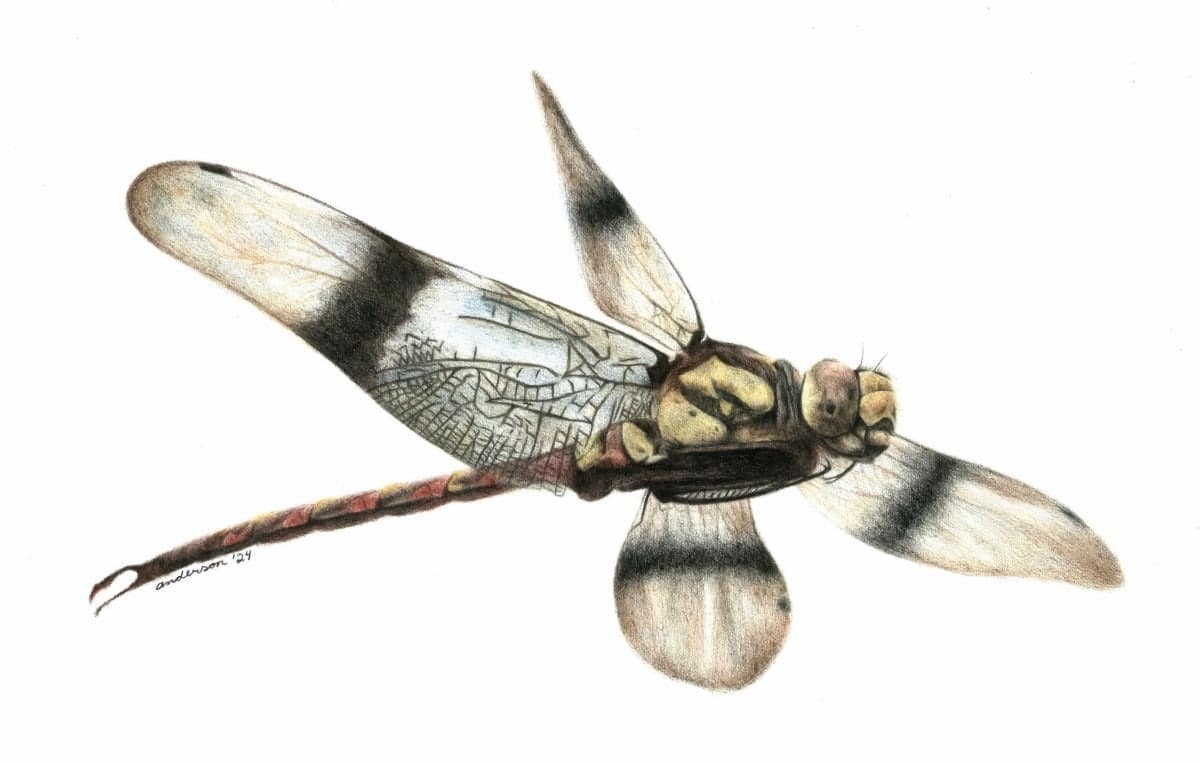 Reconstruction of an ancient dragonfly based on fossil evidence. Credit: Anderson
Larsson pointed to what the specimen contributes beyond taxonomy. “This specimen also provides insight into what life was like in Canada 75 million years ago, adding an important new missing piece of the ecological puzzle of one of the most diverse dinosaur-bearing sites in the world.”
The Dinosaur Park Formation dates to between 75 and 77 million years ago. During that window, a warm interior seaway split North America and the region’s rivers laid down the sands and muds that would become the badlands visible today.
A Signal Hidden in Plain Sight
The dragonfly discovery shifts how researchers might approach a site long defined by its large vertebrate remains. If impression fossils can preserve insect anatomy in a formation once thought nearly barren of arthropod life, similar evidence may already be sitting in museum drawers or still embedded in outcrops, unidentified because no one was looking.
Hans Larsson and his students have shown that expanding the search method, scanning fine-grained rock with attention scaled to insects, can recover fossils that conventional excavation strategies miss. The full study appears in the Canadian Journal of Earth Sciences. The approach requires patient eyes more than sophisticated equipment. It opens a path toward reconstructing the invertebrate communities that lived alongside dinosaurs.
The study’s authors expect that continued examination of the formation’s sedimentary rock will yield additional insect material. Each new find would add dimension to an ecosystem that still appears, in the scientific record, heavily skewed toward its largest inhabitants. What the dragonfly wing signals is that the small things were there all along, and the evidence may only now be surfacing.