
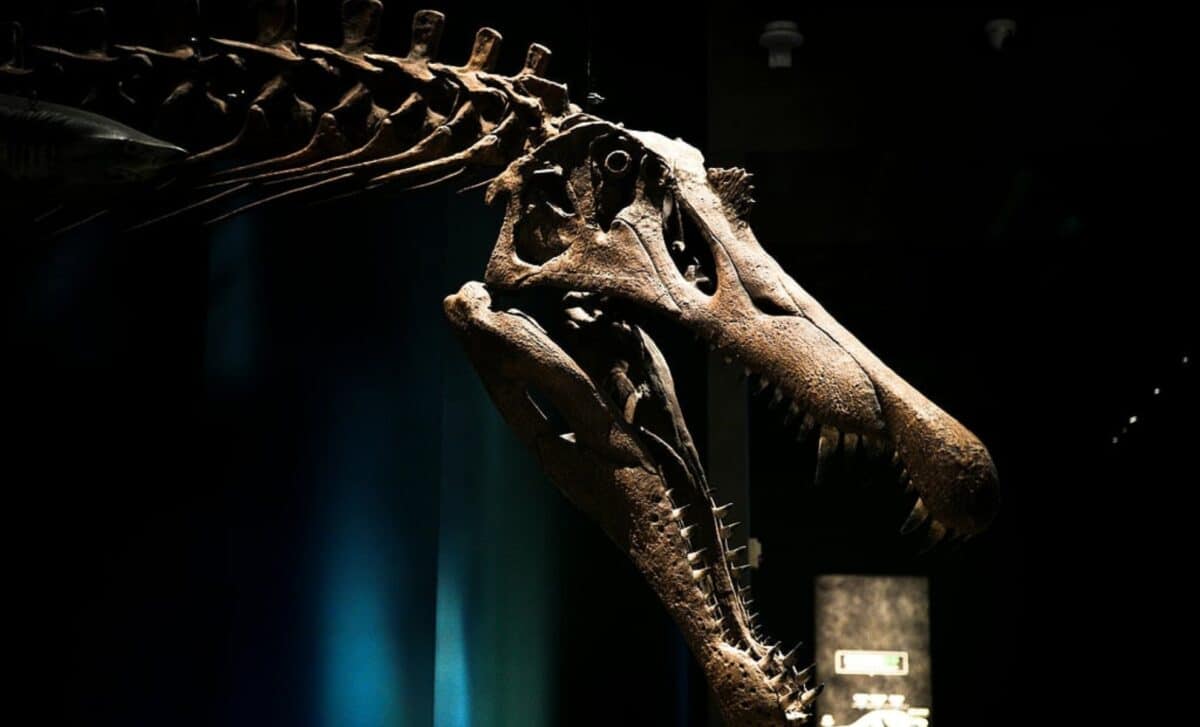
In 2019, a paleontology team from the University of Chicago pulled a massive, curved bone from the sands of a remote site in Niger and had no idea what they were looking at. It took a second expedition in 2022, two more bone fragments, and a 3D digital skull pieced together by solar power in the middle of the desert to find out. They had discovered an entirely new species of Spinosaurus, the largest fish-eating dinosaur on record, found nowhere near where decades of theory said it should exist.
The species, named Spinosaurus mirabilis, was described in a paper published in Science in February 2026. It is only the second Spinosaurus species ever identified, and the first in more than a century. The animal was roughly 40 feet long, weighed between 5 and 7 tons, and bore a bony cranial crest nearly 20 inches tall curving skyward like a blade. Researchers believe it was sheathed in keratin and likely colored in life.
The crest is striking. But where the fossils turned up is what reshapes the science.
The Aquatic Theory Runs Aground
For years, many researchers argued that Spinosaurus was fully aquatic, a deep-water swimmer that hunted in open marine environments. The case rested on where fossils of Spinosaurus aegyptiacus, the only previously known species, had been found: near the ancient Tethys Sea coastline in Egypt and Morocco. That coastal geography, combined with certain skeletal features, made an ocean-going Spinosaurus seem plausible.
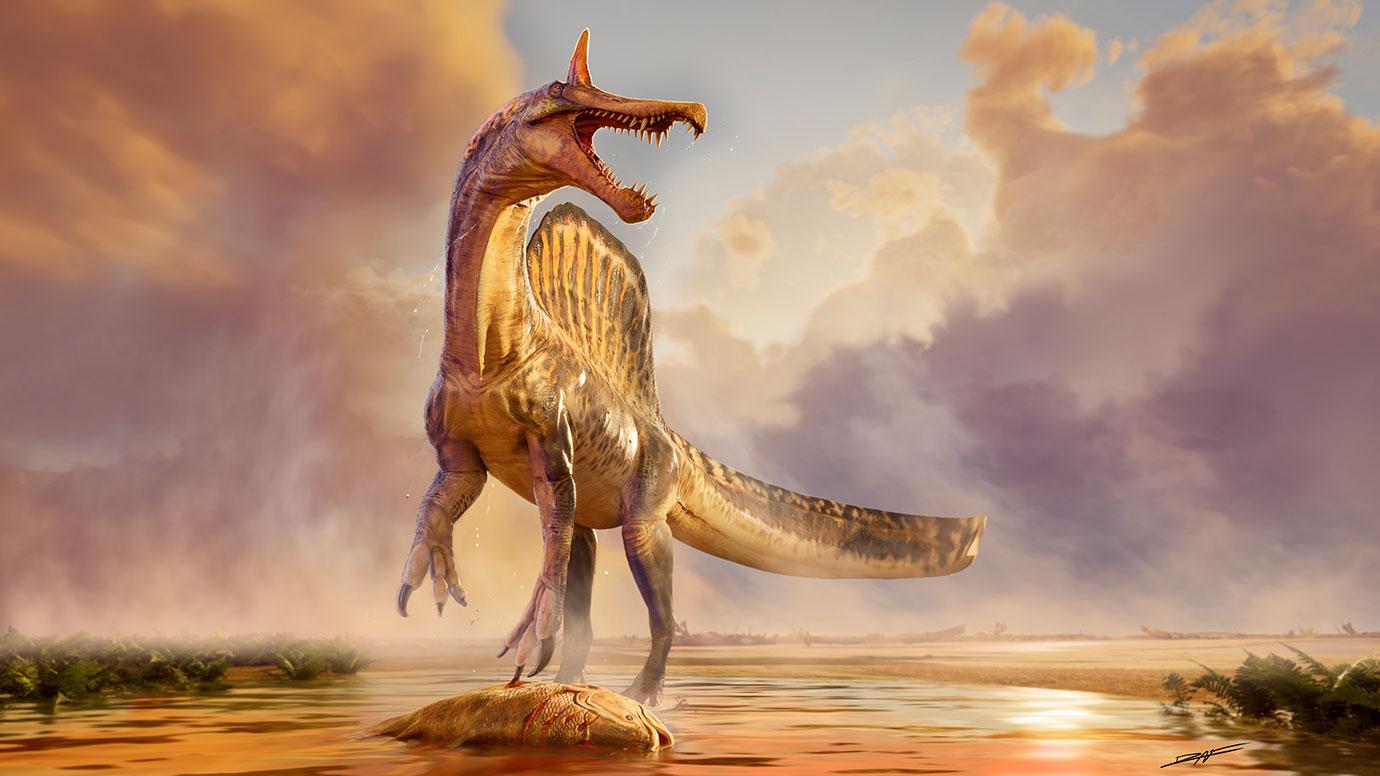 In an artist’s recreation, ‘Spinosaurus mirabilis’ stands along the river’s edge over its prey some 95 million years ago. A scimitar-shaped head crest and interlocking teeth characterize this wading giant, one of the last-surviving spinosaurid species. Illustration by Dani Navarro
The S. mirabilis fossils were recovered 300 to 600 miles from the nearest Cretaceous ocean shoreline. As the University of Chicago reports, the site called Jenguebi is a stretch of fossil-rich sandstone outcrops surrounded by sand dunes in the central Sahara. Buried in the same river sediments alongside the Spinosaurus bones were partial skeletons of long-necked dinosaurs, consistent with a forested inland habitat crossed by rivers. Paul Sereno, professor of organismal biology and anatomy at the University of Chicago and lead author of the study, called the find “the coup de grâce for the aquatic hypothesis.”
What replaces that image is something stranger and more specific. “I envision this dinosaur as a kind of ‘hell heron’ that had no problem wading on its sturdy legs into two meters of water,” Sereno said, “but probably spent most of its time stalking shallower traps for the many large fish of the day.”
A Skull Designed to Catch Fish
The anatomy of S. mirabilis points to a hunter refined around a single prey type. Its nostrils sat farther back on the skull than is typical for large predators, letting it push most of its snout underwater while still breathing. That positioning allowed it to hold position below the surface without constantly resurfacing. Its teeth interlocked upper-to-lower in a pattern called interdigitation, which researchers describe as a fish trap built from bone.
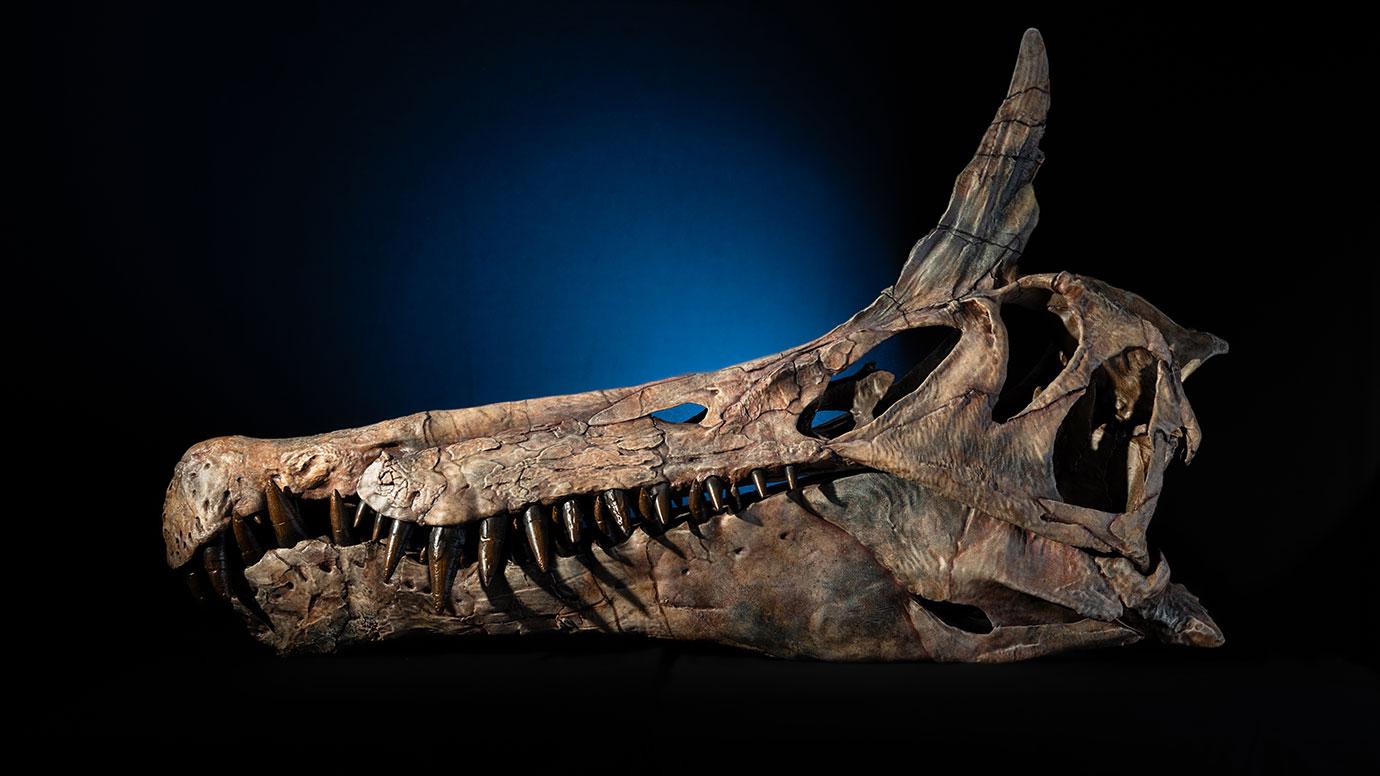 Skull cast of the new scimitar-crested spinosaurid “Spinosaurus mirabilis.” Photo by Keith Ladzinski
“Their large conical teeth without serrations that interdigitate form a ‘fish trap’ that is very good at piercing and trapping slippery fish in the jaws, preventing them from sliding,” said co-author Daniel Vidal of the University of Chicago and the Universidad Nacional de Educación a Distancia in Spain. Vidal noted that among known dinosaurs, Spinosaurus mirabilis had some of the most extreme fish-hunting adaptations on record, making it better suited, anatomically, to catching fish than to killing other dinosaurs.
The tall crest was almost certainly not a weapon. Researchers say it appears too fragile for combat and more consistent with display, a signal used in attracting mates or competing for access to feeding territory. “It’s about love and life,” Sereno said. “Attracting a mate, defending your hot feeding shallows.”
Found by Following a 70-Year-Old Footnote
The expedition began with a single sentence in a French geologist’s monograph from the 1950s, a passing mention of a saber-shaped fossilized tooth recovered somewhere in the central Sahara. Nobody had gone back to look in over 70 years. The 2022 team drove off-road from the city of Agadez for nearly three days, regularly stuck in the sand, before reaching the site.
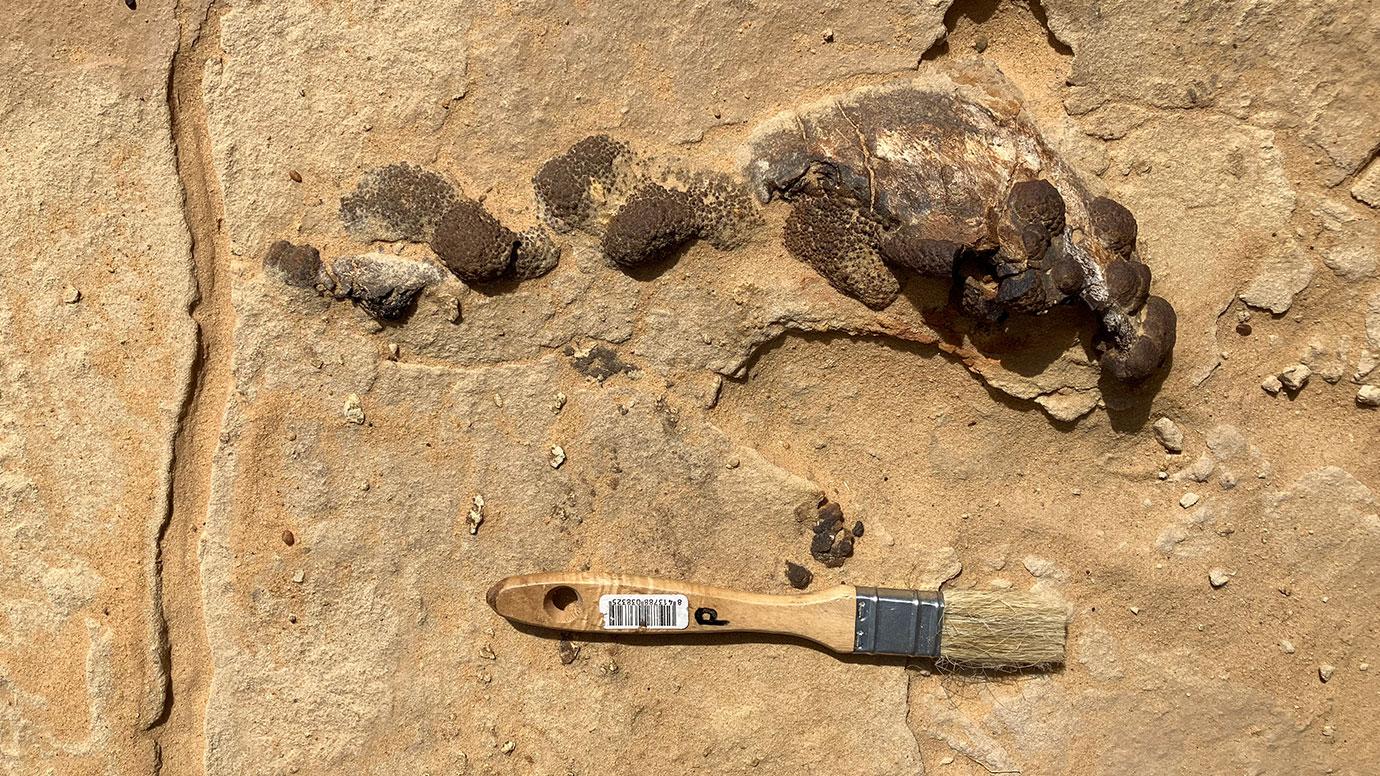 This upwardly sweeping crest of the new spinosaurid “Spinosaurus mirabilis” was discovered by Spanish paleontologist Dan Vidal, instantly revealing that it pertained to a never-before-seen species. Photo by Daniel Vidal
A local Tuareg man guided the team the final stretch on his motorbike, leading them to where he had seen large fossil bones protruding from the ground. Working quickly before losing daylight, the researchers recovered teeth and jaw fragments from the new species. Later analysis produced parts of three S. mirabilis skulls along with remains of other animals from the same site. Back in Chicago, Sereno’s team at his South Side Fossil Lab cleaned and CT-scanned the material, producing the digital skull reconstruction.
Measured against S. aegyptiacus, the new species had a noticeably larger crest, a longer snout, more widely spaced teeth, and longer hind limbs. The two species lived at the same time, roughly 95 million years ago during the Cretaceous Period, but the fossil evidence now places them in separate environments with likely different ways of hunting.