
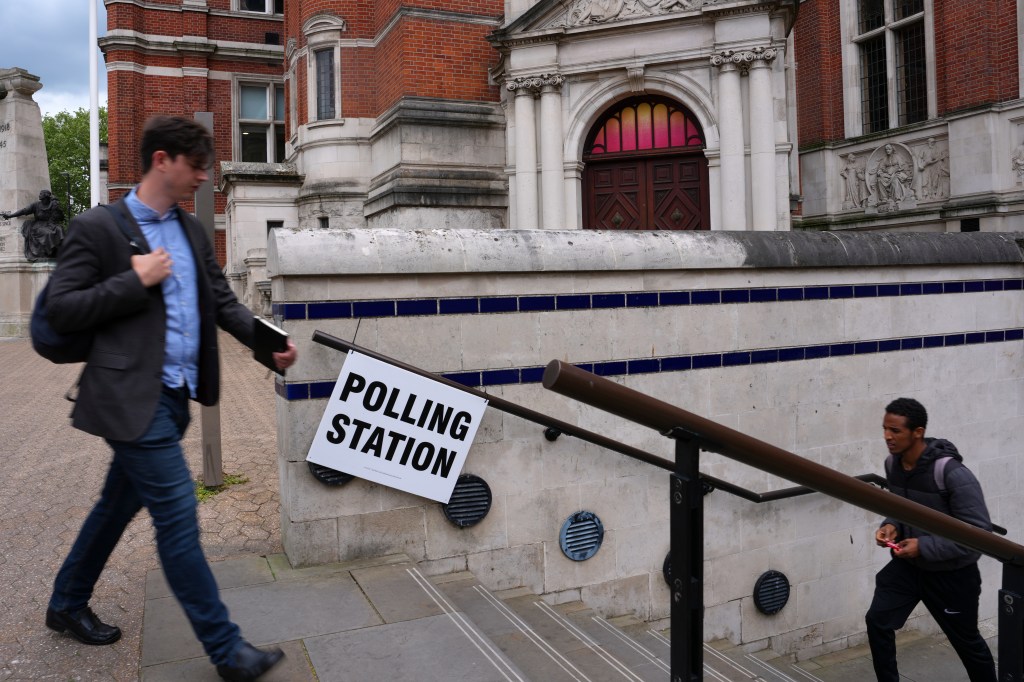
Britain held its local elections Thursday, and one headline was the ascendency of Nigel Farage’s right-wing Reform party over the traditional Conservatives. But the day hardly brought succor for the Labour Party; the traditional party of the left lost ground in key constituencies to the Green Party, historically a marginal entity in the United Kingdom but now the party of choice among 18-to-24-year-old voters.
Even Labour’s first minister of Wales, Baroness Morgan of Ely, lost her seat.
Beleaguered British Prime Minister Keir Starmer, meanwhile, was just about hanging on. To many minds, he is a dead man walking, soon to be abandoned by his Labour Party.
What is the takeaway? The results certainly look dismal for moderates of any persuasion; the Reform and Green supporters hate each other with a passion. They’re also a vote of no confidence in the legacy parties.
And they’re further evidence of how Britain, not unlike the U.S., is now deeply divided between the affluent, educated urbanites who embrace progressive ideals and government spending — in Chicago we’d call them lakefront liberals — and the population living in rural areas and hollowed-out factory towns who feel abandoned by the elite establishment, many of whom abhor Britain’s porous borders and lament what they see as an immigration-driven collapse of both social services and a traditional British life.
Age came into play, too. Despite a popular leader in Kemi Badenoch, the traditional Conservative Party increasingly is seen as a gerontocracy appealing only to the aged. Labour has some of the same problems, having lost a hefty chunk of its traditional working-class supporters. All of the energy is at their flanks.
Analysts have been split between the belief that this is a new era of multiparty politics with its own dynamics and the conviction that it is the same old two-party system re-forming itself, with two different parties. If you buy the latter theory, which is persuasive, you have to arrive at the conclusion that more and more voters are moving to the extremes.
It’s also striking how much Middle East policy has seeped into domestic elections: The Greens are unabashedly pro-Palestinian, while the anti-Islamist Reform crowd offers firm support for Israel. Most British voters wanted to choose one loyalty or another, not a nuanced view.
For the legacy parties, the warnings are clear. Perceptions of power matter. Voters who fear the imminent destruction of their country if the opposition gains power will vote tactically. If the Conservatives are seen as unable to stop Labour or the Greens, voters will chose Reform. The same applies the other way around: If the Greens are in ascendency, the tactical anti-Reform voter will choose them.
Any bowler-hatted man in the middle had better open the umbrella and brace for the storm to come.
Submit a letter, of no more than 400 words, to the editor here or email letters@chicagotribune.com.