
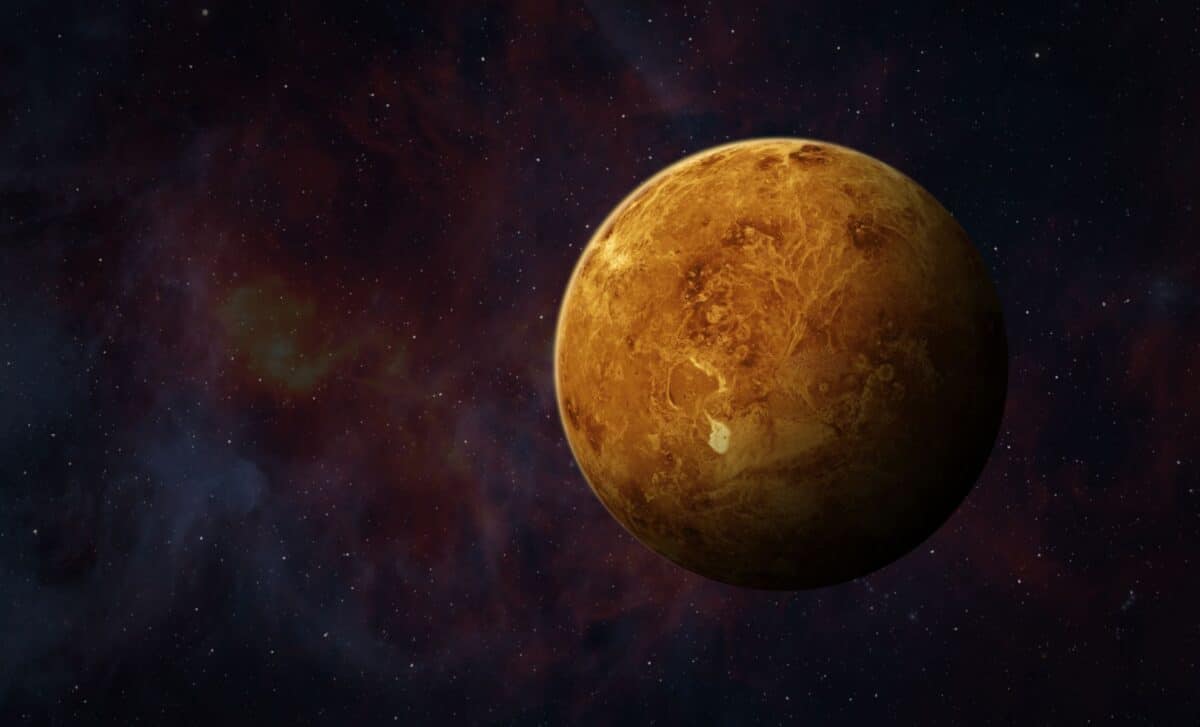
Venus is often described as Earth’s twin, yet its atmosphere represents one of the most hostile environments in the solar system. What makes the planet’s weather particularly unusual is not merely the composition of its clouds, but the fate of the precipitation they produce, and what that reveals about the relationship between atmospheric chemistry and extreme planetary conditions.
The planet’s surface, photographed by Soviet Venera probes in the 1970s and 1980s, tells the story of a world reshaped by its own atmosphere. Understanding how Venus’s acid rain behaves requires examining both the chemistry responsible for it and the physical dynamics that prevent it from causing surface damage.
Sulfuric Acid Clouds and the Chemistry Behind Them
Venus’s global cloud cover is composed not of water vapor, but of sulfuric acid. According to NASA, the planet’s atmosphere is predominantly carbon dioxide, with clouds made up of sulfuric acid that drive a runaway greenhouse effect far more extreme than anything seen on Earth. Surface temperatures average around 467 degrees Celsius (872 degrees Fahrenheit), hot enough to melt lead, while atmospheric pressure at ground level reaches approximately 93 times that of Earth’s sea-level pressure.
These conditions place Venus in a category of its own. “The atmosphere is mostly carbon dioxide — the same gas driving the greenhouse effect on Venus and Earth — with clouds composed of sulfuric acid.” NASA notes. “And at the surface, the hot, high-pressure carbon dioxide behaves in a corrosive fashion. But higher up in the atmosphere, temperatures and pressure begin to ease.”
It is within those upper atmospheric layers, where conditions are somewhat less severe, that sulfuric acid droplets form and begin their descent. The precipitation is real and measurable, but its journey toward the surface is cut short long before it arrives.
Why the Surface Remains Untouched
The mechanism responsible for keeping Venus’s surface dry is a phenomenon called virga, precipitation that evaporates before reaching the ground. According to the UK Met Office, virga appears “as light wisps which are attached to the base of a cloud” and forms when “falling rain or ice passes through an area of dry or warm air.” On Earth, the effect is relatively common in arid environments and at high altitudes, producing what are sometimes described as curtains or streamers hanging beneath cloud formations that never quite close the distance to the surface.
On Venus, the same physics applies, but at a far greater scale of intensity. The planet’s extreme surface temperatures ensure that any sulfuric acid droplets descending from the cloud layers encounter atmospheric conditions so hot that they vaporize completely during the fall. The result is a planet where acid rain forms, falls, and disappears, cycling continuously without ever contacting the terrain below.
The practical implication is that the surface of Venus, despite sitting beneath a corrosive and chemically active sky, is shielded from direct precipitation by its own heat. Soviet probes sent into the Venusian atmosphere in the 1970s survived for only a matter of minutes before being destroyed by the temperature and pressure, conditions that also render the acid rain cycle self-defeating at lower altitudes.
Virga on Earth, as EarthSky reports, is frequently spotted in deserts and at high elevation, in regions stretching from the American West to the Middle East and North Africa. It occurs when a dry air mass sits in the lower levels of the atmosphere, preventing precipitation from penetrating through to the surface. On Venus, the equivalent barrier is thermal rather than dry, but the outcome is structurally similar.
The phenomenon has a secondary consequence on Earth that does not appear to apply on Venus: under certain conditions, virga can trigger microbursts, according to the Met Office, as rainfall reverting to vapor removes heat from the air and drives a rapid descent of cold air. On Venus, where the atmospheric dynamics operate under entirely different parameters, no such effect has been documented. What remains consistent across both planets is the basic atmospheric logic, precipitation is not guaranteed to complete its journey simply because it has begun.