

A ban on unsafe cutting of kitchen worktop stone has today been introduced for the first time by UK regulators after The i Paper’s reporting on rising silicosis cases in young tradesmen.
The Health and Safety Executive (HSE) has unveiled new rules to stop “dry cutting” of engineered stone – also known as quartz – and confirm water suppression tools to dampen lung-shredding dust are a legal requirement to protect workers.
As part of an enforcement crackdown to ensure the guidance is being followed, 1,000 nationwide inspections of workplaces are being carried out by HSE over the next 12 months.
Shorts – Quick stories
Scroll to previous short
Scroll to next short

 The World Health Organisation has warned of the risks associated with the us of sweeteners (Photo: Getty)
Environment
How climate change could put tea drinkers in hot water
The familiar taste of tea may turn bitter as climate change disrupts harvests and makes it harder to achieve consistent flavours, campaigners have warned. A Christian Aid report also warns that a warming world could cause the price of a cuppa to spike.
“As climate variability increases, achieving that consistency becomes more challenging, Dr Neha Mittal from the Met Office said.
What does the report say?
Rising temperatures and worsening weather extremes in countries such as Kenya, India and Sri Lanka could make tea more bitter and harsher, researchers say.
The issue is also hitting close to home, with tea growers in the UK warning that it is making it much harder to achieve consistent flavours .
Climate-induced disruptions to harvests could cause price spikes and unreliable supplies .
The rising price of fertiliser and fuel as a result of the US-Iran war is also expected to hit tea producers.

ENVIRONMENT
3 min read
Supporting farmers
Tea production relies on stable temperature and rainfall conditions, which are shifting in producer nations. Optimal growth conditions sit within a narrow range of between 13°C and 30°C and with adequate but not excessive rainfall.
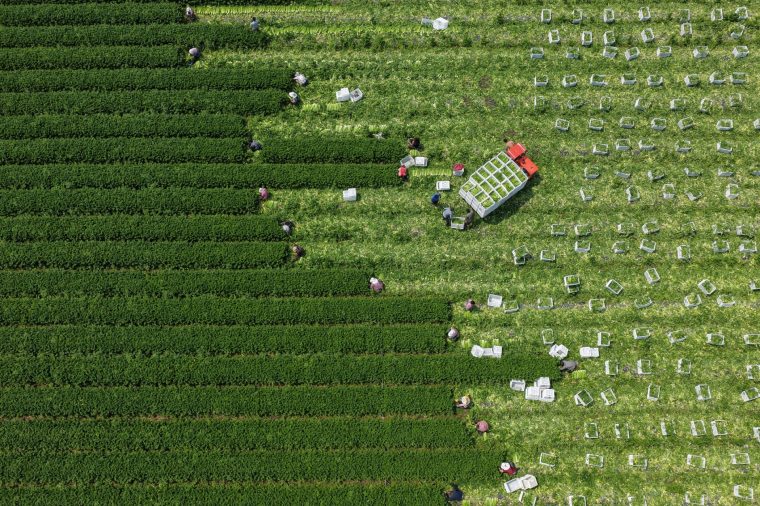 Caption: FUZHOU, CHINA – MARCH 29: Farmers harvest celery in the fields as the area enters the harvest season on March 29, 2026 in Fuqing, Fujian Province of China. (Photo by Xie Guiming/VCG via Getty Images)
Photographer: VCG
Provider: VCG via Getty Images
Source: Visual China Group
 It’s raining heavily, wearing an umbrella during the rainy season – stock photo. (Photo: Getty)
The flavour and quality of tea depends on a balance of compounds such as catechins, amino acids and polyphenols, the report said. However, higher temperatures increase the production of more astringent compounds while reducing sweetness – leading to a more bitter taste.
The expert view
For generations, consumers have taken for granted that a cup of tea will taste the same, day in, day out. But that consistency depends on a stable climate, and that stability is now breaking down. What we are seeing is the beginning of a shift towards a harsher brew
Claire Nasike Akello, climate adaptation and resilience lead at Christian Aid
 (Photo: Matthew Vincent/PA Wire)
NEWS
Who won big at the Bafta TV Awards 2026
 Caption: LONDON, UNITED KINGDOM – MAY 10, 2026: Owen Cooper attends the BAFTA Television Awards with P&O Cruises at the Royal Festival Hall in London, United Kingdom on May 10, 2026. (Photo credit should read Wiktor Szymanowicz/Future Publishing via Getty Images)
Photographer: Wiktor Szymanowicz
Provider: Wiktor Szymanowicz/Future Publis
Source: Future Publishing
Copyright: ? 2026 Wiktor Szymanowicz
The winners of this year’s Bafta Television Awards have been announced in London, with Netflix drama Adolescence emerging as the big winner.
The hard-hitting four-part series was named best limited series. Owen Cooper, who played central character Jamie in his acting debut, became the youngest ever winner of the award for best supporting actor aged 16.
A look at key winners
 Caption: LONDON, ENGLAND – MAY 10: Stephen Graham, Christine Tremarco, Hannah Walters, Owen Cooper, Ashley Walters and Erin Doherty with the Limited Drama Award for Adolescence during the BAFTA Television Awards with P&O Cruises 2026 at The Royal Festival Hall on May 10, 2026 in London, England. (Photo by Karwai Tang/WireImage)
Photographer: Karwai Tang
Provider: WireImage
Source: WireImage
Copyright: 2026 Karwai Tang
Leading actor: Stephen Graham – Adolescence (Netflix)
Leading actress: Narges Rashidi – Prisoner 951 (BBC One)
Supporting actor: Owen Cooper – Adolescence (Netflix)
Supporting actress: Christine Tremarco – Adolescence (Netflix)

Interview
6 min read
More small screen winners
Drama series: Code of Silence (ITV1)
Limited drama: Adolescence (Netflix)
Scripted comedy: Amandaland (BBC One)
Best comedy actor: Steve Coogan – How Are You? It’s Alan (Partridge) (BBC One)
Best comedy actress: Katherine Parkinson – Here We Go (BBC One)

FILM
4 min read
New Bafta record
Among the other winners were The Celebrity Traitors, EastEnders and comedy series Last One Laughing. The Celebrity Traitors and Last One Laughing each picked up two awards, while Adolescence set a record for the most Bafta victories in a single night.
In the International category, Apple TV+’s The Studio featuring Seth Rogan triumphed over fellow nominees Severance, Sky’s The White Lotus and Disney+’s The Bear.
 Caption: LONDON, ENGLAND – MAY 10: Alan Carr with the P&O Cruises Memorable Moment Award for The Celebrity Traitors during the 2026 BAFTA Television Awards with P&O Cruises at The Royal Festival Hall on May 10, 2026 in London, England. (Photo by Stuart Wilson/BAFTA/Getty Images for BAFTA)
Photographer: Stuart Wilson/BAFTA
Provider: Getty Images for BAFTA
Source: BAFTA
Copyright: 2026 Getty Images
 Caption: Ike Barinholtz, Seth Rogen and Chase Sui Wonders at the 2026 BAFTA Television Awards with P&O Cruises held at Royal Festival Hall on May 10, 2026 in London, England. (Photo by Zak Hussein/Variety via Getty Images)
Photographer: Variety
Provider: Variety via Getty Images
Source: Variety
Inside the race to replace Keir Starmer
When Angela Rayner finally commented in the wake of Labour’s election humiliation, it was a brutal takedown of Sir Keir Starmer’s record.
“What we are doing isn’t working, and it needs to change. This may be our last chance,” she declared.

OPINION
6 min read

Analysis
4 min read
Rayner sets out demands
The former deputy prime minister called on Starmer to end a “toxic culture of cronyism” and to allow the Mayor of Greater Manchester, Andy Burnham, to return to Westminster. Then she set out a left-wing shopping list of demands.
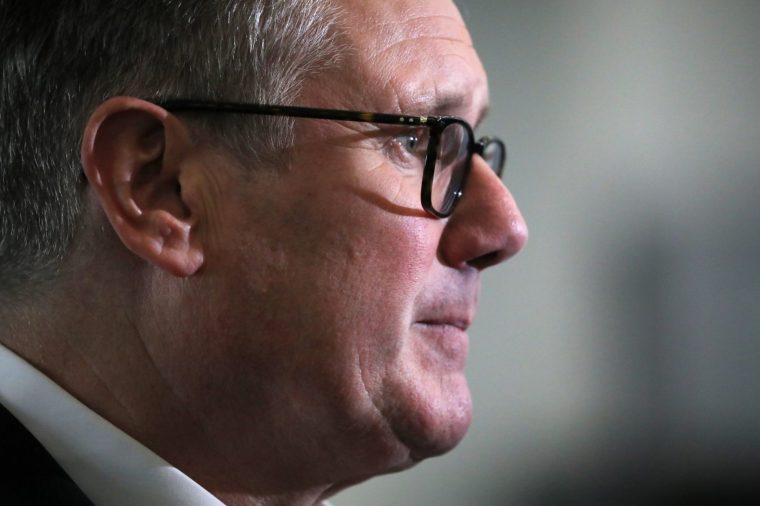 Caption: LONDON, ENGLAND – MAY 9: Prime Minister Keir Starmer speaks to media as he reacts to the local Council Election results at AFC Wimbledon on May 9, 2026 in London, England. In response to what is being seen as a disastrous set of results for Labour in the 2026 Local Elections Starmer says “the local election results do not mean tacking left or right; but mean we must bring together a broad political movement, one that is assertive in its values and bold in its vision. (Photo by Alishia Abodunde/Getty Images)
Photographer: Alishia Abodunde
Provider: Getty Images
Source: Getty Images Europe
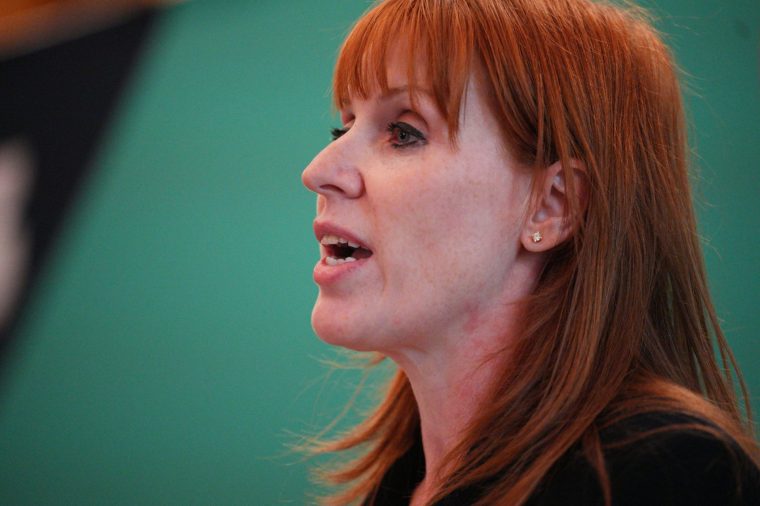 Labour MP Angela Rayner (Photo by Carl Court/Getty Images)
Her demands include taxing the wealthy, cutting household costs, ending the freehold system, raising the minimum wage, giving regional mayors more powers over planning and licensing and boosting community ownership.
Damp local elections for Labour
Rayner’s comments follow a damp set of local election results for Labour, as MPs openly debated whether there should be an immediate leadership contest.
MPs who had been previously loyal, in public and in private, were beginning to say on Sunday that they would lend Rayner support for a challenge.
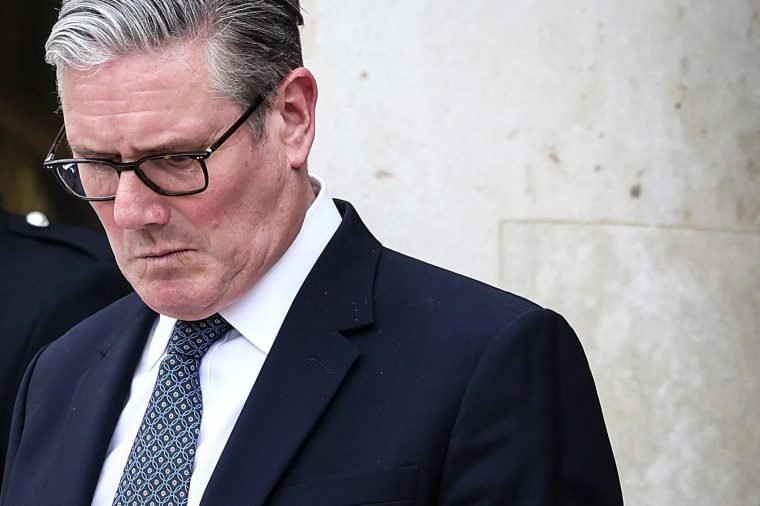 Sir Keir Starmer will deliver a key speech this morning after devastating local election results last week (Photo: AFP)

POLITICS
4 min read
Dozens of MPs call for Starmer to step down
Josh Simons, previously a Starmer loyalist, said the Prime Minister had “lost the country”.
Labour’s leader in Scotland, Anas Sarwar, blamed a “national wave” against Labour for his party’s defeat in the Holyrood election.
Labour left-wingers fear that a stalking horse candidate would boost Health Secretary Wes Streeting’s chances of becoming PM, with Burnham barred from standing until he becomes an MP.

Exclusive
7 min read
The first inspections have taken place, with enforcement action to be launched against firms and individuals breaching the guidance.
Offenders breaching health and safety law risk possible criminal prosecution, up to two years in prison and an unlimited fine.
It marks a victory for The i Paper’s Killer Kitchens campaign, which has pushed for a ban on dry cutting to protect stonemasons from deadly dust and for an HSE crackdown on rogue employers who put their workers’ lives at risk by failing to provide adequate protection.
The All-Party Parliamentary Group (APPG) on Respiratory Health praised The i Paper‘s “hard work and diligence on this issue”, saying it has “made an enormous difference”.
23-year-old referred for lung transplant
More than 50 UK quartz stonemasons, many migrants and in their 20s and 30s, have been diagnosed with silicosis since mid-2023, with the first UK cases revealed by The i Paper in February 2024.
Their average age is 43, four have died and the youngest, aged 23, is among those referred for a lung transplant. The i Paper has spoken to sick and dying men who have described how their lungs were ravaged by toxic silica dust caused by exploitative employers.
While silica-related disease in industries like mining typically takes decades to develop, cases of quartz-induced silicosis show engineered stone dust can cause the crippling lung disease to develop in a much shorter timeframe, with UK cases developing after as little as a year’s exposure.
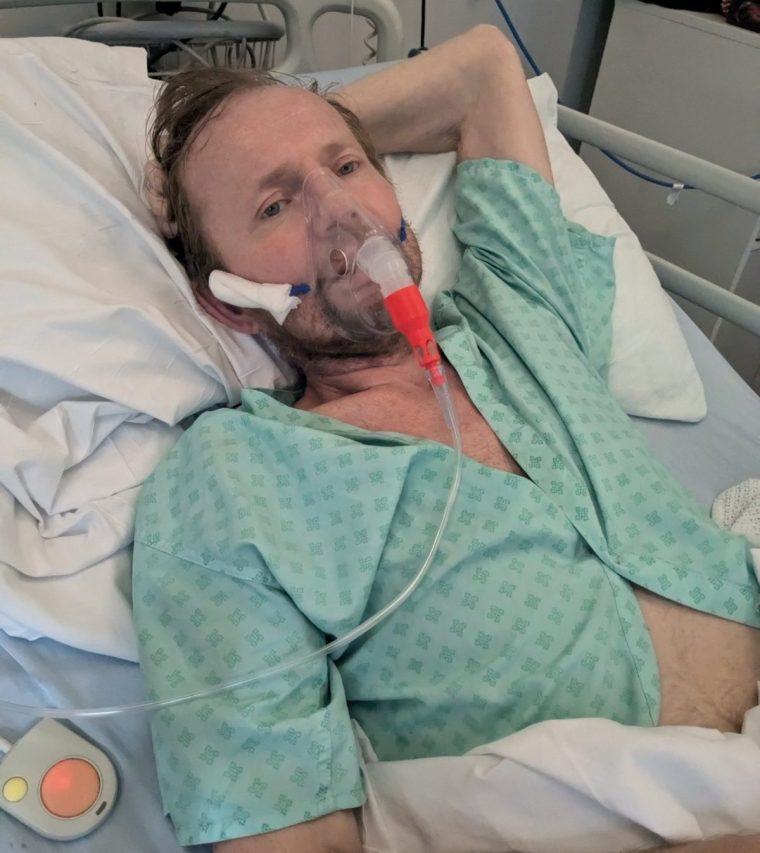 Marek Marzec died in November 2024, just seven months after he was diagnosed with silicosis
Mike Calcutt, deputy director in HSE’s Engagement and Policy Division, said: “Today’s guidance marks our most significant intervention in the engineered stone sector to date, and not without good reason.
“Silicosis is incurable, but it is entirely preventable. No worker should lose their life to a lung disease caused by their job, and that is why we have taken this action.”
It comes after HSE carried out a two-year research and industry engagement to examine the scale of the risk from engineered stone.
The regulator found dry cutting produces exposure to lethal silica dust – known as respirable crystalline silica (RCS) – five to 10 times higher than ‘wet cutting’ with water to suppress RCS.
“What we found was stark. Many businesses are not putting the right controls in place; they are still using engineered stone with high silica content and dry cutting, which must stop,” said Calcutt.
“To every employer in this sector: the guidance is now published, the expectations are clear, and our inspectors are coming. Those who are cutting corners are not just putting their workers at risk — they are undercutting the businesses that do things properly. We will create a level playing field.
“To workers handling engineered stone: know your rights and know the controls that should be keeping you safe. If you have concerns, contact HSE.”
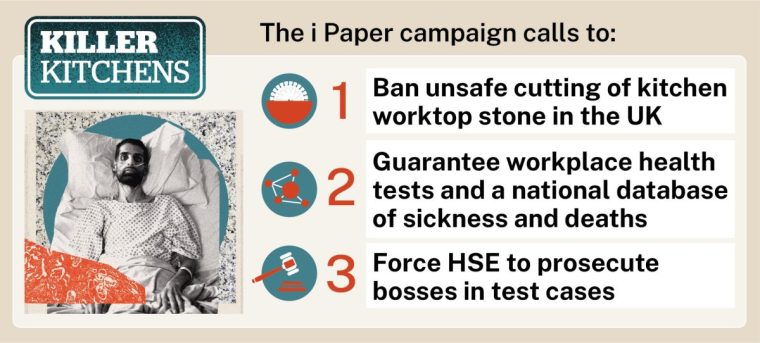
What the new guidance means
Regulations are already in place governing workplace exposure to harmful substances such as RCS dust under the Control of Substances Hazardous to Health (COSHH).
But HSE’s new guidance is the first under COSHH specifically for engineered stone and states employers have a legal requirement to use water suppression tools to control dust.
The guidance says employers must also provide workers with appropriate respiratory protective equipment (RPE) and carry out regular health surveillance of employees.
HSE is also working with manufacturers, suppliers and importers to encourage the supply of lower-silica engineered stone products.
Kevin Bampton, chief executive officer of the British Occupational Hygiene Society (BOHS), which is the chartered society for worker health protection, said the new guidance would provide “much-needed clarity” for the industry on what is needed to protect stonemasons.
“Keeping people safe at work requires more than relying on HSE to do a good job,” he said.
“We need the press to highlight when people are at risk at work; otherwise, there isn’t any motivation to do the right thing. Without The i Paper’s reporting on engineered stone, this would be an issue that lies unresolved.”
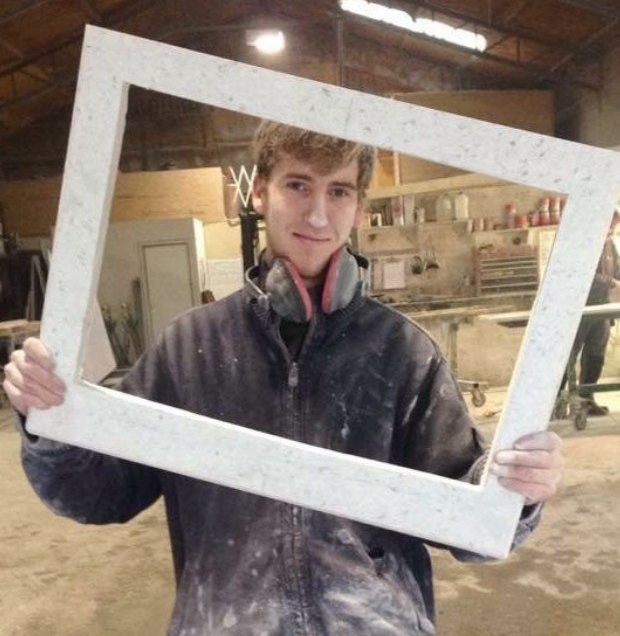 Luke Bunker, 29, a stonemason from Cambridgeshire, was diagnosed with silicosis and emphysema after working for 10 years at a firm cutting quartz worktops (Photos: Irwin Mitchell)
Jim Shannon, the DUP MP who chairs the respiratory health cross-party group of MPs, welcomed the revised guidance, calling it a “timely move forward” that could have a “significant impact on the health of workers”.
“While the guidance should have an impact with legitimate industry, we still need a national screening programme to capture those workers which the new surveillance will miss,” he said.
“We also need further action on the other causes of silica dust in the workplace and the APPG would like to see the introduction of real-time detection, when it is ready, to further reduce the risk to workers.”
‘Britain should follow Australia’s lead’
Man-made engineered stone can contain up to 95 per cent crystalline silica, much higher than natural stones like granite (typically 30 per cent) or marble (5 per cent), which are also used for kitchen revamps.
Epidemics of silicosis in workers cutting engineered stone have broken out in countries including Spain and Australia, which have both seen over 1,000 cases.
In 2024, Australia became the first country in the world to bring in a ban on engineered stone, while in California, more than 550 tradesmen have been diagnosed, 30 of whom have died, since 2018.
Trade unions here have called for tougher measures to protect workers, including an outright Australia-style ban on quartz, with doctors warning urgent action is needed to avoid the huge numbers of cases seen in other countries.
Sian Elliot, director of organising at the Trade Unions Congress (TUC), said: “Steps to strengthen protections and reduce exposure are welcome, but the most effective way to prevent deaths and diseases is to remove the hazard altogether.
“Britain should follow Australia’s lead, where the supply and cutting of engineered stone has been banned.”
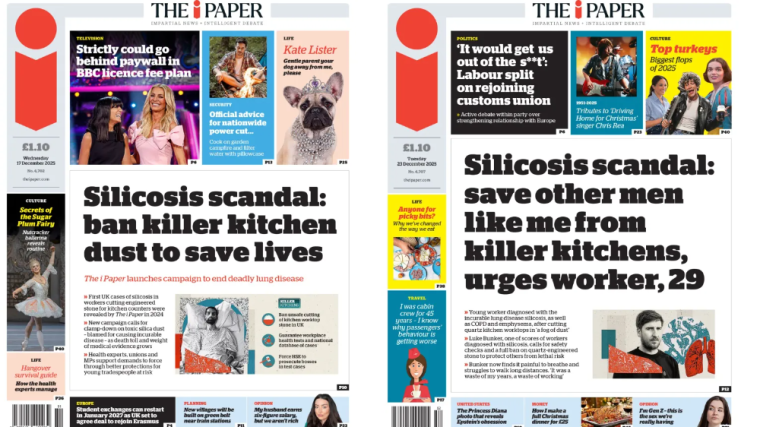 The i Paper’s Killer Kitchens campaign has pushed for a ban on dry cutting to protect stonemasons from deadly dust
Sir Stephen Timms, minister for Social Security and Disability, said: “Every worker deserves to come home safe, without fear of losing their life to a preventable, deadly lung disease caused by their job.
“This new guidance gives businesses clear, unambiguous instructions on what the law requires, and this spring and summer HSE will carry out more than 1,000 inspections across the industry to make sure those standards are enforced, and the lives of workers protected.”
The i Paper has previously reported how stonemason Marek Marzec, 48, died seven months after being diagnosed with silicosis. Weeks before his death, Marzec described how he had been working on kitchen countertops in a “tornado” of dust.
Wessam al-Jundi, 28, is believed to be the first silicosis victim in the UK and died five days after he was admitted to Harefield Hospital in May 2024, where he had been awaiting a lung transplant.
Malik Al-Khalil, 31, was among the first UK-based kitchen countertop workers diagnosed with silicosis after inhaling dust from engineered stone while working in small factories in London.
He told The i Paper in 2024: “Of course [it should be banned] because the silicosis is coming from this material. This job will be for the Government.”