
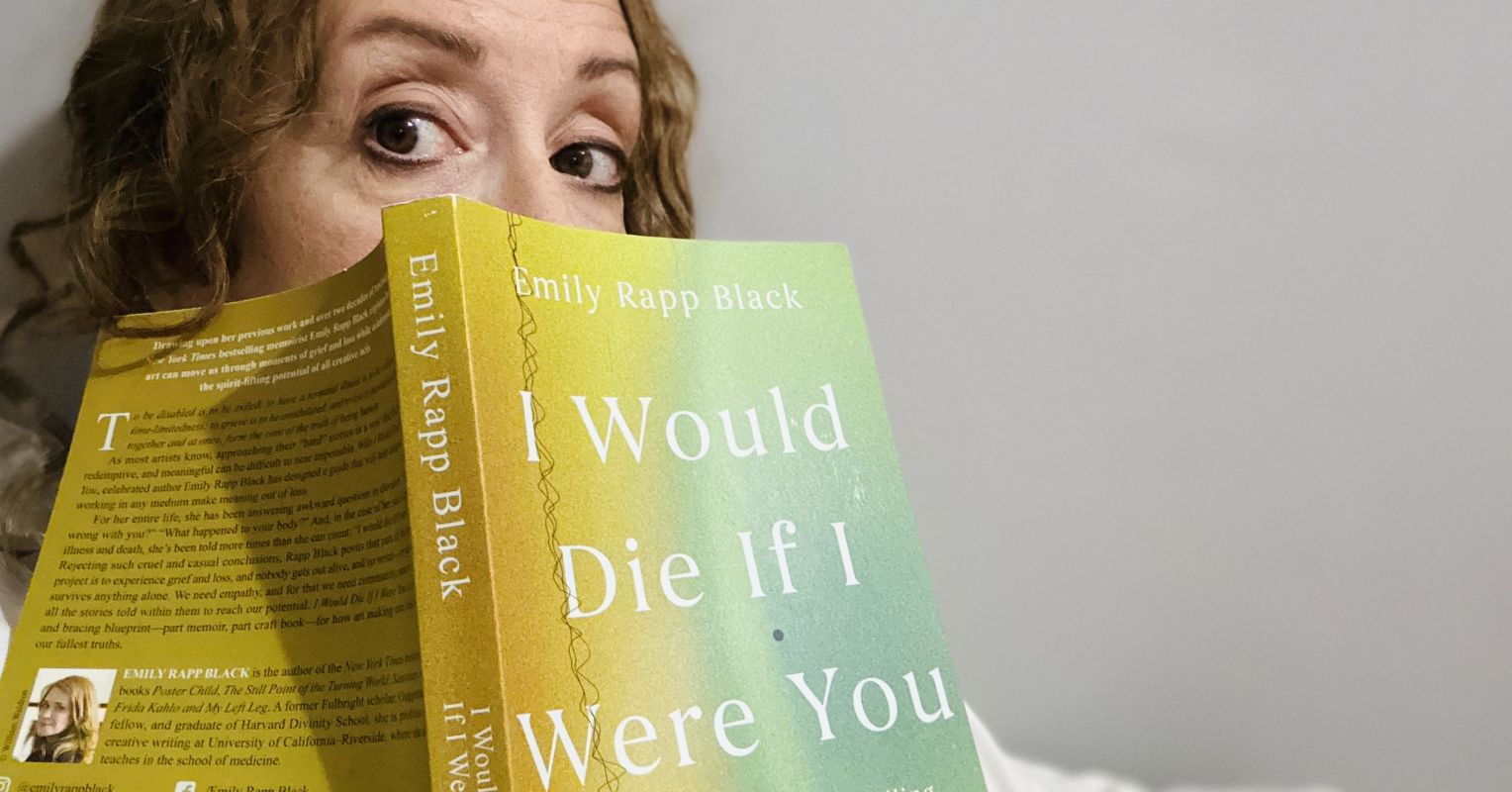
Grief is a universal human experience, yet it continues to make many people uncomfortable. We may repress its expression in ourselves for fear of being too messy; we may avoid discussing other people’s losses because we “don’t know what to say.” Writing can be a powerful tool when it comes to articulating and processing painful emotions, and reading stories that deal with taboo subjects openly can increase our empathy for and comfort with difficult topics.
New York Times bestselling author Emily Rapp Black describes her new book on grief and creativity, I Would Die If I Were You: Notes on Art and Truth Telling, as a “book for sad, funny people.” The title refers to the fact that Rapp Black, who grew up with a prosthetic leg and whose young son died from Tay-Sachs in 2014, is often faced with people who, instead of sitting with their own unease that loss, grief, and disabilities happen to most of us in time, can fall into “othering” her by casting her as a tragic figure distant from their own lives.
Rapp Black, 51, a professor, avid traveler, and mom of a 12-year-old daughter, rejects such a reductive lens, instead celebrating the power of storytelling and true empathy. Turning to everything from philosophy to the Bible to popular culture in her new book, Rapp Black explores how people through the ages have made art from suffering, and the deeply human truth that hardships do not preclude creativity, joy, nuance, and “having fun.”
I was privileged to be able to dive into some of Rapp Black’s thoughts in this interview.
Gina Frangello: You also have a master’s in divinity from Harvard and have studied theology and philosophy extensively. In your view, where are we right now as a culture in terms of how we process and perceive grief? Have we come a long way, or has it been just the opposite?
Emily Rapp Black: I think it’s much more in our faces, if you will, because we see countries being bombed, people being shot, terrorized, all of it—on the television, on the news, on whatever screen of choice. And yet all of us, perhaps because some of this comes at us in a constant yet controlled way, or in a way we think we can control (switching on the TV, turning the radio dial, etc.), and of course, we can’t. Thinking we can is what separates us from the grief even more; it’s a big step back. Maybe we’ll be deeply sad, even cry or rage, but then we move on quickly to whatever’s next—which ad, which meeting, which app.
Grief itself is a lifelong journey, one that’s the speed of a rollercoaster in one moment and then a march through a foggy bog at another, and under all kinds of emotional weather conditions. It takes a powerful witness to stay inside that process with another person, someone who can sit in the grief and weather it alongside the griever. Our closest friends and family might do this work, or want or attempt to, or books or stories that we return to, write, or discover, but the culture won’t do it for us in any significant way outside of rigid dogmatic constraints imposed by organized religion or other groups—or at least that’s been my experience. I think we’ve lost the ability to contain an experience that we can’t click away from, and you can’t click away from grief. It’s just not possible in the long term.
GF: You discuss the way writing quite literally saved your life when your son Ronan was dying. How might you recommend that someone who has not previously been a writer begin a creative practice as a means of surviving grief or other crucible junctures of life?
ERB: Since the beginning of time, recorded or otherwise, humans have been trying to make sense of the chaos of their lives. There’s a famous Sumerian saying, “Fate is like a wet bank. Sooner or later, it will make you slip.” Grief is a perfect time to begin a creative practice of any kind, because you must lead with vulnerability, not ego, or hopes that people will like you, or even that creating something will solve the situation.
Some situations cannot be solved, but creating stories or art or music in the midst of that storm, when the stakes are high, and emotions are even higher, can help you bear it. Is it a distraction? Maybe. A coping mechanism? Sure. But it is also a source of deep comfort that is almost primal, because it connects us with being human in a way that nothing else can.
Here’s a generative exercise I give often: Think of five things you must tell in order for your story to make sense or be told completely. Then take those five things—those moments or experiences—one at a time and try to remember every sensory or concrete detail about them. We don’t feel grief with our intellect; we feel it in our body. So, we have to connect with our embodied feelings, our embodied selves, to write down these memories, and that means exquisite attention to the senses.
GF: Are there narratives you have reclaimed and reframed in your writing, with time, that you initially processed quite differently?
ERB: My son died over a decade ago, and while I can still access that raw grief and sense of world-opening loss, I’m also able to see how remembering him now—writing and thinking about him—is a way of parenting beyond the grave, of continuing a relationship with him after his death.
GF: In your epilogue, you discuss writing as an act of service. Can you speak more to that, especially for those who may wonder if their writing matters or contributes anything in turbulent times—not only in the face of great personal loss but, say, amidst a pandemic or a war?
ERB: People need stories—true or fictionalized—that reflect the emotional intensity of their experience. Reading increases empathy, makes us feel less alone, and makes us understand that we are part of a large conversation across time and history, language and culture. Reading under duress is that much more powerful because it is that much more necessary to feel accompanied, to feel as if someone is bearing witness to the truth of a lived experience, and by reading that story, you become a part of it, too.
To explore these topics further with Emily Rapp Black, her other books include Poster Child, The Still Point of the Turning World, Sanctuary, and Frida Kahlo and My Left Leg.