
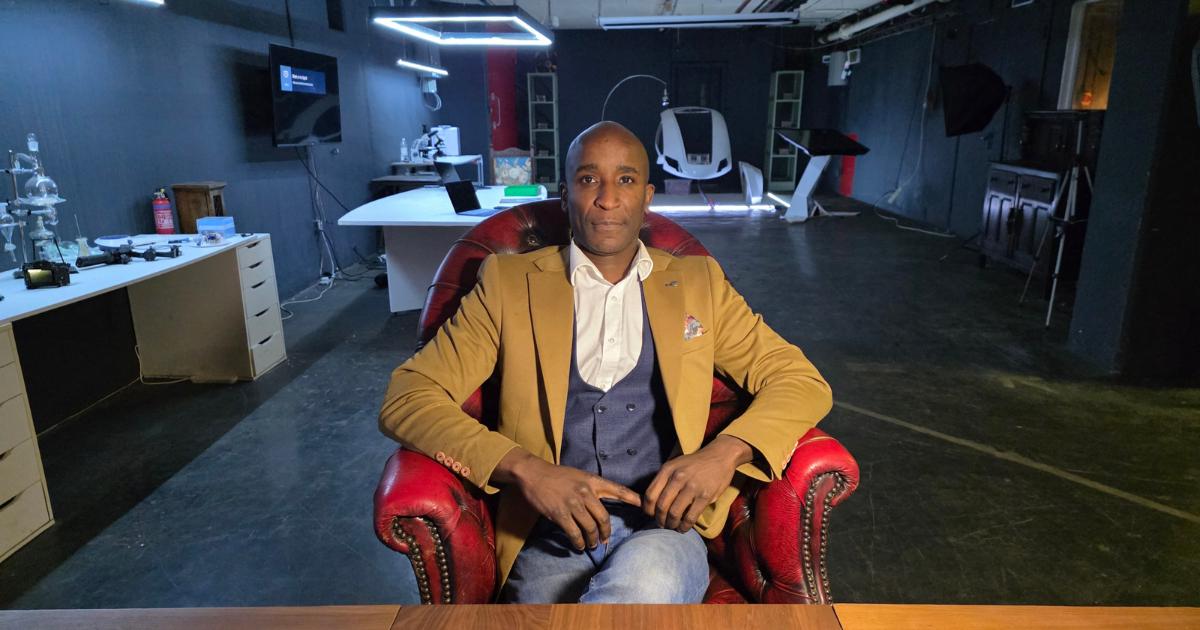
The founder and CEO of Academy of Robotics, who lives at the RAF Neatishead site after purchasing it in 2022, has launched Athena AI.
An artificial intelligence platform, it is designed to function as the “brain” behind his company’s inventions which include self-driving cars and NHS hospital robots.
William Sachiti, founder and CEO of Academy of Robotics, pictured at the former RAF Neatishead radar station, which he purchased in 2022 (Image: Sonya Duncan)
Athena has also been created for businesses, capable of carrying out day-to-day tasks such as replying to emails, answering phone calls and organising staff rotas.
At the same time, it keeps personal and company data safe by storing it within a small portable computer that firms can keep on site, rather than uploading information to the cloud.
Since purchasing the former Second World War base and Cold War radar station, Mr Sachiti’s Academy of Robotics has completed trials of its self-driving, autonomous Kar-go Delivery Bot at RAF Brize Norton in Oxfordshire and its Helper Bots at Milton Keynes University Hospital.
He now says Athena will enable the company to deliver its products at scale.
But who exactly is Mr Sachiti and what’s next for Academy of Robotics?
William Sachiti (left), founder of Academy of Robotics, and Chris Holland, commercial director (Image: Supplied)
EARLY VENTURES
Mr Sachiti is a Zimbabwean immigrant who came to the United Kingdom aged 16.
In 2009, during his early twenties, he appeared on Dragons’ Den seeking investment in a company called Clever Bins – solar-powered digital advertising street bins which he wanted to sell to local authorities.
“I actually think that idea was ahead of its time,” Mr Sachiti said.
“Today, a lot of bins have adverts on them and are solar powered. But I took it there just after Steve Jobs released the iPhone, and they laughed me out of the Den.”
William Sachiti appeared on Dragons’ Den in 2009, pitching Clever Bins (Image: BBC)
In 2011, he said he co-founded an online concierge company called MyCityVenue alongside Ronald Ndoro, which was later sold to Secret Escapes in 2014 for a reported £250,000.
Mr Sachiti studied AI and Robotics at Aberystwyth University in Wales from 2015 to 2017, but dropped out before completing his degree due to a personal tragedy.
During his two years at university, he and fellow student Ariel Ladegaard developed a prototype robot to navigate students around the university’s main library.
Alongside Mr Ladegaard and another student, Aparajit Narayan, he would go on to win a £10,000 prize as part of the university’s entrepreneurship program for the robot and developing a theoretical solution to the last-mile delivery problem – which relates to the cost and challenges associated with transporting goods from fulfilment centres to their final destination.
RAF NEATISHEAD AND KAR-GO
In 2022, Mr Sachiti purchased the former RAF Neatishead site to test Academy of Robotics’ self-driving cars and robots.
RAF Neatishead was downgraded from an RAF station 20 years ago, but it remains a military air defence radar site.
“I read an article by James Dyson saying it was impossible to buy an airfield in the UK,” he said. “I thought it was a genius idea.”
William Sachiti purchased the former RAF Neatishead site in 2022 (Image: Sonya Duncan)
He previously announced his Kar-go Road Bot – a fully-electric one or two-seater semi-autonomous vehicle built in collaboration with Pilgrim Motorsports in Brighton – would be launching to the consumer market in January last year, with the cars priced from £26,000.
He says the vehicle is street legal and will be self-driven by Athena, with one of its standout features being an advanced pothole avoidance system.
However, despite claiming to have received “a lot of pre-orders”, Mr Sachiti said the car’s release has now been pushed back to next year due to supply chain issues relating to using parts from China.
He did not say how many pre-orders had been placed.
William Sachiti pictured with the Kar-go Road Bot (Image: Supplied)
“It’s never been about the car,” he said. “The true value is the control chip, which the AI talks to, to control the car.
“Car companies can’t make this. They are engineers; this is computer science. So, the idea was that we would go to a car company and sell this chip with the intelligence, but that’s not sexy.
“So how do you make it sexy? You make an in-your-face car that gets people saying, ‘what the hell is that?’ You don’t want to make cars; it’s complicated – that’s Tesla’s job. Our job is to make the chip that we then sell to every car maker.
“The hardest thing is regulation – that takes ages and people don’t understand quite how hard that is.”
The Kar-go Road Bot (Image: Supplied)
His Kar-go Delivery Bot was trialled at the UK’s largest air base, RAF Brize Norton, in 2021.
The autonomous delivery vehicles were used to move equipment around the base, to free RAF personnel from routine errands and reduce emissions.
Mr Sachiti said he could not disclose details of the trial but claimed it “went well”.
He now plans to assemble the vehicles at RAF Neatishead and said Academy of Robotics will be opening a pop-up showroom in London’s West End later this summer to display its cars and robots. He said the showroom was offered to the company by a supporter, which it will occupy for several months.
The latest version of the Kar-go Road Bot (Image: Supplied)
HELPER BOTS
In late 2022, Academy of Robotics partnered with Milton Keynes University Hospital NHS Foundation Trust to trial its Helper Bot – an autonomous robot designed to deliver medicines to assist hospital staff.
The trial came to an end the following year, with the hospital saying it is “continuing to understand how robotics and automation can support and work alongside our workforce so that we can continue to deliver the best possible care and experience to our patients.”
Helper Bots were trialled at Milton Keynes University Hospital in late 2022 (Image: Supplied)
Mr Sachiti said around a dozen Helper Bots were made for the trial, and while it “went well”, the company continues to face challenges with regulations and manufacturing at scale.
“When customers want to place an order, they want 100 or 500,” he said.
“We need to get it ready enough so we can scale, and that’s what we’re building towards.
“I think the Helper Bots is where the big money is, more than anything else we’ve ever done.”
He believes the robots could be used to support elderly people in care homes and at bus stops in villages in Norfolk, helping with directions and shopping, with local councils paying for a subscription.
Mr Sachiti has dozens of deer at the site (Image: Newsquest)
MINISTRY OF DEFENCE
In June last year, it emerged that the Ministry of Defence had sued Mr Sachiti.
The UK Secretary of State for Defence filed a sealed claim against Academy of Robotics and its owner, Mr Sachiti.
The defence secretary issued a High Court writ, which authorises a High Court Enforcement Officer to take action to recover debts, seize assets or enforce other court orders.
Mr Sachiti said at the time that it related to a “minor dispute” which was “unrelated to any of our current or previous dealings with the MoD, and unrelated to any radar tech which was recently announced”.
He now claims the dispute was over “agreed access arrangements for the site” which had to go through the courts. He said the dispute has now been settled.
Correspondence from the MoD to Mr Sachiti and the Academy of Robotics suggests this to be the case.
INVESTMENT AND FUNDING
Mr Sachiti said the Academy of Robotics’ biggest investor is the UK government.
In 2021, the company received a £1 million grant from the British Business Bank’s Future Fund.
He claims the company has nearly 900 investors who have invested “several million pounds” to date.
He has previously used the investment crowdfunding platform Crowd Cube for two separate raises in 2017 and 2022, raising in the region of several hundred thousand pounds on each occasion.
However, Academy of Robotics has failed to file accounts since 2024. Mr Sachiti said he is currently in the process of filing these accounts.