
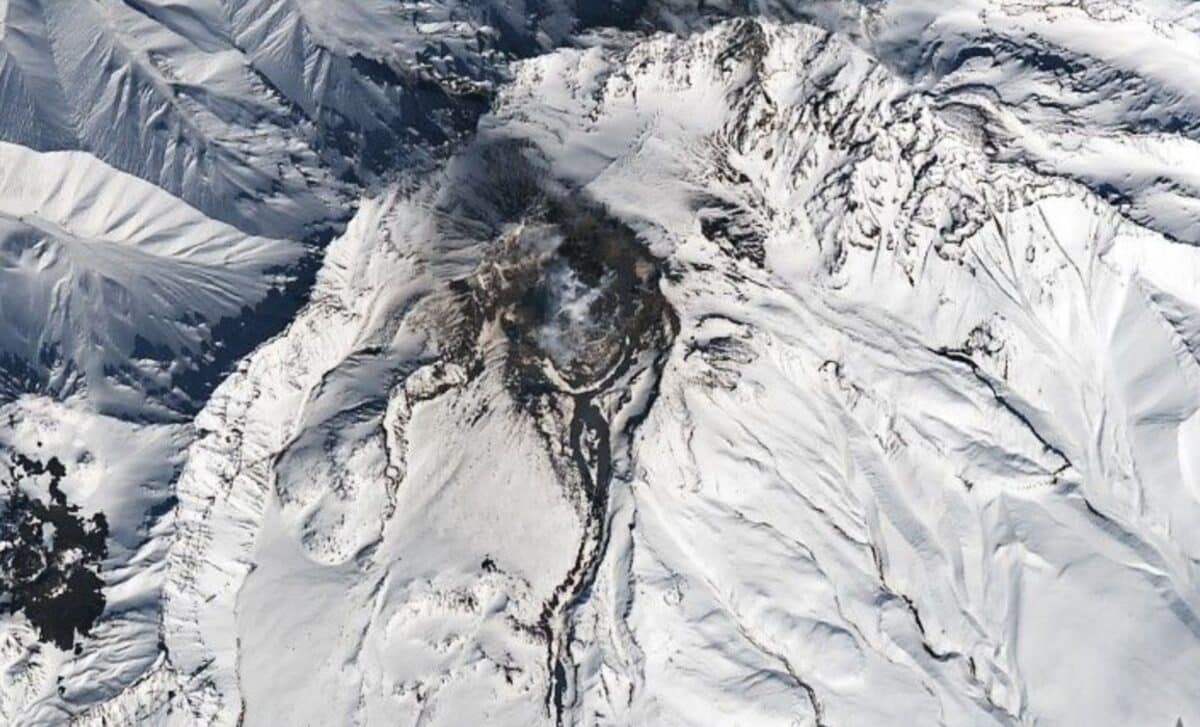
Fresh satellite imagery has revealed intense volcanic heat escaping from beneath the frozen slopes of Shivelyuch volcano on Russia’s Kamchatka Peninsula, where growing lava formations and lingering pyroclastic deposits are visibly melting snow from the inside out. The striking images, released by NASA Earth Observatory / Lauren Dauphin, offer a rare look at how one of Earth’s most active volcanoes continues reshaping its landscape years after a major eruption.
Dark Volcanic Scars Cut Through Kamchatka’s Frozen Landscape
The new images, captured by the Landsat 9 satellite on April 23, 2026, show dramatic dark streaks stretching across the snow-covered volcano. These scars are not simple surface discolorations. They are channels formed by ash deposits, volcanic debris, and heat-rich pyroclastic material that continue radiating warmth long after eruptive events. Against the bright white snowfields of Kamchatka, the contrast is stark and unsettling, revealing the hidden energy still moving beneath the volcano’s surface.
At the center of the activity sits a steadily expanding lava dome inside Shivelyuch’s massive horseshoe-shaped crater. Lava domes form when thick magma rises slowly and accumulates near the vent instead of flowing freely downhill. Over time, pressure builds inside these unstable formations, creating conditions for sudden collapses and explosive releases of hot gas and volcanic rock. Scientists monitoring the volcano through the Kamchatka Volcanic Eruption Response Team (KVERT) have observed continued dome growth during recent months, indicating that magma movement remains active beneath the mountain.
The melting patterns visible from space highlight how much heat remains trapped inside recent volcanic deposits. Snow has vanished along several flow channels where pyroclastic material spread during recent eruptions and collapse events. Some of the darker zones may still be retaining heat from the volcano’s massive 2023 eruption, an event that sent huge pyroclastic avalanches racing across the slopes and dramatically altered the surrounding terrain.
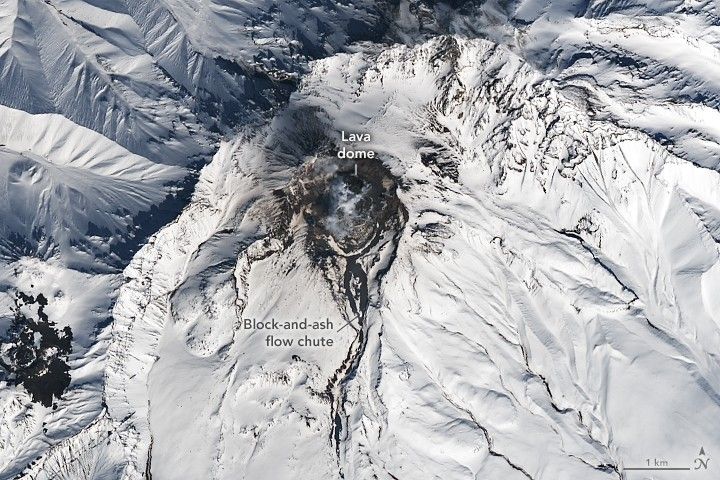 The caldera contains a growing lava dome and signs of block-and-ash flows in channels radiating outward in this detailed image, acquired April 23, 2026, by the OLI (Operational Land Imager) on Landsat 9.
NASA Earth Observatory / Lauren Dauphin
A Volcano That Constantly Destroys And Rebuilds Itself
Shivelyuch is widely recognized as one of the most persistently active volcanoes on the planet. Located in the remote volcanic arc of eastern Russia, it has produced repeated eruptions, collapses, ash plumes, and lava dome growth cycles for centuries. Scientists consider it one of Kamchatka’s most closely monitored volcanoes because of both its explosive potential and its nearly continuous activity.
Volcanologist Janine Krippner described the volcano’s unusual behavior in comments released alongside the imagery by NASA Earth Observatory.
“Shivelyuch is an incredible volcano that has collapsed over and over again,” said volcanologist Janine Krippner in a statement released alongside the images by NASA Earth Observatory. “It goes through cycles of collapse but then builds itself up again and again through constant volcanic activity.”
Her remarks reflect the volcano’s remarkable geological resilience. Each time sections of the lava dome fail or erupt violently, new magma begins rebuilding the structure almost immediately. This cycle creates an ever-changing volcanic landscape shaped by destruction and renewal occurring simultaneously. Massive eruptions can flatten portions of the crater, yet within months new lava accumulations begin emerging again from the vent.
“It should really be on a motivational poster,” Krippner added.
The humor in that observation points to a deeper scientific fascination surrounding Shivelyuch. Few volcanoes demonstrate such persistent regenerative behavior at this scale. The mountain effectively reconstructs itself through endless magma supply, making it an ideal natural laboratory for volcanologists studying lava dome dynamics and long-term eruption cycles.
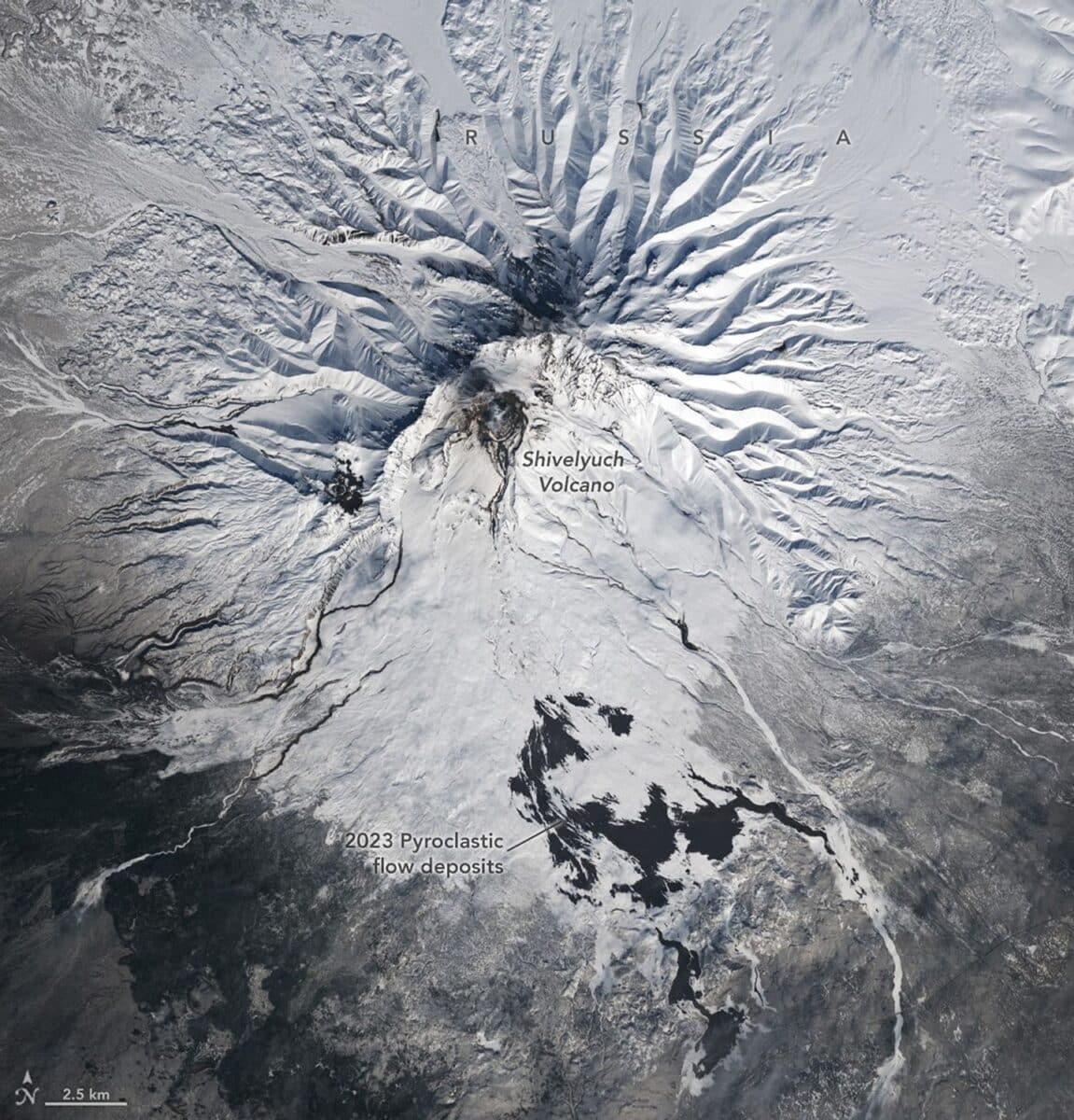 Snow has melted from warm volcanic deposits of ash and rock on the flanks of Shivelyuch on April 23, 2026, in this image captured by the OLI (Operational Land Imager) on Landsat 9.
NASA Earth Observatory / Lauren Dauphin
Why The Heat Remains Visible Long After Eruptions End
One of the most striking aspects of the new imagery is how clearly volcanic heat can still be detected beneath the snowpack. Pyroclastic flows generated during eruptions contain superheated mixtures of ash, gas, and rock fragments capable of exceeding hundreds of degrees Fahrenheit. Once these materials settle across a volcano’s slopes, they can retain internal heat for extremely long periods depending on thickness and composition.
In the case of Shivelyuch, some deposits from recent activity continue warming the surrounding terrain enough to prevent snow accumulation entirely. Satellite sensors are able to identify these thermal anomalies because the warmer surfaces alter the reflectivity and infrared signature of the landscape. The result is a visible network of dark melt paths that effectively maps the movement of volcanic material across the mountain.
The phenomenon also illustrates how volcanic systems remain active even during periods without large explosive eruptions. Surface activity may appear calm compared to dramatic eruption footage, yet magma movement, gas release, and underground heating continue constantly beneath the crater. Scientists rely heavily on satellite monitoring because remote volcanoes like Shivelyuch are difficult to observe safely from the ground, particularly during winter conditions common across Kamchatka.
The imagery released by NASA Earth Observatory / Lauren Dauphin demonstrates how modern Earth observation satellites have become indispensable tools for tracking volcanic hazards globally. High-resolution satellite monitoring allows researchers to detect changes in lava dome growth, thermal emissions, ash deposits, and slope instability in near real time, offering critical information for both scientific analysis and aviation safety.