
The findings do not yet amount to a fully “19-amino-acid” organism. Still, the bacteria managed to remain alive and reproduce for more than 450 generations despite extensive genetic alterations affecting its protein-making machinery.
All known life on Earth relies on 20 canonical amino acids to build proteins, the molecules that drive nearly every biological function. Scientists have debated for years how this specific set became established during evolution, especially because some microorganisms are known to use up to 22 amino acids.
According to the researchers, several amino acids share biochemical similarities that may allow some redundancy inside living systems. The study states that “multiple lines of evidence suggest the feasibility of life with a more restricted amino acid alphabet,” while computational models indicate that as few as 9 to 12 amino acids could theoretically support nearly all protein folds.
Researchers Targeted Isoleucine Because of Its High Energy Cost
The Columbia University team focused its work on isoleucine, an amino acid involved in metabolism and immune functions in humans. The researchers selected it partly because producing it requires substantial energy, making it one of the amino acids that evolution has sometimes substituted over time.
According to Popular Mechanics, earlier studies had already shown that mutated E. coli deficient in compounds containing isoleucine could sometimes continue functioning by using valine instead, a chemically similar amino acid.
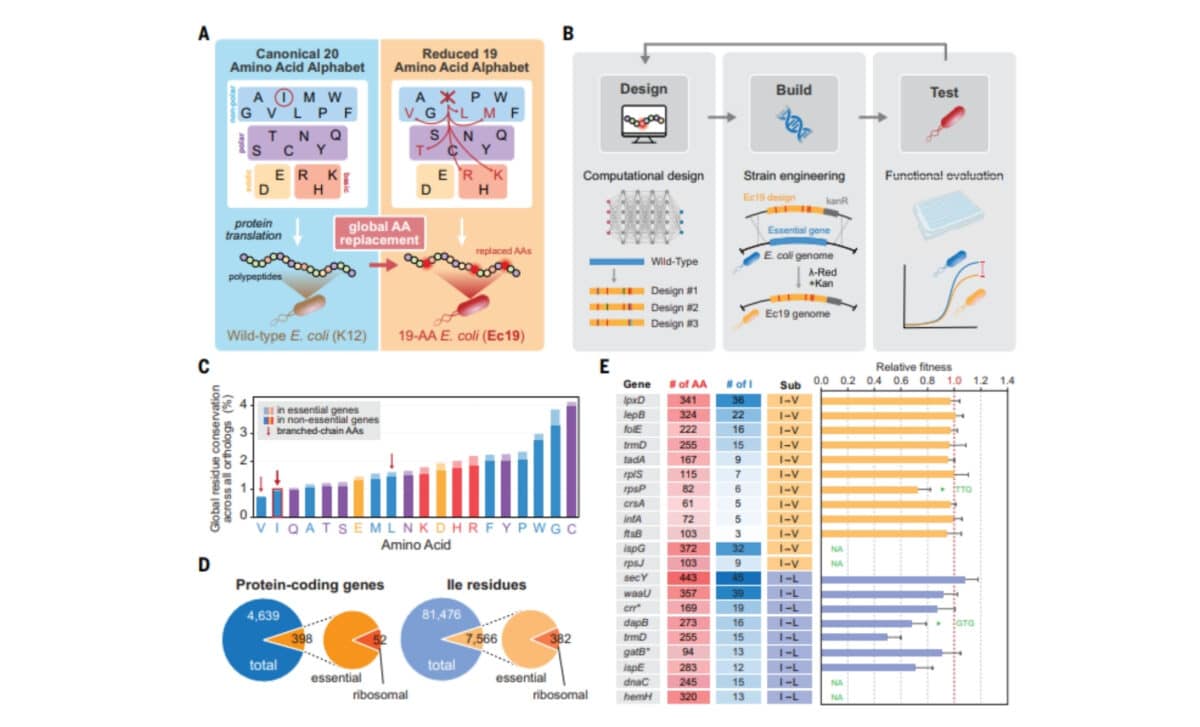 Building a cell with a 19–amino acid alphabet – © Journal Science
The researchers initially aimed to create a bacterial strain known as “Ec19,” which would survive using only 19 amino acids. That objective quickly proved difficult. Replacing isoleucine throughout the entire E. coli genome would have required edits at more than 81,000 genetic sites.
Rather than attempt a full-genome rewrite, the team narrowed its target to ribosomes, the structures responsible for assembling proteins inside cells. Ribosomes themselves contain around 50 proteins, making them a more practical system for testing amino acid substitutions.
Scientists replaced isoleucine with valine or leucine in 39 genes tied to highly expressed or essential ribosomal proteins. Many modified bacteria either grew poorly or died entirely after these changes.
Artificial Intelligence Helped Redesign Ribosomal Proteins
Facing repeated failures, the team turned to artificial intelligence tools known as protein language models. These systems generated new amino acid sequences while predicting how the altered proteins would behave and interact.
According to study recently published in the journal Science, the algorithms proposed “nonintuitive ribosomal protein sequences” capable of compensating for the absence of isoleucine. Researchers drew inspiration from the fact that two of E. coli’s 52 ribosomal proteins naturally contain no isoleucine at all.
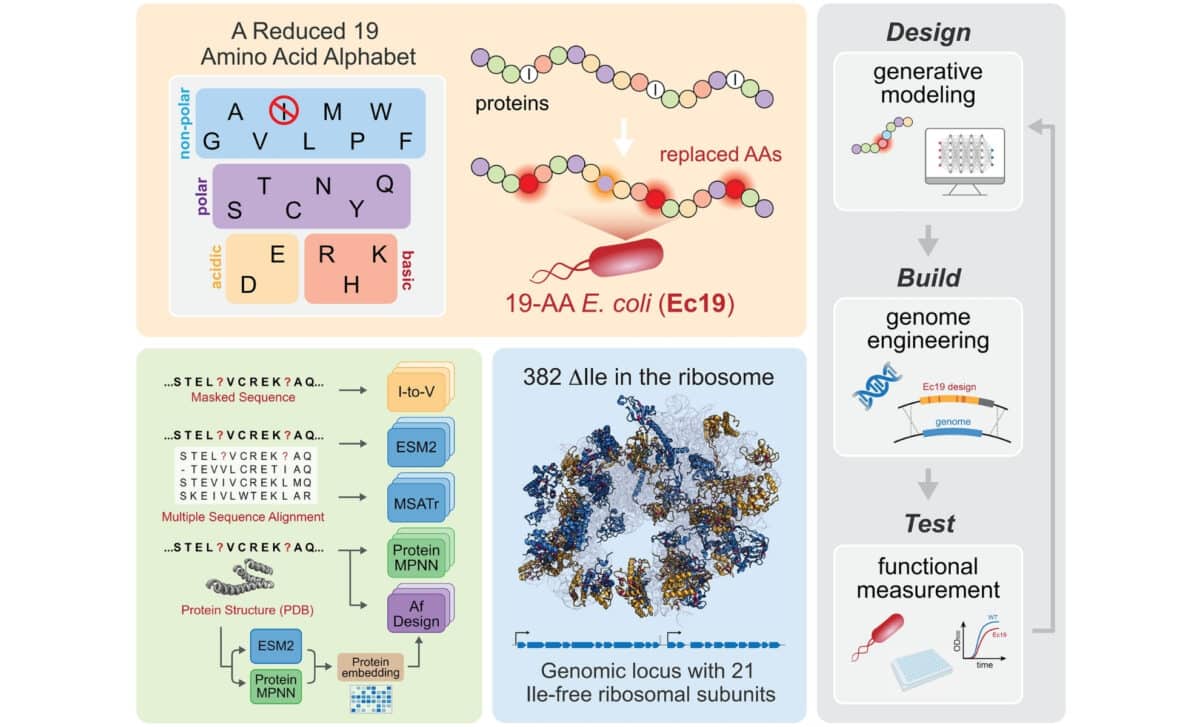 llustration showing how researchers engineered a modified E. coli bacterium with a reduced set of 19 amino acids by removing isoleucine from ribosomal proteins. Using AI-based protein design and genome engineering tools, the team redesigned 21 ribosomal subunits and successfully created a viable bacterial strain capable of surviving with these modifications – © Journal Science
Several experimental strains still struggled to survive. After multiple iterations, the researchers finally engineered a version of E. coli in which 21 ribosomal proteins no longer used isoleucine.
The altered bacteria grew more slowly than ordinary E. coli strains. Even so, the organism remained viable and continued reproducing without reversing the engineered changes.
The Modified Bacteria Survived for More Than 450 Generations
The final strain maintained its altered ribosome for over 450 generations. Researchers described this as evidence that major parts of a living organism’s protein synthesis system can function with a reduced amino acid set.
The experiment still falls short of eliminating isoleucine entirely from the organism. Most of the bacterium’s genome continued relying on the amino acid, meaning the microbe technically still required all 20 canonical amino acids to survive.
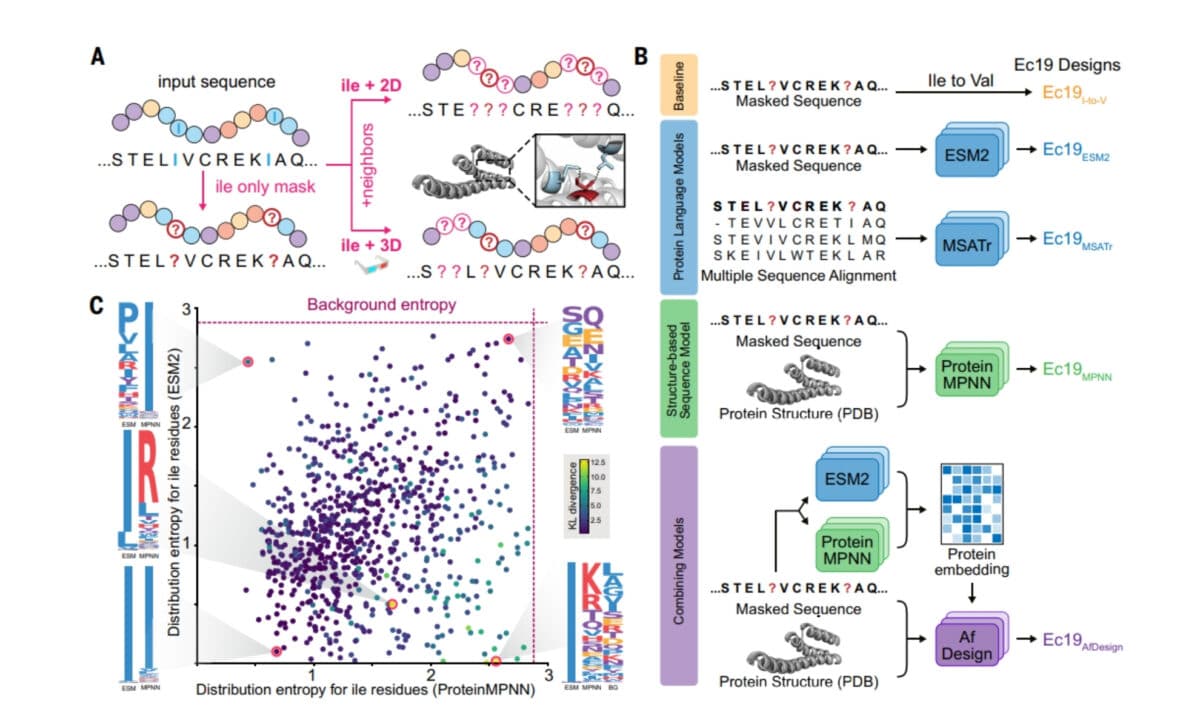 Application of generative models for Ec19 designs – © Journal Science
Even so, the researchers argued that the work demonstrates the possibility of reducing the modern amino acid code. In the paper published in Science, they wrote that their efforts represented “the largest targeted sequence changes” performed while introducing major alterations to the organism’s biological machinery.
The study also provides a new experimental framework for exploring how early life may have functioned before the modern genetic code became fixed.