
We meet him in the middle of rehearsal week at Vienna’s Museum of Science and Technology, where the second floor is full of early mechanical instruments and historical synthesisers.
Hyperactive at the best of times, Sam enters the exhibition like a kid in a candy shop, who has eaten all the candy, then discovered a secret, second room full of even more candy on which to binge.
He charms the staff with his knowledge of these obscure machines – pointing out the bellows that power a church organ, and the pneumatic underpinnings of a piano roll player.
“That’s the sound you hear on Strawberry Fields Forever,” he says, indicating a Mellotron organ, an early sampler that used tape loops to produce orchestral sounds.
“And if you flick this ‘rumba’ button,” he says, prodding at a Roland CR-78 drum machine, “you’ll get the start to Blondie’s Heart of Glass.”
The museum’s curator turns to me and observes: “He’d be a great tour guide. He almost knows more than we do!”
Sam immediately offers his CV, before adding: “I don’t have a CV. But I’ll write one.”
Still, none of this excitement is conducive to an interview.
“Sorry! I’m forgetting I have a job to do,” Sam apologises. “You’ve taken me to the worst place!”
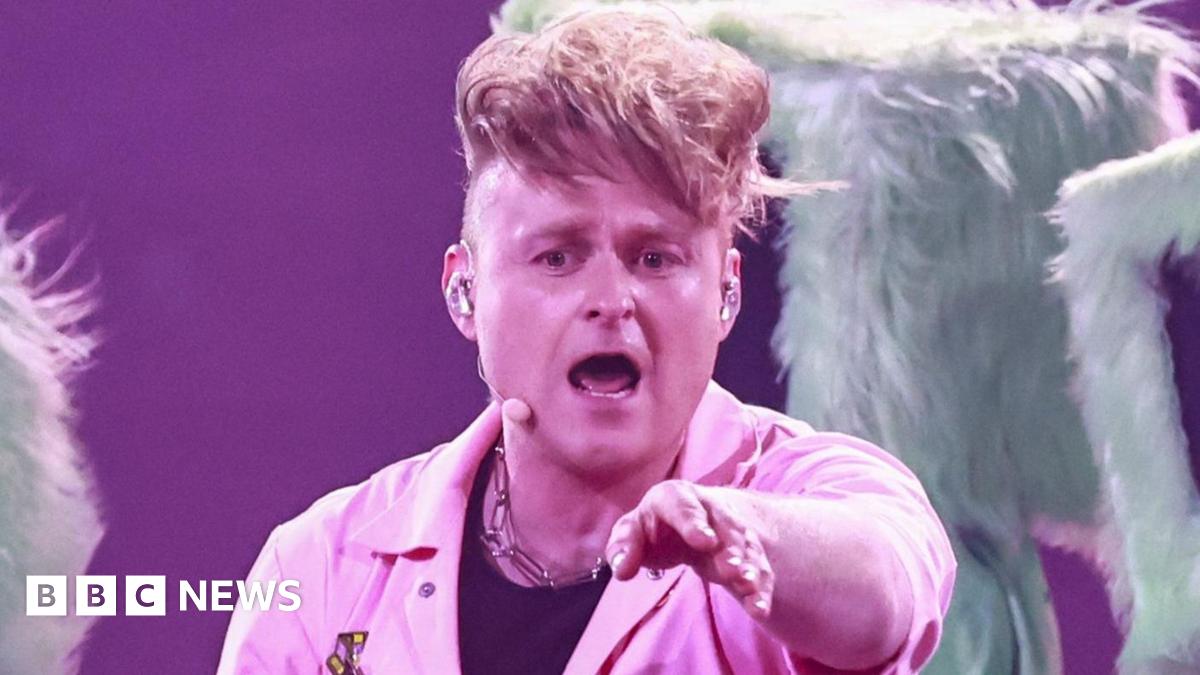
Then he’s off again, having spotted a Eurovision karaoke booth. Grabbing the mic, he launches into a squeaky falsetto version of Abba’s Waterloo, followed by Tommy Cash’s 2025 entry Espresso Macchiato, complete with its loose-limbed choreography.
Finally, this gives us an opportunity to discuss his own Eurovision performance.
“I’m literally not a dancer,” he grins. “I’m awful.
“I’ve got two left feet and there are parts where I need to use my right foot. But I’m all up for an experience and a challenge. It’s fun.”