
Global equity markets remain on a seemingly unstoppable upward trajectory, fuelled by enthusiasm for artificial intelligence.
In recent weeks, however, the primary beneficiaries of the AI boom have changed. While the so-called Magnificent 7 — tech giants including Alphabet, Microsoft and Amazon — continue to dominate attention, many smaller semiconductor stocks have comfortably outperformed them this year.
Over the past six weeks, the Philadelphia Semiconductor Index has increased 68 per cent, while the Magnificent 7 stocks have gained 27 per cent, largely thanks to strong earnings. The eight leading US semiconductor companies reported revenue growth of 54 per cent year-on-year in their last reported quarter, according to figures from Rothschild & Co Redburn.
It is not just in the US that semiconductor stocks are in demand. Markets in Taiwan, Korea, and Japan have all hit fresh highs this month thanks to the strong performance of companies exposed to the AI boom. Chipmakers SK Hynix and Samsung, which together account for more than 43 per cent of South Korea’s Kospi index, have gained 121 per cent and 192 per cent respectively. Taiwan-based TSMC, the company responsible for physically manufacturing over 90 per cent of the world’s most advanced semiconductors, has gained 33 per cent.
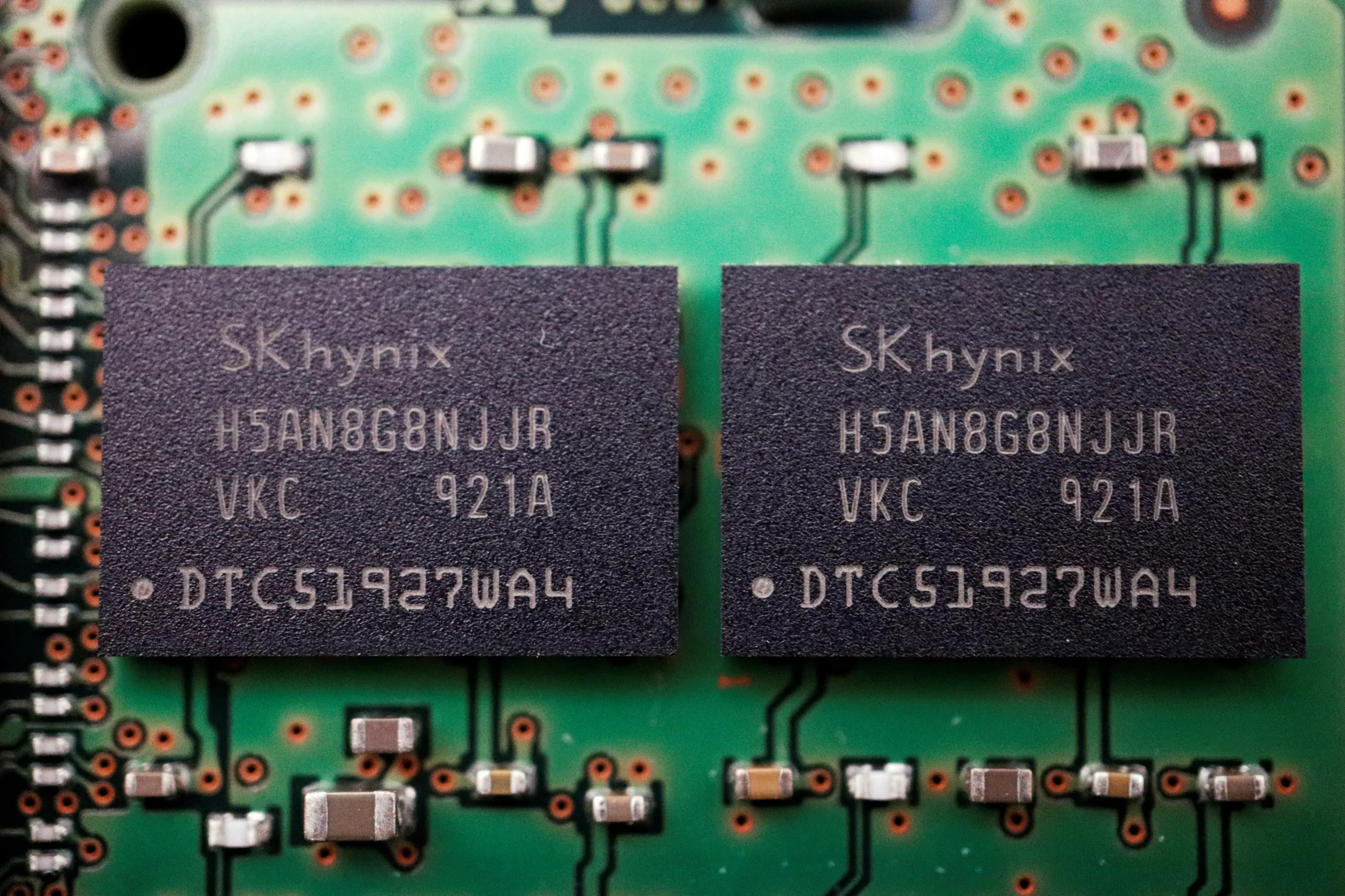 Memory chips made by South Korean semiconductor supplier SK HynixReuters
Gaurav Gupta, a VP analyst in the emerging trends and technologies team at research firm Gartner, said the semiconductor rally has been driven by “explosive demand” for chips to run AI workloads. Gartner estimates that global semiconductor revenue will hit $1.3 trillion this year, up 64 per cent year-on-year, of which more than half will come from AI.
The buyers of these chips are familiar names. Alphabet, Amazon, Meta, and Microsoft alone expect to spend as much as $725 billion on the infrastructure hardware underpinning AI this year, up 60 per cent year-on-year. Jonathan Cofsky, a portfolio manager at Janus Henderson, described the huge infrastructure commitments as a “land grab” from big tech companies looking to get access to “all of the semis and compute they can get their hands on”.
But this massive wall of capital reflects the hope that the economy is undergoing a pivot in the deployment of AI, as businesses start to roll out autonomous agents across their companies, and consumers integrate it into their daily routines. These real world use cases rely on a process called “inference”, through which a model is able to produce something new, or make a decision based on its training data.
Timm Schulze-Melander, head of semiconductor & technology hardware research at Rothschild & Co Redburn, said: “We’re at the very start of a moment when inference becomes extremely widespread. Hyperscalers, the owners of AI models and those that wish to deploy AI as a business, will likely build out capacity at an unprecedented scale.”
The roll-out of AI brings more chipmakers into the picture. Over the last few years, Nvidia has been the semiconductor stock most associated with AI. The company specialises in the exceptionally high performance graphics processing units (GPUs) which are essential for training AI models. GPUs are used for processing trillions of data points simultaneously. However, increasing need for inference will require many more central processing units (CPUs) to direct GPUs. For training AI models, the ratio between GPUs and CPUs is around 4-to-1, and can be as high as 8-to-1. For inference, that falls to 2-to-1, or even parity.
As a result of the greater need for inference, AMD expects the CPU market to grow at 35 per cent annually, reaching $120 billion by 2030. That’s around double what it predicted just six months ago.
Nvidia’s dominance with GPUs helped it become the first company to surpass $5 trillion in market capitalisation and head toward $6 trillion but its shares are up just 26 per cent this year — a small increase compared to other listed semiconductor companies. Shares in AMD have gained 110 per cent this year on the back of increasing demand for CPUs, while shares in Intel — the largest US CPU maker — have gained 214 per cent, surpassing the company’s previous record set at the height of the dotcom boom.
AI also requires specialised high bandwidth memory chips to house the models, and feed the GPUs at high speeds. Demand for these memory chips has also massively increased, while supply has remained fairly constrained, giving producers immense pricing power. Gartner predicts memory chip prices will increase 125 per cent this year.
Kim Jaejune, an executive in Samsung’s chip business, said that the company’s “supply falls far short of customer demand” after reporting income from its chip business increased nearly 49-fold, predicting that the “supply-to-demand gap” would widen in 2027. Micron, the leading US memory chipmaker, reported that profit increased nearly 800 per cent year-on-year with boss Sanjay Mehrotra telling analysts that its high bandwidth capacity was “sold out” until the end of the year. Its stock has gained 500 per cent this year.
But these vertiginous share price gains have unnerving parallels to previous bubbles. Indeed, the performance of the Philadelphia Semiconductor Index in April was its best monthly showing since February 2000, the month before the dotcom bubble began to burst.
Analysts at UBS said: “Markets are assuming that the lifecycle of AI firms is different to all other companies historically and that they are immune to normal competitive dynamics.”
Michael Burry, who garnered fame for predicting the 2008 housing market collapse, has warned of the parallels between the current bull run and the dotcom bubble.
“For any stocks going parabolic, reduce positions almost entirely,” he wrote in a substack post last weekend, referring to near vertical movements in the share price. “They are going straight up because they have been going straight up. On a two-letter thesis that everyone thinks they understand.”
There are clear risks for a sector to be so closely associated with the outlook for AI. If monetisation of AI looks like it may take longer or be lower than expected, then the big tech companies may scale back, postpone or cancel their huge investment projects.
Gartner estimated that if AI infrastructure spending contracts by 10 per cent within the next two years, then semiconductor suppliers could lose out on as much as $1.5 trillion in revenue. A fall in demand would see suppliers lose their dominant pricing power, potentially leading to “price crashes” for the high-margin chips, the company said. It would also free up manufacturing capacity.
“If data centre construction slows down or demand drops, due to questions about return on investment, regulatory approvals, availability of power, and constrained supply of other materials, we could see a significant correction,” Gupta said.
For the moment, however, many in the industry are hopeful that the good times will continue to roll.
“The long-term outlook for the sector, and continued demand for new sources of supply to meet it, remains exceptionally strong,” said David Moore, chief executive of Cambridge-based Pragmatic Semiconductor, and a former senior executive at Intel and Micron. “It is difficult not to be extremely bullish on its prospects.”