
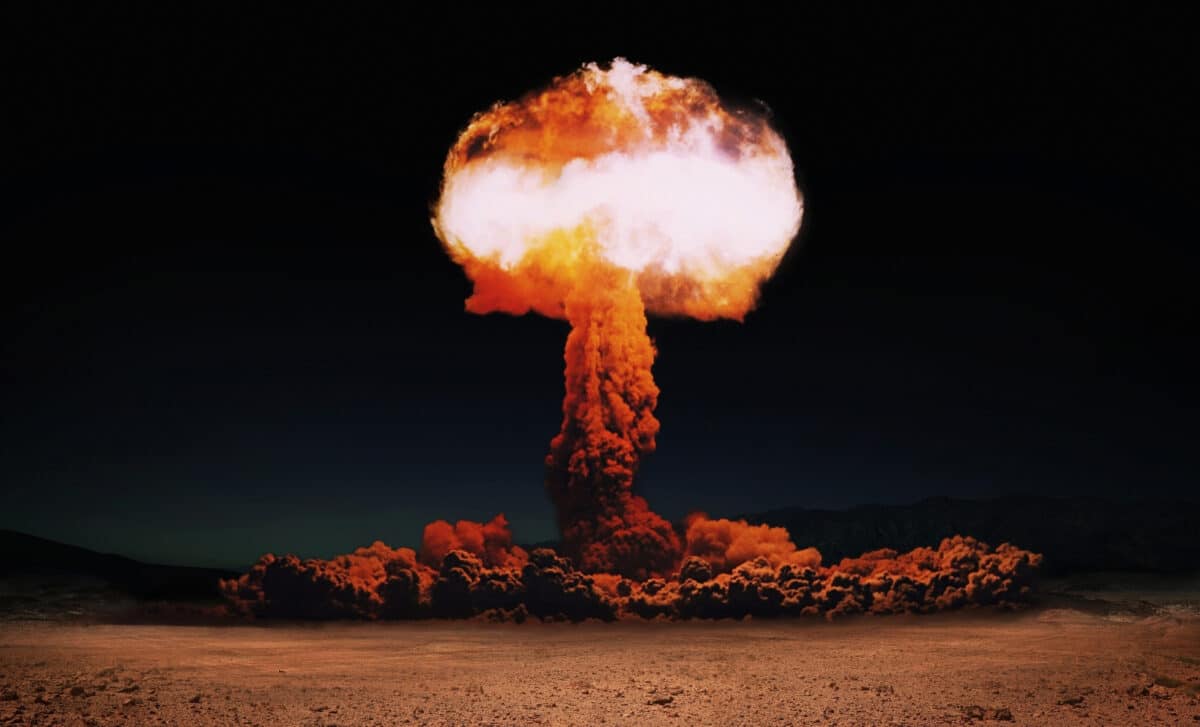
Trinitite was born on July 16, 1945, at 5:29:45 a.m., when a plutonium device codenamed “Gadget” detonated atop a test tower nearly a hundred feet in the air at an Air Force base near Alamogordo, New Mexico. The blast, the culmination of two years of classified research, led by head physicist Robert Oppenheimer, who had initially been skeptical about the plutonium bomb and remained nervous about its prospects until the moment of detonation, unleashed 18.6 kilotons of power.
It instantly vaporized the quartz and feldspar in the desert sand below, merging them with asphalt, copper cables, and iron from the tower into a glassy, greenish substance. Scientists named it trinitite. It was the first substance ever created by humans that bore any resemblance to the tektites left behind by meteorite impacts or the obsidian formed from volcanic lava.
What made trinitite unusual from the start was what the explosion had done to ordinary desert sand. Gamma ray measurements established that the material formed near the end of the tower’s coaxial cable, approximately 180 to 197 feet from ground zero. Nano-CT scans later revealed iron and copper inclusions within silicate glasses, the source of the material’s distinctive glassy shine. For decades, trinitite was treated primarily as a historical curiosity, a relic of one of the most consequential mornings in modern history. That changed in 2021, when geologist Luca Bindi and his research team found that the Trinity explosion had produced something far stranger than fused sand.
A Red Variant With an Impossible Structure
Bindi’s team discovered that the explosion had synthesized a rare form of trinitite infused with enough copper to turn it red rather than its characteristic pale green. More striking still, parts of this red trinitite had the structure of a quasicrystal, a material whose atoms arrange themselves in highly organized patterns that, unlike in most crystals, never repeat perfectly.
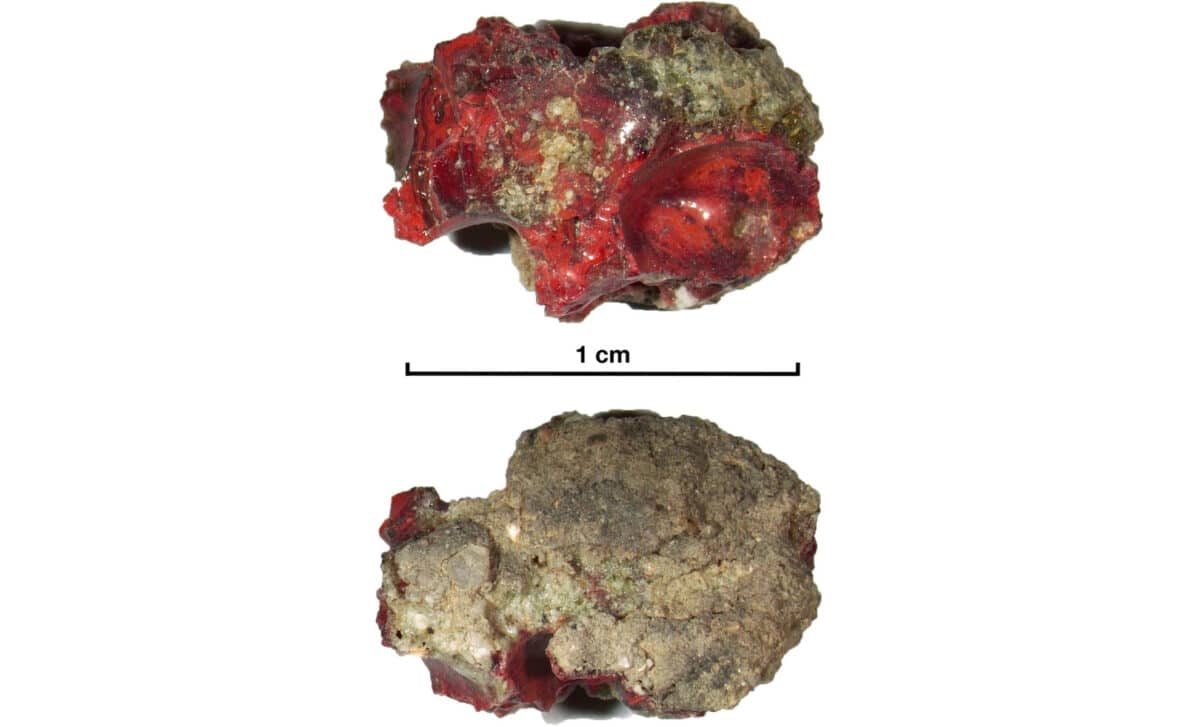 Incident light images of the red trinitite sample used in this study (front and back of the sample) – © Journal PNAS
The quasicrystal was found occurring within metallic droplets with a high copper content and was also rich in silicon. While some quasicrystals can be produced in a lab, this particular one has not been successfully replicated, as it is considered too valuable to risk potential damage during synchrotron experiments. Researchers have tested it virtually instead, using mathematical models.
A Second Crystal Hidden in the Same Fragment
After returning to the same red trinitite sample, Bindi realized the material was even stranger than the 2021 findings had suggested. Nestled alongside the quasicrystal was a second, entirely different type of crystal: a clathrate, in which atoms form cage-like structures that trap other atoms inside.
The clathrate found in the trinitite is made of silicon atom cages, polyhedrons with 12 or 14 faces, surrounding trapped calcium atoms, with traces of copper and iron also present. Analysis was conducted using an electron microscope and X-ray diffraction.
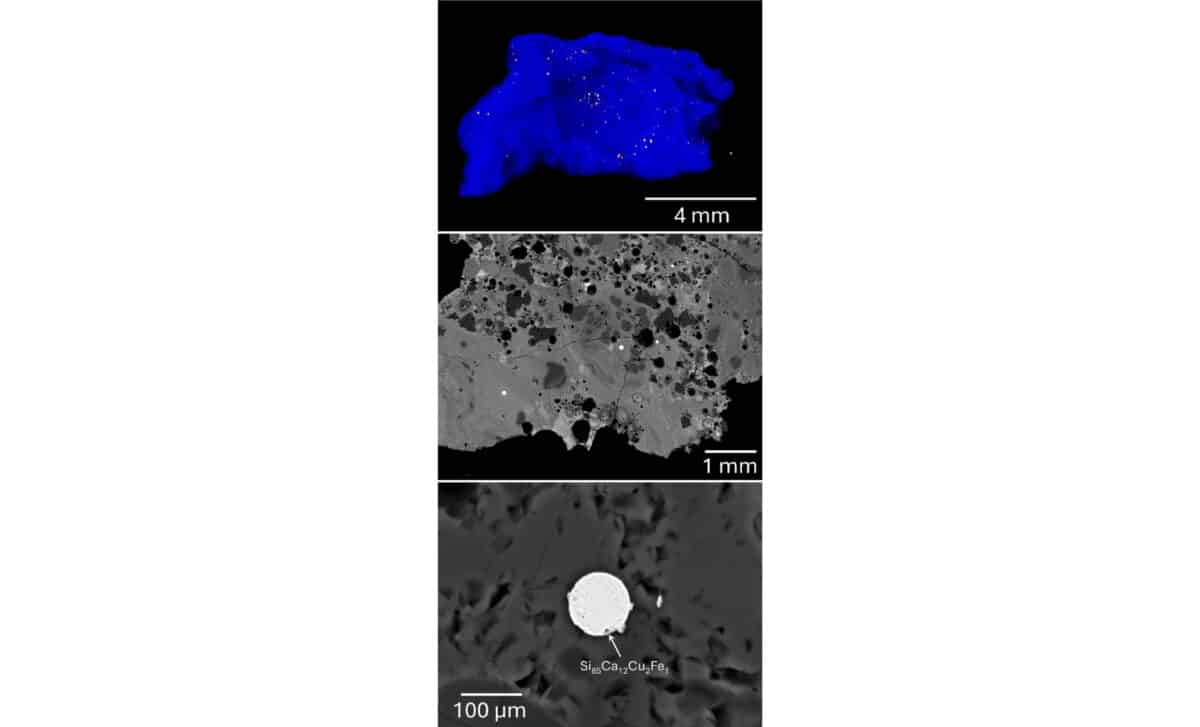 (Top) Nano-tomographic image of the studied sample. The metallic Cu-droplets (orange spheres) are immersed in a glass silicate (blue matrix). General backscattered scanning electron microscope image of the polished surface of the sample studied (Middle). The small copper droplet containing the new clathrate (Bottom) – © Journal PNAS
According to the study, recently published in the journal PNAS, this makes it the first clathrate known to emerge from a nuclear explosion. A single fragment of trinitite now contains two of the rarest crystal structures known to science.
Two Structures, One Blast, and an Unresolved Question
With both structures identified, Bindi turned to the question of whether they might be related. To find out, his team probed the mechanical and energetic stability of the clathrate and compared it to that of the quasicrystal using mathematical models. The results showed that the clathrate with low copper levels was metastable, meaning it could remain stable under minor disturbances. Stability dropped sharply, however, as copper levels rose toward those found in the quasicrystal.
This led the team to conclude that two completely different crystal structures had formed from the same explosion. According to Popular Mechanics, as Bindi states, “as both the clathrate and the quasicrystal are made of typical elements found in either desert sand or the metallic tower, it seems evident that both were formed in the detonation,” adding that “the coexistence of these two rare phases naturally raises the question of whether a broader structural or topological relationship might exist between them.”
The findings also offer broader insight into how other extreme phenomena, including lightning strikes and meteorite impacts, produce crystalline structures that are, in Bindi’s own words, “beyond the reach of conventional synthesis.”