
Small businesses are significantly raising prices in response to President Trump’s tariff regime that came into effect this month, in a development that could fuel inflation in the world’s biggest economy.
Businesses surveyed by the Financial Times in the Midwestern city of St Louis said their suppliers had hiked prices for a broad range of products in recent weeks, sometimes by as much as 30 per cent, leaving them with little choice but to pass the increases on to customers.
Many said they had stockpiled products priced at the pre-tariff level before the levies came into force, but have since run these stocks down.
“I believe inflation will increase as each item that was in inventory is replaced by a new one,” said Justin Breckle, chief executive of Authorized Appliance, a St Louis business that sells high-end kitchens, barbecues and washing machines.
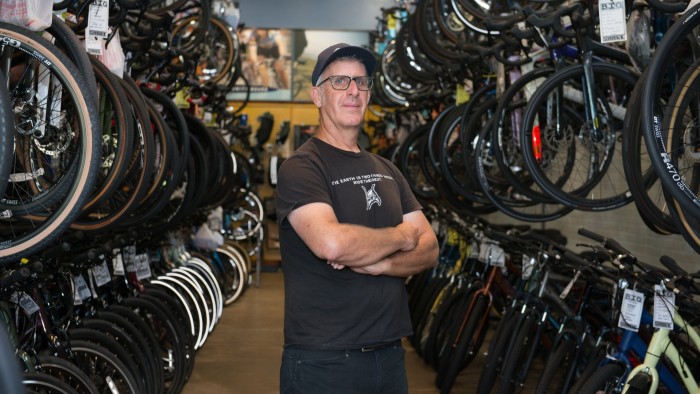
“What we’re seeing with new products is they’re all being marked up,” said Mike Weiss, owner of the Big Shark Bicycle Company, which runs a chain of local bike shops in St Louis. “We’re seeing an average 10 per cent increase in the retail price.”
A bike that sold for about $730 before the tariffs were announced was now retailing for $800, he added. “Normally we would reprice things on an annual basis, not daily,” he said. “The goalposts keep moving.”
The trend is backed up by a number of recent surveys. A small business optimism index released last month by the National Federation of Independent Business showed 32 per cent of companies plan to increase prices, the highest reading since March last year.
A census bureau survey in late July had a similar result, with 34 per cent of businesses expecting increased prices in the next six months, up from 29 per cent in mid-July.
 Justin Breckle of Authorized Appliance said he has seen price increases of up to 35 per cent, depending on the manufacturer © Neeta Satam/FT
Deutsche Bank economist Justin Weidner compared the current situation with 2018, when Trump imposed tariffs on imported washing machines.
“They went into effect at the end of January 2018 and then you saw three months of price increases in April, May and June,” he said. “That suggests that you tend to get a bit of a delay [in the price effect] of the tariff increases.”
Breckle and Weiss were speaking hours before Trump’s global tariffs took effect, pushing American import duties to their highest level in a century.
The new regime, which involves so-called reciprocal levies on almost all foreign countries, will profoundly reshape an international trading system developed over decades that was predicated on open borders and the removal of protectionist barriers.
The policy moves on tariffs have triggered deep uncertainty about where prices are headed in the US, as Trump steps up his fierce attacks on Federal Reserve chair Jerome Powell over US monetary policy.
At its last meeting in late July, the Fed’s main policymaking body held interest rates steady, while awaiting more clarity on how the Trump tariffs will feed through to consumer prices.
Powell said the higher levies had “begun to show through more clearly to prices of some goods”, though he stressed that the overall effects on economic activity and inflation remained uncertain.

Despite this, the Fed could end up cutting rates next month amid signs of a slowdown in the jobs market. Only 73,000 jobs were added in July, the weakest monthly gain in over two years.
The White House insists the tariffs, which it says are designed to reduce America’s trade deficits with its partners and encourage manufacturers to move their production to the US, will have only a limited effect on prices.
It has urged the Fed to immediately cut rates as a way to bolster the economy and lower government borrowing costs.
So far, inflation readings have indeed been lower than many economists had expected. But some trade experts say this is because companies used the various delays and deferrals introduced by Trump to pull in stock from their suppliers at pre-tariff prices.
“There’s still inventory in the supply chain, but it’s gradually being depleted, so pretty soon we’ll start feeling the effect of the tariffs on prices,” said Panos Kouvelis, professor of supply chain, operations and technology at Washington University in St Louis. “And SMEs [small and medium-sized enterprises] will feel it the most.”
That could have broad implications for the rest of the economy. Small businesses employ 46 per cent of American workers, or about 59mn people, and account for 44 per cent of the country’s GDP.
 Trinita Rhodes, co-owner of Beauty Supply Refresh, said the tariff on China would push up the price of human hair by almost a third © Neeta Satam/FT
Trinita Rhodes, co-owner of Beauty Supply Refresh, a beauty products store in the St Louis suburb of Florissant, said most of her retail prices rose significantly after Trump imposed a 145 per cent tariff on all Chinese goods in April — and stayed that high even after he announced a 90-day truce with Beijing.
She pointed out a Chinese-made “Yellow Bird” hairdryer that used to retail at $65.99 in her shop before the tariffs, and now cost $95.99. Hoop earrings that were for sale at $5.49 a pair a few months ago now cost $7.49.
Rhodes said the tariff on China would push up the price of human hair by 30 per cent. $50 wigs now cost $75, while the price of a pack of synthetic braiding hair was expected to rise from $5.99-7.99 to $9.99. “That’s astronomical,” she said.
“We’ve been sourcing from China all these years, so flipping the switch off is a challenge,” she said. “They’re not thinking about the impact on small businesses.”

Other companies are also being hit. Stonemaier Games, a board-game maker based in St Louis, is expecting to pay $600,000 in tariff-related expenses this year since most of its products are made in China.
“We pay a $3 tariff tax to the US government for every $10 we spend manufacturing a game with our long-term partner in China,” said Jamey Stegmaier, its co-founder and president.
But he said the company would resist putting up its prices. “We do not want to contribute to inflation,” he said. It will merely ask customers buying in its US web store to make a voluntary additional payment of $3 to help the company cover the cost of the new levies.
 Nick Colombo of Switchgrass distilleries said the company could keep prices down until it ran out of glass acquired before the tariffs came in © Neeta Satam/FT
Even companies who derive most of their inputs domestically are vulnerable.
The St Louis firm Switchgrass Spirits makes bourbon from American grain and ages it in American charred white oak barrels. But its glass bottles come from Italy and its corks from Portugal. These will now be subject to the 15 per cent US tariff on the EU.
Nick Colombo, head of operations at Switchgrass, said the company was relatively protected because it ordered a big consignment of glass before the tariffs hit.
“We are going to try and keep the prices the same as long as we are using all of the glass that we frontloaded,” he said. But when it has to order more, “we will most likely raise our prices then”.
Breckle of Authorized Appliance is particularly exposed to the tariff effect.
“I’ve seen price increases of up to 35 per cent, depending on the manufacturer,” he said.
He cites the example of Zephyr wine fridges, made in China, which retailed at $1,499 a few months ago. “Now they’re $1,999,” he said.
Even the price of fridges made by True, a US company headquartered in O’Fallon, just outside St Louis, has risen by 4 per cent to 6 per cent, he said. “They’re built down the street but they use aluminium and steel which is subject to the new tariffs, so their input prices have also gone up,” he said.
“I’ve been in business for 20 years and I’ve never dealt with anything like this in terms of price uncertainty,” Breckle said.
He compared the situation to the Great Recession of 2007-9 and the Covid-19 pandemic. “But this one we’ve created ourselves,” he said.