
For Singapore’s multifamily offices and external asset managers, the promise of artificial intelligence is seductive: greater efficiency, deeper client engagement, and the ability to scale advisory services without proportionally scaling headcount. But beneath the enthusiasm lies a more sobering reality. Most firms are still in the early stages of adoption, testing off-the-shelf solutions, navigating regulatory guardrails, and grappling with a question that technology alone cannot answer: what, precisely, is the proposition they are trying to deliver?
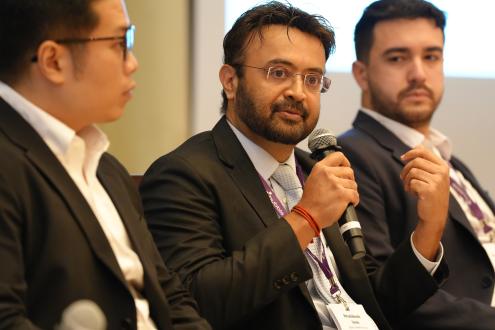
At the recent Hubbis Independent Wealth Management event in Singapore, the second panel discussion of the day explored how independent wealth managers are translating digital ambition into tangible advisory outcomes. Among the panellists, Hrishikesh Unni, Managing Director, Client Investments at Taurus Wealth Advisors, offered a grounded and candid assessment of where multifamily offices stand in their AI journey, why clarity of purpose must precede technology adoption, and how the evolving behaviour of clients themselves is reshaping the advisory dynamic.
Key Takeaways
Know Your Proposition Before You Automate It: Firms must first define what type of family office they are, whom they serve, and what they are trying to deliver before deploying AI as an enhancement tool.
Off-the-Shelf First, Build Later: Most independent wealth managers are not yet at the stage of building proprietary AI solutions. Testing and evaluating commercially available tools is the appropriate starting point.
Regulatory Compliance Is Non-Negotiable: Any AI deployment must be assessed against Monetary Authority of Singapore risk guidelines, and compliance cannot be an afterthought.
Clients Are Already Using AI: Advisers must contend with the reality that their clients have access to the same tools and are actively using them to cross-check advice.
The Worst Thing You Can Tell a Client Is That You Were Busy: AI’s most immediate value for multifamily offices lies in freeing up adviser time to deliver on the full breadth of the client proposition.
Start With the Proposition
Unni’s opening remarks set a tone that was notably distinct from the technology-forward framing of the broader discussion. Before any conversation about AI tools or deployment strategies, he argued, firms need to answer a more fundamental set of questions.
“If you look at 64,000-foot level, EAMs, family offices, you have to figure out what type of family office you are, if you are a multifamily office, a single family office, your size, your proposition, who are the clients you are trying to help,” he said. “You really need to bolt that down very, very well. And then it comes to using AI as a tool to enhance what you are trying to deliver for clients.”
The observation may appear straightforward, but its implications are significant. In a market where AI is frequently positioned as a transformative force in its own right, Unni’s insistence on treating it as a secondary consideration, subordinate to the clarity of the firm’s advisory proposition, represents a deliberate counterweight to the prevailing narrative. Technology, in this framing, is an enabler of a well-defined strategy, not a substitute for one.
For Taurus, a multifamily office whose stated proposition spans a wide range of advisory and investment services, this clarity is particularly important. The breadth of the offering creates complexity, and AI’s role is to manage that complexity more efficiently, not to redefine the offering itself.
Infancy, Not Immaturity
Unni was forthright about where Taurus, and the broader EAM sector, currently sits in its AI journey. The word he used was “infancy,” and he applied it without qualification.
“I think in general, the EAMs are at an infancy stage of how to incorporate AI,” he said. “We are at a stage where we are not at that build-your-own level. We are trying to buy off-the-shelf solutions, and we are still testing them out.”
The candour is notable in an industry where there is often pressure to overstate the sophistication of one’s technology capabilities. Unni’s willingness to acknowledge that Taurus is still evaluating different platforms, deliberately avoiding the temptation to commit prematurely to any single solution, reflects a disciplined approach to adoption.
Crucially, he framed this caution not as hesitancy but as rigour. The firm is testing multiple solutions to understand what works within its specific operating environment. It is cross-referencing those solutions against MAS risk guidelines to ensure compliance. And it is resisting the bandwagon effect, the pressure to adopt a particular tool simply because it is fashionable or widely discussed.
“We do not want to just join the bandwagon,” he said. “We try to test different solutions that are out there just to see what is working.” This was a measured approach to assimilating AI into the Taurus value proposition.
The Three Client Archetypes
One of the more compelling observations Unni offered was not about the firm’s own use of AI, but about how clients are engaging with it. He identified three distinct archetypes that are emerging across Taurus’s client base, a taxonomy that will likely resonate with many independent wealth managers.
The first archetype comprises clients who are aware of AI but do not yet trust it. These individuals prefer traditional advisory interactions and are not inclined to incorporate AI-generated insights into their decision-making. The second sits at the opposite extreme: clients who rely almost entirely on AI tools for their investment decisions, using platforms to construct and manage portfolios of ETFs and equities with minimal human input. As Unni noted, this cohort has, over a short history, achieved a strong track record, though the longevity of that performance remains to be tested.
The third, and largest, group occupies the middle ground. These clients value the human advisory relationship and rely on their adviser as the ultimate decision-maker, but they routinely cross-check advice against AI tools.
“Whatever we suggest or we advise, they do cross-check it with an AI app,” Unni said. “In a way, it keeps us on our toes.”
The implication is clear. Advisers can no longer operate on the assumption that their clients lack access to the same analytical capabilities. The tools are freely available, and clients are using them, not necessarily to replace their adviser, but to verify and challenge the advice they receive. For firms that pride themselves on the quality and depth of their advisory relationships, this dynamic raises the bar considerably. Consistency, rigour, and the ability to substantiate recommendations are no longer differentiators. They are baseline expectations.
Never Tell a Client You Were Busy
For Unni, the most immediate and tangible value of AI lies not only in sophisticated analytics or revenue generation, but in something more prosaic: time. Specifically, the time that advisers need to deliver on the full scope of the client proposition.
“I think the worst thing you can tell a client is I am busy or I was busy,” he said. “If they have signed on the dotted line, they are a client, and we should be delivering on not necessarily everything, but at least everything that they have come to us for.”
The comment speaks to a tension that is familiar to every multifamily office. The range of services on offer, from investment management and estate planning to tax advisory and lifestyle concierge, is typically broad. But the capacity of any individual adviser to deliver across that full spectrum is inherently limited. When administrative tasks, documentation, compliance preparation, and meeting follow-ups consume a significant portion of the working week, the time available for substantive client engagement is compressed.
AI, in this context, is not a strategic weapon. It is a practical tool for reclaiming the hours needed to honour the firm’s commitments to its clients. If a workflow tool can reduce the time spent on non-revenue-generating activities, the benefit is not measured in abstract productivity gains, but in the adviser’s ability to deliver the service that the client was promised.
Security Cannot Be an Afterthought
Unni also raised a point that received less attention from other panellists but carries significant practical weight: the security implications of building an AI ecosystem. Drawing on a recent visit to the Palo Alto Networks office, he described emerging solutions designed to provide a security overlay across an entire AI technology stack, regardless of its composition.
“There are challenges around data confidentiality, security, and so on,” he noted. “They are building something that can sit as an overlay across whatever ecosystem yours looks like.”
For independent wealth managers, who handle sensitive client data and operate under strict regulatory obligations, this is not a peripheral consideration. The compliance and security dimensions of AI adoption must be budgeted for and planned from the outset, not bolted on after the tools have been deployed. Unni’s point was that the cost of an AI ecosystem extends well beyond the licence fees for the tools themselves, and firms that fail to account for the security layer risk exposing themselves to regulatory and reputational risk.
Alignment Over Age
On the question of cultural adoption, Unni offered perhaps the session’s most direct rebuttal of the assumption that AI resistance is a generational phenomenon. With a workforce spanning from 21 to 70 years of age, Taurus has a broad demographic and experienced professional range from which to draw conclusions.
“I think finally it is not about age which is just a number,” he said. “It is really character and the culture that you want to foster in the company. Once you are aligned with the benefits of AI and why we should be looking at it, that adage regarding age goes out the door.”
The lesson is that adoption is a function of leadership and institutional culture, not individual demographics. Where the leadership articulates a clear rationale for AI adoption and embeds it within the firm’s strategic priorities, resistance tends to dissipate regardless of the age profile of the team. Where it is treated as a technology initiative rather than a business imperative, adoption stalls.
For Taurus, that alignment is driven from the top, with CEO Mandeep Nalwa placing a significant strategic emphasis on the firm’s AI capabilities. The result, Unni suggested, is an environment in which the question is not whether to adopt AI, but how to do so in a way that is rigorous, compliant, and genuinely additive to the client experience.