
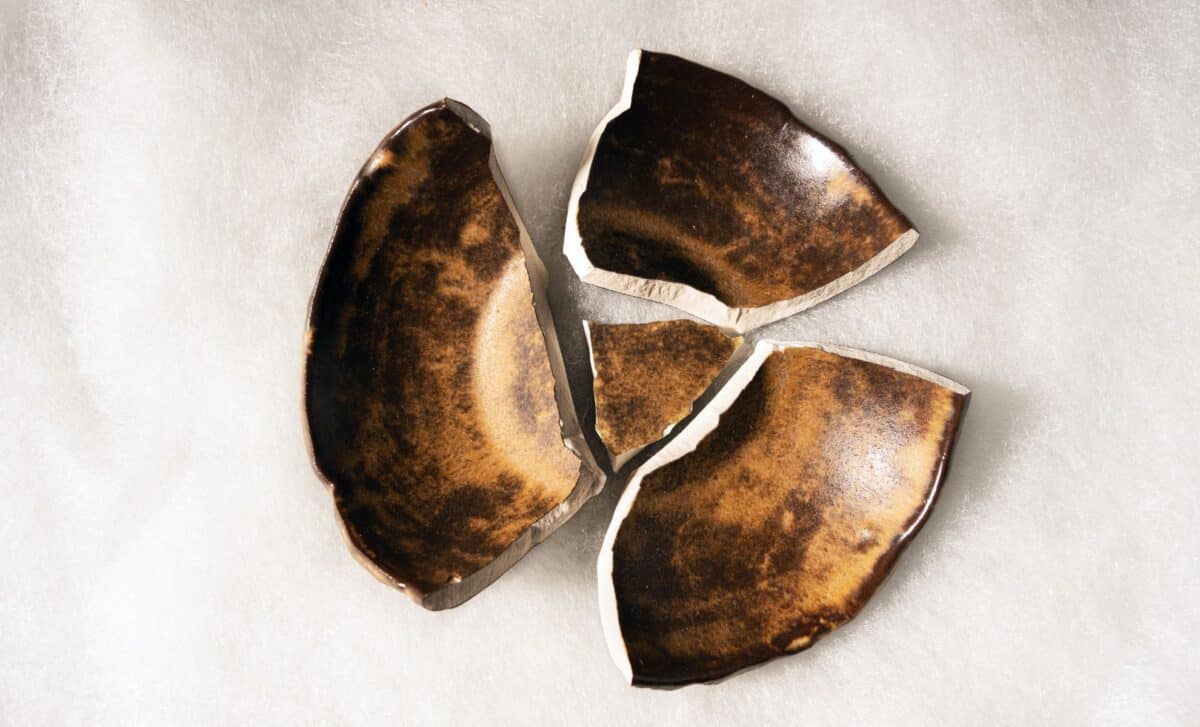
French researchers have developed a ceramic material that is ten times tougher than conventional ceramics by using a process based on water, alumina powder and controlled freezing. Inspired by the structure of nacre found in abalone shells, the material reproduces a natural architecture known for slowing the spread of cracks.
Ceramics are widely used in industry because they are hard, rigid and resistant to heat. Their main weakness has always been brittleness. Once a crack appears, it can travel quickly through the material and cause it to break under stress or impact.
To reduce that fragility, researchers in France engineered a bioinspired material that delivers fracture resistance up to 10 times greater than traditional ceramics.
Researchers Turned To Nacre For A Solution
The project drew inspiration from nacre, the material lining the shells of abalones and other mollusks. Nacre is composed mainly of aragonite, a brittle mineral form of calcium carbonate. Yet despite this composition, it displays strong resistance to fracture.
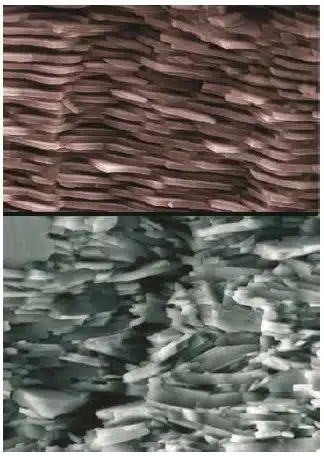 Structure of natural nacre (top) and synthetic nacre (bottom), shown at the same scale. Credit: Sylvain Deville, Florian Bouville, LSFC.
According to a translated press release published by ENS Lyon, the explanation lies in the material’s internal organization. Nacre is built from microscopic mineral layers assembled like bricks and connected by biological matter acting as mortar. When a crack forms, it cannot move in a straight line. Instead, it must weave around each layer, losing energy along the way.
Researchers attempted to recreate this structure using ceramic particles. Rather than changing the material’s chemistry, they focused on organizing its architecture, a choice that ultimately shaped the entire process.
Ice Crystals Organize The Ceramic Particles
The manufacturing process begins with microscopic alumina platelets suspended in water. The suspension is then cooled under carefully controlled conditions to direct the growth of ice crystals.
As reported by the paper, avaliable on Nature Materials, the growing ice crystals push the alumina particles aside, forcing them to align into stacked layers. Once the ice is removed, the remaining porous structure is densified at high temperature to produce a solid ceramic.
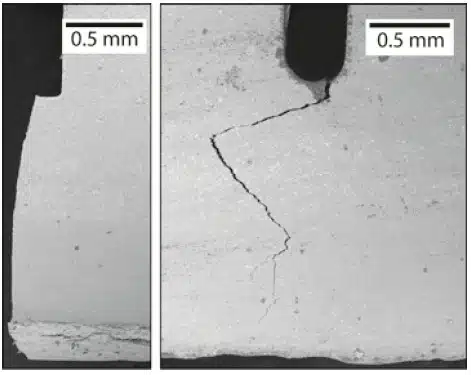 Fracture morphology of a traditional ceramic (left) and synthetic nacre (right). Credit: Florian Bouville, LSFC.
The resulting architecture resembles natural nacre. Cracks moving through the material are repeatedly diverted around the aligned alumina platelets rather than crossing directly through the ceramic.
Researchers reported that this mechanism improves toughness by a factor of 10 compared with conventional ceramics. Fractures are not completely prevented, but their progression becomes far harder to sustain.
Built for Extreme Conditions
The ceramic maintains its properties at temperatures of at least 600 °C, according to the research teams. That temperature range exceeds the limits of many polymer-reinforced systems currently used to improve toughness.
The process could also be adapted to other ceramic powders, provided they are available in platelet form. The National Institute of Applied Sciences of Lyon explained that the manufacturing method is therefore linked to structural organization rather than to alumina alone.
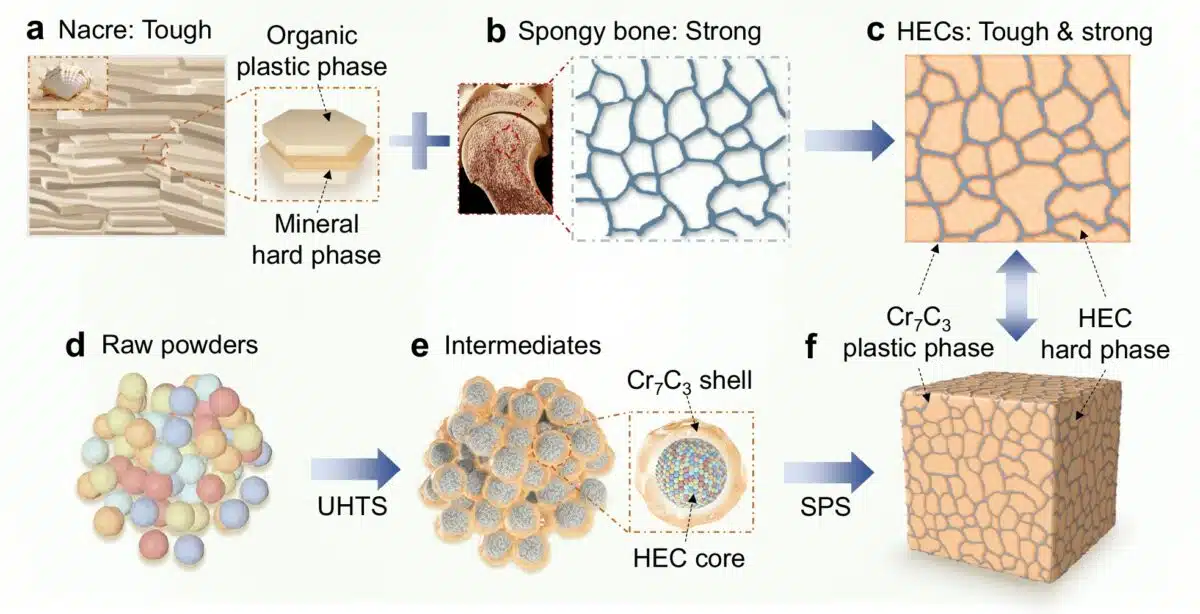 Bio-inspired structure of high-entropy ceramics combining the toughness of nacre with the strength of spongy bone. Credit: Nature Communications
Researchers say the material could eventually be used in industries facing extreme heat and mechanical stress, including aerospace, energy systems, and industrial furnaces. The study also pointed out to possible applications in ballistic protection. Alumina ceramics are already found in some armor plates, and making them tougher without adding extra weight could significantly improve their impact resistance.
The research also stands out for the simplicity of its ingredients. Alumina is one of the most abundant oxides on Earth, and the process relies on relatively simple physical effects involving freezing and particle movement.