

But any such decision and shift in strategy cannot occur in isolation. It will happen within a system that is relatively simple in structure. The international game generates the majority of income. That income depends on a small number of professional players performing in elite environments. Those environments are costly to sustain. And the entire model ultimately relies on grassroots clubs to provide both the player pipeline and the future audience.
In effect, the system is a loop:
Grassroots participation feeds the professional pathwayThe professional game feeds the international teamThe international game generates the incomeThat income is then reinvested back into the system.
The key question is not whether the system is busy, or well-intentioned, but whether it is viable. Specifically: does it return sufficient value to sustain and regenerate the participation base on which it depends?
Any analysis should begin at the bottom of the system because if that loop breaks at the bottom, the rest of the system, no matter how well funded at the top, becomes increasingly difficult to sustain.
Participation and sustainable week-to-week competition
On the surface, the indicators appear positive. The Scottish Rugby Union continues to report increasing registration numbers, with approximately 20,019 adult players recorded in the 2024-25 season. The women’s game is expanding rapidly, youth participation remains strong, and overall engagement with rugby appears healthy.
However, once the lens shifts from registrations to actual match participation, a more complex and concerning picture begins to emerge. The introduction of ‘active players on team-sheets’ as a reporting metric provides a clearer view of the system’s functional capacity. In 2024/25, only 10,741 adult players were recorded as active 8,524 men and 2,217 women). That figure has remained broadly unchanged for three consecutive seasons. In effect, just over half of registered adult players are consistently taking the field.
This gap between participation and capacity is not theoretical, it is visible every weekend across the league structure. Using fixture-level data, covering all adult 1st XV and reserve leagues (excluding cup competitions and youth rugby), the scale of the issue becomes clear. Across the 2025/26 season, there were 176 matches unfulfilled due to insufficient players in the adult game.
That figure is significant in both absolute and structural terms. It represents not isolated disruption, but a systemic issue affecting the integrity of competitions. Spread across the season, it equates to multiple fixtures every weekend being decided not by performance, but by absence. More importantly, it reveals where within the system the pressure is being absorbed.
At the top of the game, the Premiership remains largely insulated. The men’s Premiership recorded a single awarded fixture (when Watsonians couldn’t field a competitive side in the play-off semi-final), while the women’s competition experienced none. Similarly, the National Leagues remain broadly stable. Divisions 1 and 2 saw no non-fulfilments, while Division 3 recorded just one. Only National Division 4 showed signs of strain, with four awarded matches and the withdrawal of Ellon RFC. These tiers continue to benefit from deeper squads, stronger retention, and a concentration of playing resource.
The picture changes markedly as the analysis moves into the regional game. Across the East, West and Caledonian 1st XV leagues, non-fulfilments begin to accumulate and team attrition becomes more visible. In the East, there were 12 matches awarded across the divisions, alongside the disqualification of Royal High RFC and the withdrawal of Inverleith RFC. The West leagues recorded 14 awarded fixtures and the loss of Waysiders/Drumpellier, while the Caledonian structure showed 21 non-fulfilments across its divisions. These leagues are not collapsing, but they are clearly under pressure – operating with reduced margins for error and increasingly reliant on a narrow base of committed players. A question also remains whether the clubs that withdrew from the leagues this year will return next season.
It is in the lower levels, however, that the structural weakness of the system becomes most apparent. Of the 176 non-fulfilled fixtures, 102 occurred in reserve and development leagues, accounting for 58 percent of the total. This is not coincidental. Reserve teams exist at the edge of a club’s playing capacity. When squad depth is insufficient, it is the 2nd XV that fails first.
The data across reserve competitions is stark. The East Regional Reserve League alone recorded 26 awarded fixtures and the withdrawal of Edinburgh Accies 3rd XV. The West Regional Reserve Division 1 saw 21 awarded matches, while Division 2 recorded 10 alongside the withdrawals of Helensburgh RFC 2nd XV and Cumnock RFC 2nd XV. The Inter-City Reserve leagues also showed significant disruption, with 22 combined non-fulfilments. These are not isolated incidents. They represent systemic fragility in the layer of the game responsible for player development, retention and progression.
The women’s game presents a more nuanced picture. At the top level, the Premiership is stable, and growth in participation is clearly visible. There is a widening performance gap amongst the Premiership which is in danger of returning to a two-team race each season, similar to 10 years ago where Hillhead Jordanhill and Murrayfield Wanderers dominated the league.
However, at regional level, structural challenges are beginning to emerge. The Caledonia Midlands/East Division 1 saw three teams withdraw – Corstorphine RFC 2nd XV, Kelso RFC and Strathmore RFC – reducing the league to a minimal competitive base. Lower-tier competitions, such as West Division 3, also experienced withdrawals, including Greenock Wanderers RFC 2nd XV and East Kilbride RFC 2nd XV. Even within a growth environment, the same structural issue is visible: participation is increasing, but consistent team-based capacity remains fragile.
The full extent of this structural picture is summarised below (three fixtures were played as development matches due to lack of front row):
Adult League Structure, Non-Fulfilment and Team Attrition (2025/26)
TierLeagueGames Awarded
(Insufficient Players)Teams Withdrawn / DisqualifiedStructural PositionTier 1Premiership (Men)10Stable Premiership (Women)00StableTier 2National Division 1 (Men)00Stable National Division 2 (Men)00Stable National Division 3 (Men)10Stable National Division 4 (Men)41 (Ellon)StableTier 3East Regional Division 1 (Men)60Under Pressure East Regional Division 2 (Men)31 (Royal High – DQ)Under Pressure East Regional Division 3 (Men)31 (Inverleith – WD)Under Pressure West Regional Division 1 (Men)10Functional West Regional Division 2 (Men)41 (Waysiders/Drumpellier)Functional West Regional Division 3 (Men)90Fragile Caledonian Division 1 (Men)80Fragile Caledonian Midlands Division 2 (Men)50Fragile Caledonia North Division 2 (Men)30Fragile Caledonia Midlands 3 (Men)20Fragile Caledonia North 3 (Men)30Fragile Caledonia/East Division 1 (Women)23Unstable Caledonia North Division 1 (Women)80Functional West Division 1 (Women)50FunctionalTier 4Inter-City Reserve League 1 (Men)140Critical Inter-City Reserve League 2 (Men)80Critical East Regional Reserve League (Men)261Critical West Regional Reserve Division 1 (Men)210Critical West Regional Reserve Division 2 (Men)102Failing Caledonia/East Division 2 (Women)150Fragile Caledonia North Division 2 (Women)20Developing West Division 2 (Women)60FragileTier 5West Division 3 (Women)62Failing
What emerges from this analysis is not a system in collapse, but one that is increasingly uneven. The top of the pyramid remains strong, supported by concentrated resources and stable playing populations. The middle tiers are under pressure, with growing signs of strain in both fulfilment and retention. At the base, particularly in reserve rugby, the system is struggling to function as intended and some strong Premiership/National sides 2nd XV’s have been unsuccessful at fielding sides last season.
The significance of this cannot be overstated. Rugby is not sustained by registrations alone; it is sustained by repeatable, reliable participation in weekly competition. The evidence suggests that while Scottish Rugby and it’s clubs have been successful in broadening engagement, they have been less successful in maintaining the depth required to sustain its competitive structures.
The 176 non-fulfilled fixtures are not just a statistic, they are a symptom. They represent the visible manifestation of a deeper structural issue: a system that is expanding at the top of the funnel, but not converting that growth into durable playing capacity. Until that gap is addressed, the pressures observed in reserve and regional rugby will continue to move upwards through the pyramid.
This is the test of the system’s long-term viability. Not how many players are registered, but how many can take the field-week after week-and sustain the game.
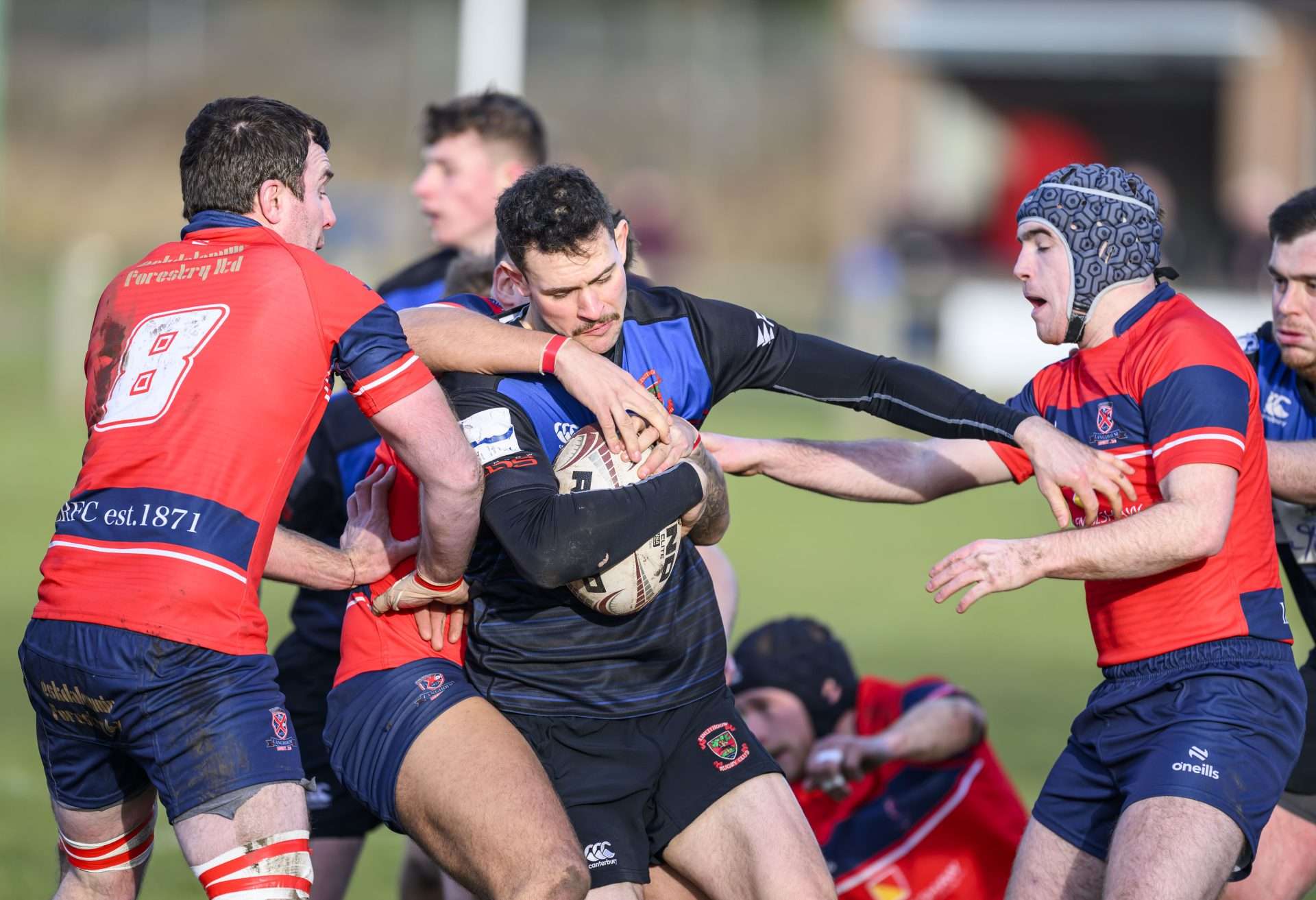
There was 176 non-fulfilled fixtures in adult league rugby in Scotland this season. Image: © Craig Watson – www.craigwatson.co.uk
The system beneath the system
Participation does not exist in isolation. It is created, supported and, crucially, funded. At the centre of that sits Scottish Rugby’s Development Department. This is the layer of the game that connects national strategy to local reality. It is responsible for supporting clubs, delivering school programmes, growing youth and female participation, developing coaches and volunteers, and ensuring that players continue to move through the system. In simple terms, it is the engine room of the sport.
Its impact is everywhere, even if it is not always visible. The growth of girls’ rugby, the emergence of new women’s teams, the expansion of state school rugby and the day-to-day functioning of clubs are all underpinned by development staff working on the ground. The annual report highlights the close collaboration between development teams, clubs and schools, with delivery embedded locally across the country .
In 2024-25, Scottish Rugby reported a headline club rugby investment of £9.43 million, a figure that at first glance suggests a significant increase in support for the grassroots game. However, the composition of that total tells a more nuanced story with £4.38m allocated to domestic rugby through centrally delivered Rugby Development activity, while £5.05m is distributed as direct funding to clubs and schools . This means that, in real terms, the direct financial support reaching clubs has only marginally increased from the £4.9m reported in 2023-24 .
The apparent growth in overall investment is therefore largely driven by internal programme spend rather than a meaningful uplift in cash flowing into the club game itself. Against a backdrop of rising operating costs for clubs – energy, facilities, staffing and equipment – this distinction is critical, as it points not to expansion, but to a system where the financial burden at grassroots level continues to intensify despite higher headline investment figures. However, the more revealing story sits beneath those headline numbers.
One of the clearest examples is the Rugby Development Officer (RDO) network. These roles are fundamental to the delivery of the game. They are the people running school sessions, supporting volunteers, building club capacity and driving participation growth. Without them, much of the activity that underpins the sport simply does not happen.
Yet the funding model that supports these roles has remained largely unchanged for over a decade. Scottish Rugby’s contribution has been capped at around £10,000 per role for many years. When that figure was first introduced, it represented something close to a shared investment model between the governing body, clubs and local authorities.
Since then, the financial landscape has shifted significantly. Salaries have risen, the cost of living has increased, and clubs are dealing with higher costs across facilities, energy, equipment and general operations. The central contribution, however, has remained static.
The consequence is a gradual but meaningful shift in where the burden sits. The real-term value of that £10,000 has declined year-on-year, with clubs and local partners absorbing the difference. What was once a balanced partnership has become increasingly reliant on local funding. In effect, clubs are now contributing more to deliver the very development work designed to support them.
This pressure does not sit in isolation. It feeds into the broader structure of how the game is supported regionally. The current regional management system is already stretched, with relatively few Regional Managers responsible for large geographic areas and a wide range of clubs, schools and programmes. That inevitably limits the level of contact, support and strategic alignment that can be delivered consistently across the country.
An increase in investment would not simply mean more money in the system; it would change how the system functions. Additional funding would allow for an expansion of the regional management structure, creating more Regional Manager roles with smaller areas of responsibility. That, in turn, would allow for closer relationships with clubs, more consistent engagement, and a better understanding of local challenges and opportunities.
The knock-on effect would be felt directly at delivery level. With stronger regional oversight and support, Development Officers would be better supported, better aligned and more effective in their roles. Rather than operating within a stretched structure, the system would become more connected, more responsive and ultimately more capable of delivering sustained growth.
This is where the conversation shifts from cost to capability. The current model is not simply under financial pressure; it is constrained in what it can realistically deliver. The ambition to grow participation, expand the women’s game and strengthen pathways remains clear, but the structure supporting that ambition is operating close to its limits.
When viewed alongside the participation challenges outlined above, this becomes increasingly significant. Fixture cancellations, team withdrawals and fragility in parts of the adult game are not just symptoms of player numbers; they are also indicators of system capacity. If the development structure is stretched, its ability to respond to those challenges is reduced.
None of this suggests that the Rugby Development department is not delivering value. In many respects it is achieving a great deal within its current constraints. But it does highlight a growing gap between what is being asked of the system and the resources available to deliver it.
That leads to a more fundamental question. Not just how much is being invested, but how that investment is structured and whether it is sufficient to support the long-term sustainability of the game.
Because if the goal is to strengthen the base of Scottish Rugby, then the system responsible for building that base cannot continue to absorb increasing pressure without consequence. This can also be said for club volunteers who are increasingly taking on extra work and demands.
There is a finite amount of money available, so what is prioritised and who misses out?
Two things have become clear. The first is that there are visible structural pressures within the system, namely participation challenges, club strain and fragility in parts of the adult game. The second is that, while the financial position is stable, it is also tightly constrained.
The current professional model built around Glasgow Warriors and Edinburgh Rugby was not designed in a period of growth. It was a response to overreach. Reducing from four professional teams to two brought financial control, improved competitiveness, and alignment with the national side. In many ways, it saved the professional game in Scotland.
However, this model now creates limits. The professional game remains structurally loss-making, requiring significant subsidy each year, while the wider system relies heavily on the surplus generated by the international game. There is no meaningful surplus sitting idle. Every new initiative must come from the same finite pool of money.
That shifts the debate. This is no longer about what Scottish rugby could do next. It is about what it can afford to prioritise without undermining what already works. Where is the value placed?
1. Create a third professional men’s team?
The idea of a third professional team continues to hold appeal. It suggests expansion, a wider geographical footprint, and more opportunities for players progressing through the system. In theory, it addresses the perception that the male pathway is too narrow.
In practice, however, the financial reality is difficult to ignore. The current two-team structure already requires substantial annual subsidy. Adding a third team does not just increase opportunity, it increases cost at a level the system has historically struggled to sustain. Scotland has already experienced the consequences of over-expansion, and the move from four teams to two was not strategic ambition, it was financial necessity.
Beyond cost, there is a more fundamental issue. A third team does not address the pressures identified above. It does not increase participation, it does not reduce fixture cancellations, and it does not ease the financial burden on clubs. Instead, it risks spreading limited playing resources more thinly while adding further strain to the system. There is no clear fan base awaiting a team arriving in their area that would show enough return financially to justify a third pro team.
The attraction is clear, but the alignment with the underlying problems is not.
2. Invest in Scottish PWR team(s)?
The women’s game presents a different kind of opportunity. Unlike parts of the men’s club system, it is still in a growth phase with increasing participation, visibility, and engagement.
Investment in a Scottish presence within Premiership Women’s Rugby (PWR), or an equivalent elite structure, would strengthen the top end of the pathway. It would provide clearer progression routes, help retain talent, and raise the profile of the women’s game domestically.
However, this is still primarily a high-performance intervention. It operates at the top of the system rather than the base. Without strong alignment to grassroots and domestic leagues, there is a risk that it becomes disconnected from the wider participation landscape.
The strategic context has now shifted. With Scottish Rugby having now formally confirmed its own intention to enter a team into the PWR, this is no longer a theoretical option.
That changes the nature of the decision. The question is no longer if investment is required, but how much and from where. At an estimated minimum of around £1.2m per team, this becomes a significant and ongoing allocation within an already constrained system. With the majority of the starting national side plying their trade in the PWR, there may also be a danger of Scottish Rugby paying significantly more for what they already have. It would seem a strange decision to invest that amount of money into a programme without it’s biggest players who are already signed to PWR Clubs. However, reducing to one team from the current Celtic Challenge model reduces the wider exposure of top end players.
This may ultimately become one of the defining financial decisions of the next cycle – not because of its risk, but because of its inevitability.
3. Invest more into Rugby Development?
If the core issues sit at the base of the system, then investment in Rugby Development is the most direct response.
This area underpins everything else. It supports schools rugby, club infrastructure, coaching capacity, and the recruitment and retention of players and volunteers. The challenges identified earlier – non-fulfilments, team withdrawals and financial strain – are all symptoms of pressure at this level.
Increased investment here would not deliver immediate visibility or short-term performance gains. What it would do is stabilise participation, strengthen the pipeline, and reduce the fragility currently visible in parts of the adult game. Over time, it would improve the health of the entire system.
The difficulty is that this kind of investment is inherently long-term. It requires patience, and its impact is often less visible than success at the elite level. But if the test is long-term viability, this is the area most closely aligned with meeting it.
4. Adopt an Argentinian-style model?
This would be a rather radical approach in the men’s game. Rather than expanding the current structure, another option is to rethink it entirely.
Argentina has historically operated a model that does not rely on a large domestic professional footprint. Instead, it focuses on centralised development while allowing players to gain professional experience in overseas leagues. Investment is concentrated on pathways and the national team rather than sustaining multiple professional clubs.
There are already elements of this approach within Scottish rugby, particularly in the women’s game. Expanding it further could reduce the financial burden associated with additional professional teams while giving players access to higher levels of competition abroad.
However, this is not simply a financial decision, it is a structural one. It would mean less control over player development environments, reduced domestic visibility of elite players, and a shift away from the traditional model of professional club identity within Scotland – something that Edinburgh and Glasgow Warriros supporters would reasonably resist.
It is a more efficient model in financial terms, but also a more disruptive one in cultural and strategic terms.
5. Increase investment in Glasgow Warriors?
Another approach, that has had some airing within Scottish rugby journalistic circles, is not to expand, but to concentrate.
Glasgow Warriors have consistently delivered strong on-pitch performance in recent times, and have built a credible, competitive environment. Increasing investment here would be a way of backing a proven asset-maximising return at the elite end of the game.
This could drive higher attendances (if suitable stadium alternations allow), stronger commercial performance, and continued success in professional competitions. It would also reinforce a high-performance environment that benefits national team development.
But this is, by definition, a top-of-pyramid strategy. It does not address participation challenges, club sustainability or structural fragility elsewhere in the system. Instead, it concentrates resources in an area that is already functioning relatively well.
The question is whether that strengthens the system overall or simply amplifies success in one part of it?

Should Glasgow Warriors be rewarded for sustained success over a number of years with even more investment? Image: © Craig Watson – www.craigwatson.co.uk
6. The Carruthers Alternative: private investment as a third-team solution?
If a fully union-funded third team is not viable, the alternative is to revisit the idea of external investment.
This has been attempted before, most notably when Edinburgh Rugby was placed under private ownership in the mid-2000s as part of an effort to reduce the financial burden on the union. The outcome is well understood. The model did not hold, and the team returned to central control.
The reasons are instructive. The financial gap between revenue and cost was too large for private ownership to absorb sustainably. The commercial market was not strong enough to support independence. And, critically, the alignment between the needs of the union and the incentives of private investors was never fully resolved.
That experience reinforced the idea that Scottish rugby is not just centrally run, but centrally funded.
However, the broader concept should not be dismissed entirely. A different structure – partial investment, hybrid models or regional partnerships – could, in theory, reduce the financial barrier to expansion without repeating the same mistakes. It would not eliminate risk, but it might redistribute it.
In that sense, the Carruthers experiment does not close the door on external investment, it reframes the conditions under which it might work. The question would be whether the URC is able to draw similar types of investments that the PREM Clubs are now drawing in in England.
Final framing: What is the system trying to optimise?OptionFocusTime HorizonRisk3rd Pro TeamExpansion & visibilityShort–mediumHighPWR InvestmentWomen’s high performanceMediumModerateRugby DevelopmentParticipation baseLong-termLowArgentinian ModelEfficiency & performanceMedium–longHigh (structural)Glasgow InvestmentElite successShort–mediumSystem imbalancePrivate Investment ModelExpansion via external capitalMediumExecution risk
Closing reflection: The Real Question
Where you think money should be invested is really only part of the question. One rugby podcast host recently stated on their Instagram feed:
“Our governing body needs to find money from somewhere to put in place a proper structured youth set up which involves our state schools, properly funded.”
It’s an admirable position and one that reflects a widely held view about where the game should be heading.
But the financial reality is already clear.
There is a finite amount of money available.
And now, with Scottish Rugby having looking at entering a team into the PWR, part of that allocation is already beginning to take shape.
If more goes into the women’s professional game, something else receives less. If the professional game expands or strengthens, that investment comes from somewhere. If resources are concentrated at the top, they are not being spent at the base, and with a £1.6m gap created by the lack of Cashback funding the pressures are likely to be even more evident in the Community Game.
As Michael Fealey, the respected sports systems specialist, outlines here, the opportunity is not simply to invest more, but to ensure the system becomes self-reinforcing, where value created at the top translates consistently into growth at the base-
“Scottish Rugby presents as a system with a number of encouraging structural signals – there is visible and increasing investment into clubs, schools and the women’s game, participation indicators are moving in the right direction, and the governance model provides a credible platform for long-term alignment. The commercial engine is also functioning, which is critical. The key consideration is less about intent or activity and more about how these elements are structurally connected: at present, the link between top-layer value generation and sustained base-layer expansion is not yet fully embedded. The opportunity, therefore, is to strengthen that connection – locking in more consistent return mechanisms, ensuring proportional balance between elite and community investment, and converting participation growth into a more explicit economic loop – so that the positive signals already present translate into a fully self-reinforcing system over time.”
Every decision carries an opportunity cost. Every priority creates an omission.
So the final question is this:
Where do you believe the money should be invested, and just as importantly, who or what should miss out as a result?
Keen to hear readers thoughts….