
Large, thick-shelled snails had armor to protect them from predatory crabs onshore; smaller snails could more easily cling to wave-battered rocks. With the help of her then-3-year-old daughter, Johannesson collected hundreds of large snails and placed them on empty rocks exposed to the sea. As the years turned into decades, and as generations of snails came and went, the entire population became smaller, with thinner shells. In less than 30 years, the wave-battered ecotype had been selected for across the population.
A few years later, she would uncover the genomic features that made the snails’ rapid adaptation possible.
Shuffling Chromosomes
A given ecotype might require the expression of hundreds of genes. So how can selection act on all of them at once? Genomic studies have found explanations in chromosomal architecture.
During egg and sperm formation, genes can be shuffled between chromosomes (highly compact packages of DNA) in a process known as recombination. Some portions of DNA can be deleted or inserted. Chromosomes can break into two, or fuse into one. And entire segments of DNA can be flipped, in what is called an inversion.


Mark Belan/Quanta Magazine
An inversion happens when a portion of DNA from the chromosome breaks off, rotates 180 degrees, and plugs back into the chromosome in the reverse orientation. After inversion, a block of genes sits in one orientation on one chromosome, and in the opposite orientation on the other. This effectively prevents recombination from happening again in that region, and locks that group of genes together in a block. If those genes are somehow related, this can create a supergene, or multiple genes that act as a single unit. The snail traits for thick shells and evasive behavior to hide from crabs, for instance, become linked so that they will be inherited together in subsequent generations.
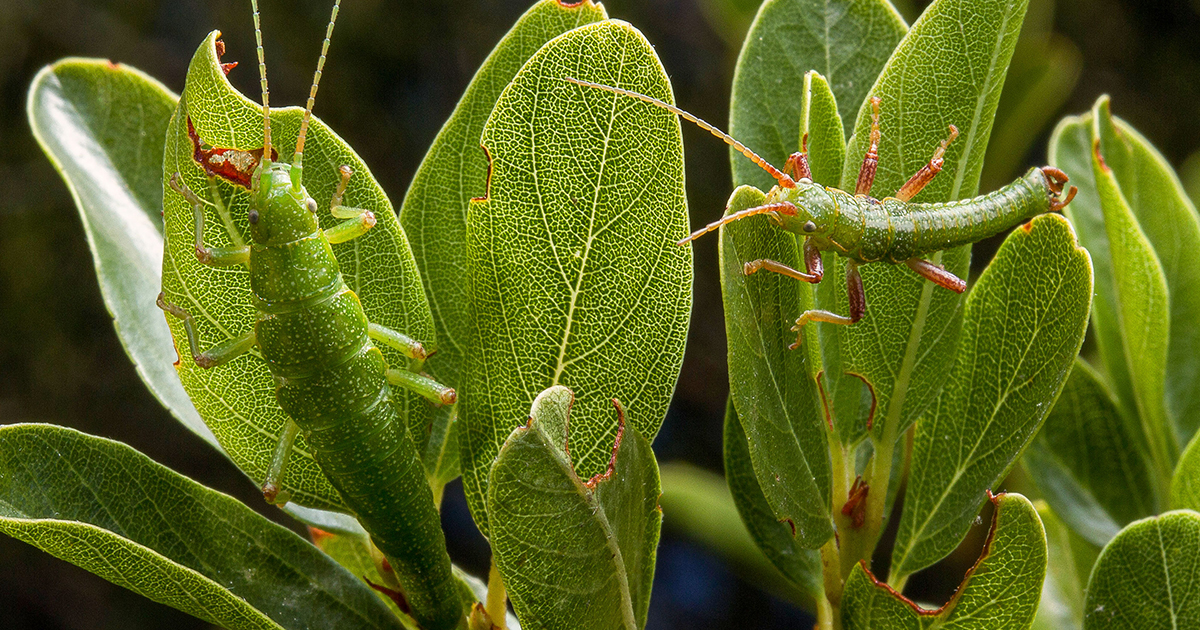
“It’s like if you had a deck of cards,” said Patrik Nosil, an evolutionary geneticist at the French National Center for Scientific Research who studies speciation and ecotypes of stick insects. “With normal genetics, you shuffle that deck completely — all 52 cards. Whereas with these chromosomal inversions, you have a part of the deck that refuses to shuffle, so you can never change the order of the cards in there. That’s the part that controls the traits that make the ecotypes different.”
This is what Peichel suspects happened in the sticklebacks. Even though they still mate across ecotypes (marine sticklebacks return to freshwater inlets to breed), past inversions ensure that the freshwater genes stay together and that the marine genes do too, she said. This differentiates the two ecotypes while maintaining species-wide gene flow.
It’s by far the most exciting time to be a biologist, ever.
Sean Stantowski, University College London
Peichel’s lab is getting closer to confirming this hypothesis. Using the gene-editing technology CRISPR, her lab can flip an inversion back to its original orientation. As these sticklebacks reproduce, the genes in this region will be able to shuffle again, perhaps disrupting the suite of traits that form the ecotypes. “This would be some of the first proof of this idea that inversions actually bring together, and hold together, adaptive [genes] that distinguish ecotypes,” Peichel said.
Inversions aren’t always beneficial. They come with risks, including reproductive failure. For example, thousands of inversions have been identified in the human genome, and some can cause pregnancies to fail. But when they successfully hold groups of traits together, the rewards can be high. Indeed, Johannesson and Stankowski’s review surfaced inversions associated with ecotypes across the tree of life, including in plants, birds, fish, mammals, marine invertebrates, and insects.
“No one predicted that [inversions] would be as abundant as they are” in ecotypes, Stankowski said. “In evolutionary genetics, it’s probably one of the biggest realizations of the last two decades.”
And some ecotypes contain many chromosomal inversions. By the mid-2010s, Johannesson and her colleagues had identified nearly 20 different ecotype-related inversions in the marine snail genome. Interestingly, these same groups of traits are found across populations — in Spain and the United Kingdom as well as Sweden — even though these populations are isolated and don’t interbreed. Further analysis showed that some of these inversions are millions of years old, likely having occurred in a common ancestor.