
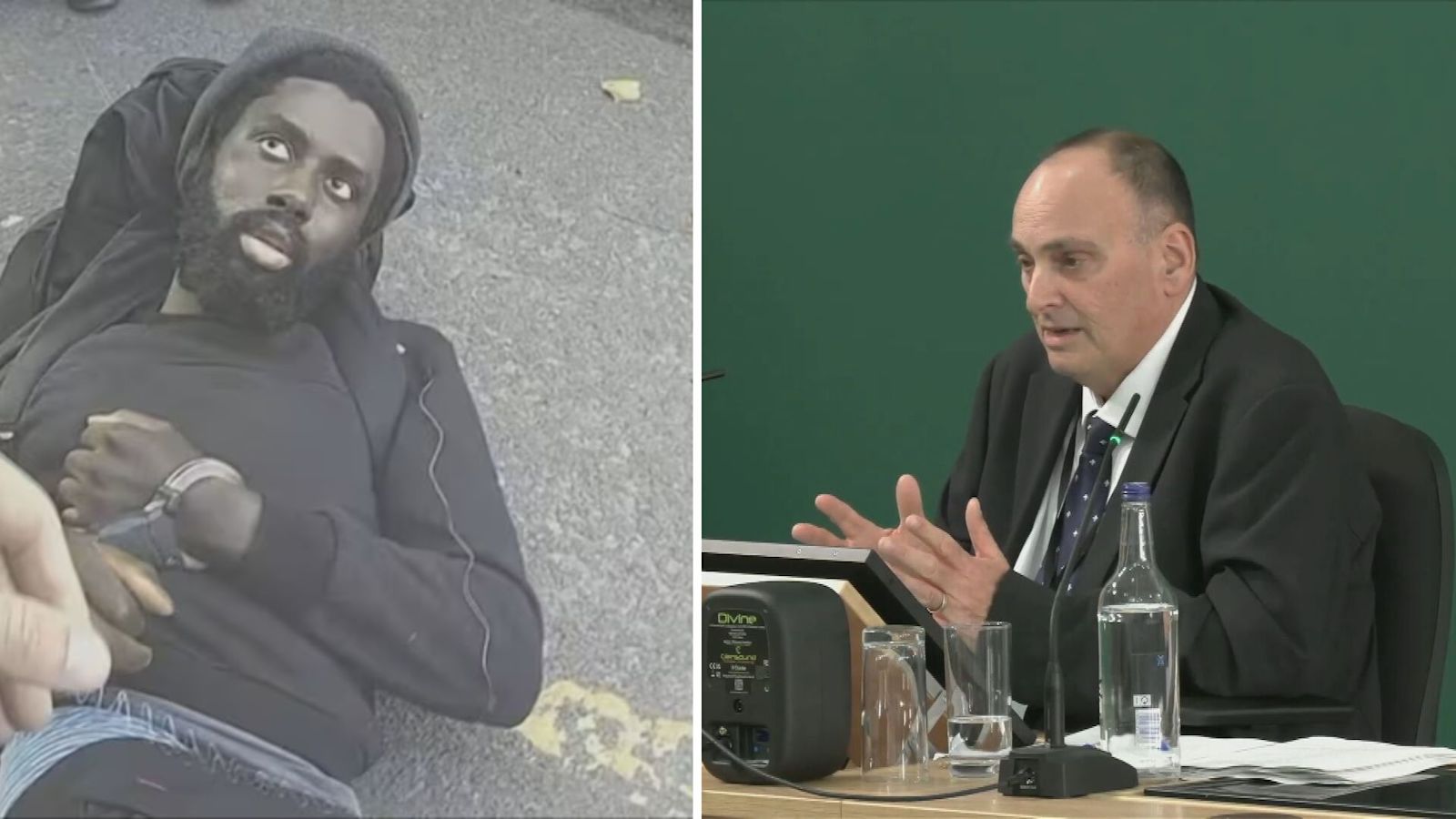
The Nottingham Inquiry has today heard from the chief executive of the NHS trust that treated Valdo Calocane that there were clear issues around risk assessment, years before the attack.
Calocane was in the care of the trust two years before he went on to kill three people, and injure three others in the city in 2023.
Head of Psychiatric Services for Nottinghamshire Healthcare NHS Foundation Trust Ifti Majid was head of mental health services when the attacks happened, but he had only been in place for six months at the time.
He was asked by Rachel Langdale KC about the risks surrounding Calocane: “Staff were doing visits in any case in a combination for their own safety. Before then had you heard of that in any other case?”
He replied: “Not as I recall specifically but it’s not uncommon practice.”
Majid was then asked “Would you have seen that as a risk to other members of the public as well as care professionals if you deemed it necessary for two people to visit VC at that point?”
He responded that “I would expect as part of the explanation of that action that risk of violence or whatever it was would extend beyond just staff.”
University of Nottingham students Grace O’Malley-Kumar and Barnaby Webber died in the attack, along with 65-year-old school caretaker Ian Coates.
Caretaker Ian Coates and students Barnaby Webber and Grace O’Malley Kumar were all killed in the Nottingham attacks. Credit: PA Images
“Fed up” with needing to do the inquiry
Mr Majid also defended an email he sent to staff in which he said he was “fed up” as he prepared for the Nottingham Inquiry.
He was was asked to explain what he meant in an email to around 11,000 staff sent in October last year which read:
“Along with many colleagues in our trust I now have to respond to a very detailed Nottingham Inquiry rule 9 (set of legal questions) within a set timescale and I am so sorry, but this means that many of the sessions I have had planned to come out to teams and services need to be postponed.
“I am fed up with needing to do this, but I am afraid needs must.”
Mr Majid said he wanted to make it “absolutely clear” that he recognised the importance of the inquiry process, which is examining events leading up to the killings.
He said: “When I am talking about being fed up, I am talking about being fed up with letting colleagues down by needing to cancel clinical visits.
“The reason for that is that clinical visits are a really important way of engagement and escalation.
“I want to make it absolutely clear that in no way am I talking about being fed up with the inquiry and recognise the importance of the inquiry, but also… I recognise how hard colleagues work to meet the needs of the inquiry and I think it is important I recognise them for doing that.”
Mr Majid is due to retire in June.
John Brewin is Head of Psychiatric Services forNottinghamshire Healthcare NHS Foundation Trust Credit: The Nottingham Inquiry
“There was clearly an issue with risk assessments”
Mr. Majid’s predecessor, Dr. John Brewin, also gave evidence at the inquiry.
He was in charge of mental health services at the trust while they were caring for Calocane, and admitted today that he thought the team took ‘insufficient steps’ when asked about managing risk.
Questioned by Inquiry Counsel Craig Carr, Dr. Brewin was asked about CQC (Care Quality Commission) report from 2019, around the start of the period of his leadership. It found risk management at the trust was ‘inadequate’.
He said “I was somewhat surprised at the level of concern the CQC had found, and that’s not a good position to be in. You like to think that you know where things are, but this was clearly a signal early in my tenure that this was not the case.”
Asked about a further CQC report from 2020 found that risk management at the trust was still ‘inadequate’, Dr. Brewin said the context of the ‘huge change’ brought by the covid pandemic at the time was an important to keep in mind.
“There were some positive statements about the staffing on the ward being adequate, the environments were clean and well-kept.
“There was a sense that despite everything the pandemic had thrown at us we were starting to lay the foundation for changes. There was certainly no sense of complacency.
“The improvement plan I was trying to roll out would take a minimum of three or four years.”
Mr Carr then referred to a 2022 CQC report which had concerns about risk assessments asking “Is that something which is effected by covid, having risk assessments which were not complete, or comprehensive, isn’t the issue a more fundamental one?”
Dr. Brewin responded: “I’m not suggesting that covid was the only reason for this. There was clearly an issue with full risk assessments, and doing full risk assessments to the standard of national guidance yes.”
He was also asked about the trusts relationship with the police in relation to a previous incident in 2020 when Calocane had tried to kicked a woman’s door, scaring her into jumping out of a window.
Dr. Brewin accepted that there had been a ‘failure to report a serious incident’ at the time, and asked if this ‘reflected poor oversight at the executive level or by the serious incident group’ he admitted ‘it would suggest that yes.’
His successor Mr Majid said that he didn’t believe the trust has been in contact with her to offer an apology yet, but said “it’s something that we need to look to do.”
“Threatened with closure”
The inquiry was shown an email Mr Brewin had sent on October 29 2021 following a meeting with three ward managers at Highbury Hospital in Nottingham, where Calocane was detained under mental health laws on four occasions between 2020 and 2022, in which he feared the hospital could be threatened with closure if improvements were not made.
His email said he had “had a very sobering and at times harrowing conversation about their concerns”, adding: “They were professional, committed and passionate about doing the right thing… we have reached a point where the services are not safe and we need an immediate response to help support them.
“There is a sense of despondency that despite flagging this since at least June, nothing has happened.
“And that if CQC arrived, we would be threatened with closure.”
Asked by counsel to the enquiry Craig Carr what the basis of the managers’ concerns were, Mr Brewin said: “The general thrust of their concern and this call to arms was related to staffing and having adequately qualified and experienced senior staff on the wards, that the more senior staff on the wards were compromised in their ability to spend time on the ward due to other tasks they had.”
He also said there were concerns about an “overemphasis” on the use of agency staff and a “sense of exhaustion” at having to work in this way with an inpatient population of patients who were “probably more unwell than prior to the pandemic due to perhaps delays in getting access to treatment”.
The inquiry continues.
Reporting History sees journalists join News At Ten anchor Tom Bradby to revisit their remarkable on-the-day reports of the defining events of the modern age. Listen to the episodes below…