
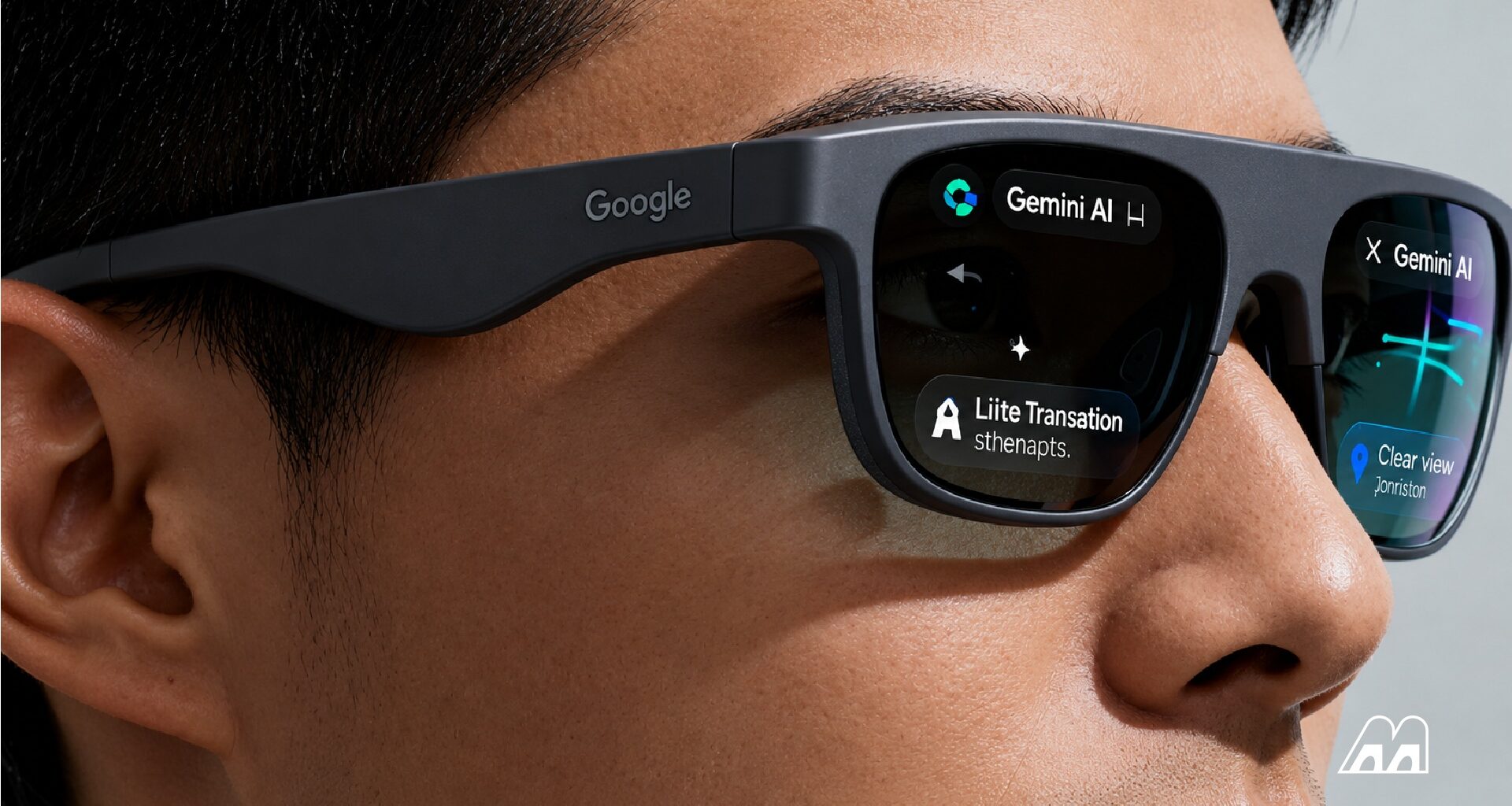
Google has officially entered the AI smart glasses race. At its annual Google I/O 2026 developer conference on May 19, the company pulled back the curtain on its first consumer “intelligent eyewear,” a new category of AI-powered audio glasses built in partnership with Samsung, Warby Parker, and Gentle Monster.
The glasses run on Android XR, Google’s operating system for extended reality devices, and are deeply integrated with Gemini AI. They feature built-in cameras, speakers, and microphones, but notably skip an in-lens display for now. Google says the audio-first design is intentional, delivering information through audio rather than visual overlays.
A fall 2026 launch is confirmed, though Google has not yet revealed specific pricing or exact release dates.
What Google’s AI Smart Glasses Can Actually Do
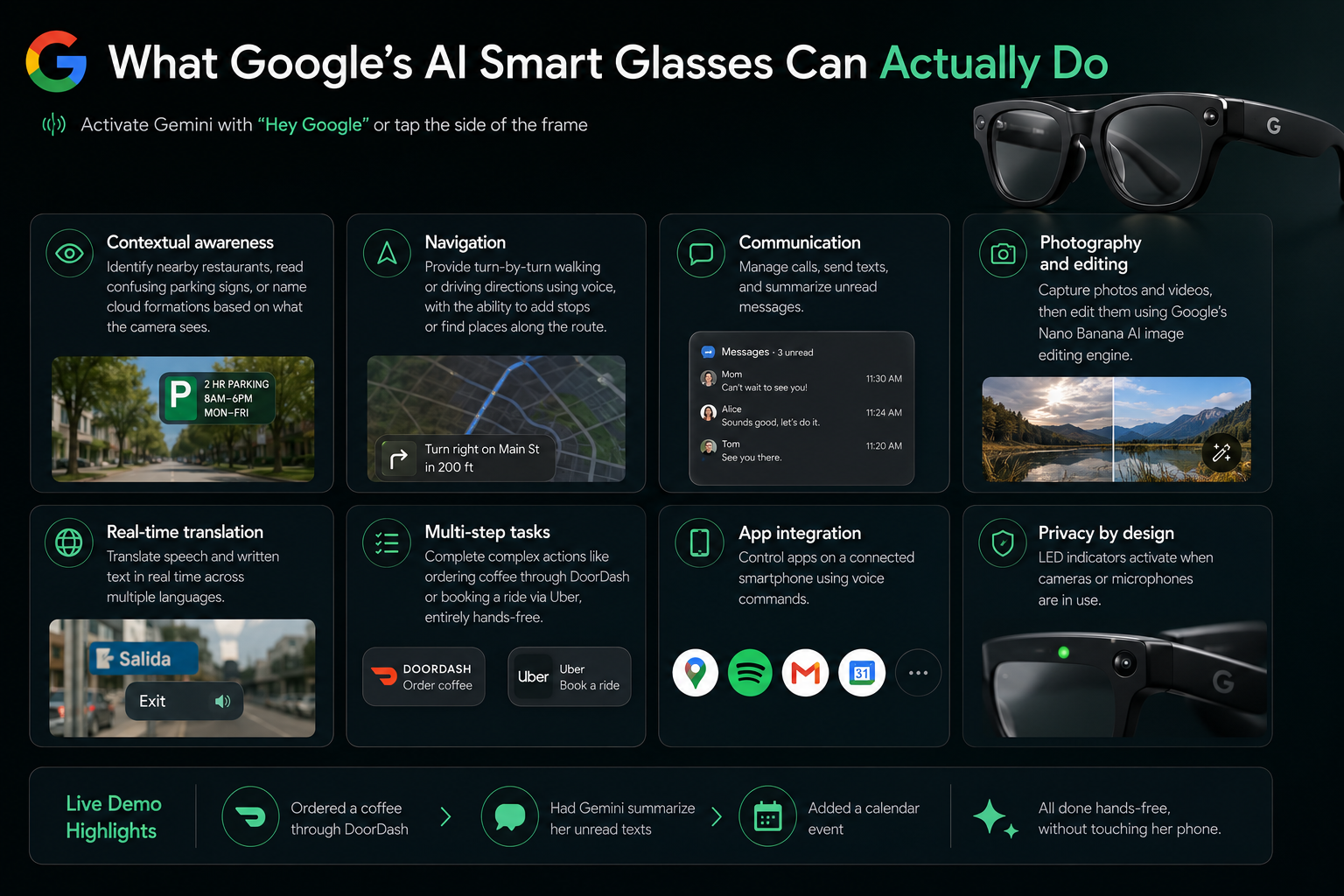
During the Google I/O keynote, Google Product Manager Nishtha Bhatia gave a live demo of the glasses, showcasing a range of Gemini-powered capabilities. Users can activate Gemini by saying “Hey Google” or tapping the side of the frame, and the AI assistant can handle a wide range of tasks:
Contextual awareness: Identify nearby restaurants, read confusing parking signs, or name cloud formations based on what the camera sees.Navigation: Provide turn-by-turn walking or driving directions using voice, with the ability to add stops or find places along the route.Communication: Manage calls, send texts, and summarize unread messages.Photography and editing: Capture photos and videos, then edit them using Google’s Nano Banana AI image editing engine.Real-time translation: Translate speech and written text in real time across multiple languages.Multi-step tasks: Complete complex actions like ordering coffee through DoorDash or booking a ride via Uber, entirely hands-free.App integration: Control apps on a connected smartphone using voice commands.
This also extends Google’s broader Gemini Intelligence push across Android, where AI is becoming more deeply embedded into everyday device interactions.
In the demo, Bhatia ordered a coffee through DoorDash, had Gemini summarize her unread texts, and added a calendar event, all without touching her phone. According to CNBC, Google did not discuss privacy terms related to the forthcoming glasses during the event, though the devices will include LED indicators that activate when cameras or microphones are in use.
iPhone Support Is a Strategic Power Move
One of the biggest surprises from the announcement is that Google’s smart glasses will support iPhones in addition to Android devices. This cross-platform compatibility is a significant strategic decision, considering that iPhone users represent a massive chunk of the wearable technology market in key regions like the United States, the United Kingdom, and Australia.
This move essentially means Google is choosing market reach over ecosystem lock-in. Meta’s Ray-Ban smart glasses already work with both iOS and Android, so Google needed to match that flexibility to compete effectively. But there is a deeper play here: by supporting iPhone from day one, Google is signaling that the smart glasses market is still too small for ecosystem wars, and the real battle is about capturing users from Meta’s dominant position.
Apple is reportedly working on its own AI smart glasses with similar capabilities, but according to Bloomberg, those are not expected until 2027 at the earliest. This gives Google a potential 12-month head start to win over iPhone users before Apple enters the space.
Hardware Partners: Warby Parker, Gentle Monster, and Beyond
Google is taking a fundamentally different approach to hardware design compared to its ill-fated Google Glass experiment from 2013. Instead of building everything in-house, the company is partnering with established eyewear brands to ensure the glasses actually look like something people would want to wear.
The two launch partners are:
Warby Parker: Known for affordable, prescription-friendly frames popular in the United States. Warby Parker’s version features a light, flexible, dark green nylon frame available as both sunglasses and regular glasses. According to Fast Company, Google committed up to $150 million as part of the Warby Parker partnership.Gentle Monster: A South Korean luxury eyewear brand known for fashion-forward, oversized designs. Google invested $100 million for a 4% stake in the company in June 2025.
Google has confirmed that both partners will offer “full collections” at launch, with additional frame styles beyond what was previewed at I/O.
Looking further ahead, Gucci is also joining the Android XR ecosystem. Kering CEO Luca de Meo confirmed a Gucci and Google collaboration in April 2026, with a luxury AI glasses launch planned for 2027. This three-tier brand strategy (affordable, fashion-forward, and luxury) shows Google’s intent to cover multiple market segments rather than relying on a single design.
Samsung plays a critical role as the hardware engineering partner, bringing its expertise in miniaturized electronics, battery technology, and manufacturing scale. Qualcomm provides the processing backbone, with its Snapdragon chips likely powering the compute-heavy AI tasks.
Google Smart Glasses vs. Meta Ray-Ban: How They Compare
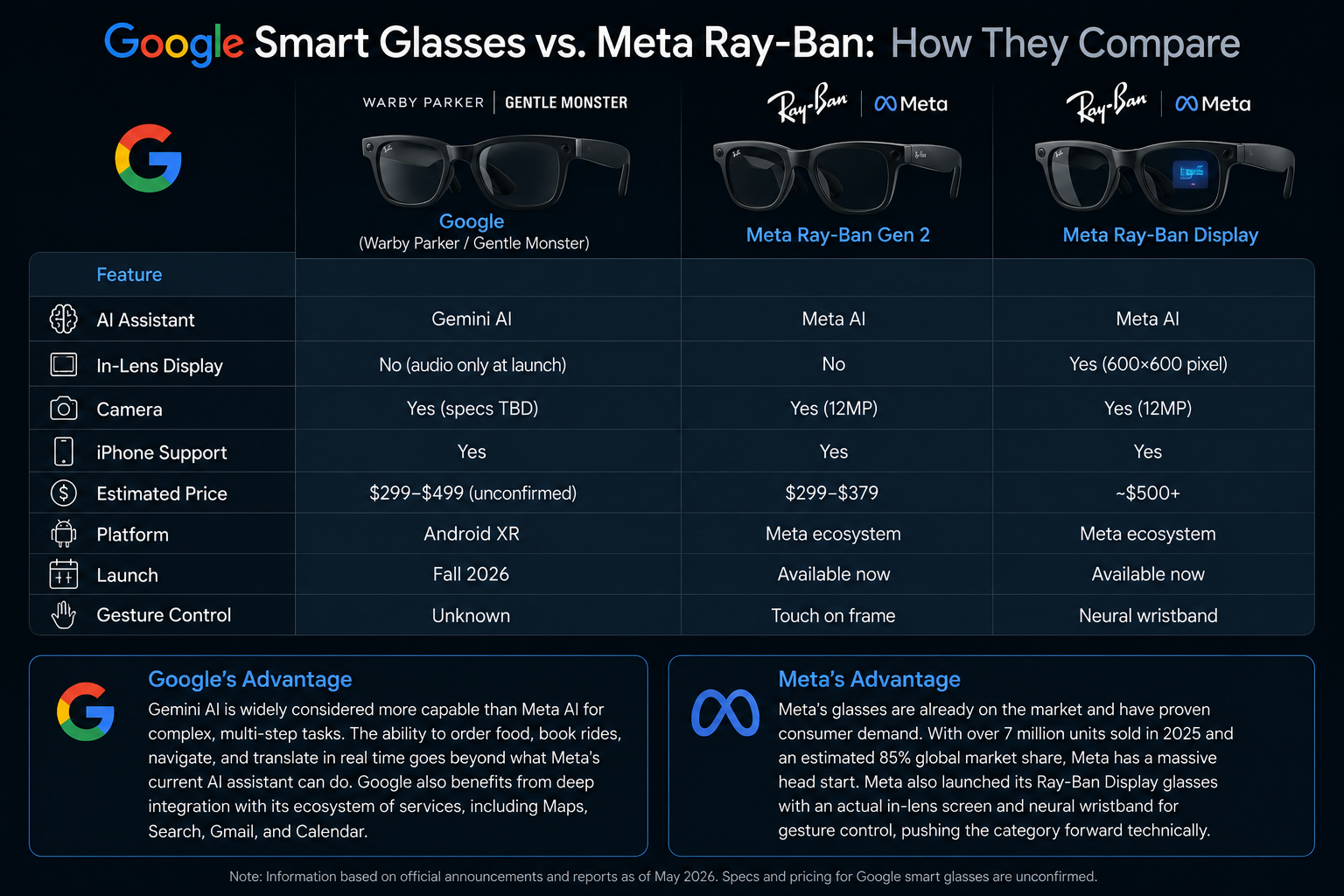
The biggest question on everyone’s mind is how Google’s offering stacks up against Meta’s Ray-Ban smart glasses, which have effectively owned the market since their 2023 launch. Here is a side-by-side comparison based on what we know so far:
FeatureGoogle (Warby Parker / Gentle Monster)Meta Ray-Ban Gen 2Meta Ray-Ban DisplayAI AssistantGemini AIMeta AIMeta AIIn-Lens DisplayNo (audio only at launch)NoYes (600×600 pixel)CameraYes (specs TBD)Yes (12MP)Yes (12MP)iPhone SupportYesYesYesEstimated Price$299–$499 (unconfirmed)$299–$379~$500+PlatformAndroid XRMeta ecosystemMeta ecosystemLaunchFall 2026Available nowAvailable nowGesture ControlUnknownTouch on frameNeural wristband
Meta’s earlier Ray-Ban Stories glasses already showed how camera-enabled eyewear could bring hands-free photo capture into everyday use.
Google’s primary advantage is Gemini AI, which is widely considered more capable than Meta AI for complex, multi-step tasks. The ability to order food, book rides, navigate, and translate in real time goes beyond what Meta’s current AI assistant can do. Google also benefits from deep integration with its ecosystem of services, including Maps, Search, Gmail, and Calendar.
Meta’s advantage is that its glasses are already on the market and have proven consumer demand. With over 7 million units sold in 2025 and an estimated 85% global market share, Meta has a massive head start. Meta also launched its Ray-Ban Display glasses with an actual in-lens screen and neural wristband for gesture control, pushing the category forward technically.
The AI Smart Glasses Market Is Exploding
Google’s entrance comes at a perfect time. The AI smart glasses market is experiencing unprecedented growth, and 2026 is shaping up to be the year the category goes mainstream.
Key market data points paint a compelling picture:
According to Smart Analytics Global (SAG), global AI smart glasses revenue is projected to quadruple in 2026, with sales volume rising from 6 million units in 2025 to 20 million units in 2026, while market value expands from $1.2 billion to $5.6 billion.Meta sold over 7 million Ray-Ban Meta glasses in 2025, tripling year-over-year sales.The broader AI smart glasses market was valued at approximately $2.07 billion in 2025 and is projected to grow at a CAGR of over 11% through 2035.Approximately 14.5 million XR devices were shipped globally in 2025, a 41.6% year-over-year increase, with most growth coming from AI-powered smart glasses rather than traditional VR headsets.Only about 5% of U.S. adults plan to buy smart glasses in the next 12 months, suggesting the market still has massive room for growth.
The growth trajectory is undeniable, but challenges remain. About 56% of consumers cite high costs as a barrier, and 47% express concerns about privacy and data security linked to camera-enabled devices.
Privacy Concerns and the Google Glass Shadow
Google’s re-entry into smart glasses comes with unavoidable baggage. The original Google Glass, launched to “Explorers” in 2013 and discontinued for consumers in 2015, became a cultural punchline. Wearers were dubbed “Glassholes,” and the product failed largely due to privacy backlash, a $1,500 price tag, and the lack of clear everyday use cases.
The new approach addresses several of these historical failures:
Design-first partnerships with Warby Parker and Gentle Monster ensure the glasses look like normal eyewear, not a tech experiment.LED indicators activate when cameras or microphones are in use, similar to Meta’s approach.Audio-first interaction reduces the “creepy factor” of an always-on display.Advanced AI capabilities provide genuine everyday utility that simply was not possible in 2013.
Google’s senior director of product management for XR, Juston Payne, has acknowledged that smart glasses risk failure without broad social acceptance, which is why privacy and wearability are central to the new design philosophy.
Still, community sentiment remains mixed. Comments on tech forums show persistent skepticism about camera-equipped wearables, with concerns ranging from unauthorized recording to data collection by Google.
What Comes Next: Display Glasses, Apple’s Entry, and the 2027 Horizon
Google has already teased what comes after the audio glasses. A “display glasses” model with a small in-lens screen is planned for a later release, likely in 2027. This version would show visual information from Gemini directly in the wearer’s line of sight, enabling features like navigation arrows, real-time captions, and notification previews without pulling out a phone.
Google is also working with Xreal on Project Aura, a pair of wired XR glasses with full binocular displays and a 70-degree field of view, powered by an external Snapdragon processing puck. Project Aura is aimed at developers and immersive applications rather than everyday consumers.
Apple remains the wildcard. Apple is also exploring camera-based AI wearables, which could give it another path into the same ambient computing race.
Reports indicate Apple is testing four different smart glasses frame styles, with a display-free, AI-focused design expected first. Deep integration with Apple Intelligence and Siri would make Apple’s glasses uniquely powerful for iPhone users. If Apple ships in 2027, it will likely recalibrate the entire competitive landscape.
By 2030, SAG expects Apple, Samsung, and Meta to be the top three global AI smart glasses vendors, suggesting Google’s future in the space may depend on how well Android XR performs as a platform rather than on Google’s own hardware.
Should You Buy Now or Wait?
The short answer depends on your priorities:
If you want AI glasses today: Meta Ray-Ban Gen 2 is the proven choice with a strong feature set and available now for $299–$379.If you want Gemini AI and Android integration: Wait for Google’s fall 2026 launch, especially if you are already embedded in the Google ecosystem.If you are an iPhone user: Google’s cross-platform support makes them worth considering, but Apple’s own smart glasses may arrive in 2027 with tighter iOS integration.If you want a display: Meta Ray-Ban Display is the only option currently shipping with an in-lens screen.
The smart glasses category is evolving faster than any other wearable segment right now. With Google, Meta, and Apple all committed to the space, prices are likely to become more competitive and features will improve rapidly over the next 18 months.
FAQsWhen do Google’s AI smart glasses come out?
Google confirmed a fall 2026 launch at Google I/O 2026. Exact release dates and supported markets have not been announced yet.
How much will Google’s smart glasses cost?
Google has not revealed official pricing. Industry analysts estimate the audio-only model could fall between $299 and $499, positioning it competitively against Meta Ray-Ban’s $299–$379 range.
Do Google smart glasses work with iPhone?
Yes. Google confirmed that its intelligent eyewear will be compatible with both Android and iOS devices, making them cross-platform from launch.
What AI features do Google smart glasses have?
The glasses are powered by Gemini AI, offering contextual visual recognition, turn-by-turn navigation, real-time language translation, message summarization, photo and video capture with AI editing, and hands-free task execution through third-party apps like DoorDash and Uber.
How are Google smart glasses different from Meta Ray-Ban?
Google’s glasses use Gemini AI (generally considered more capable for complex tasks) and run on the open Android XR platform. Meta’s glasses use Meta AI and operate within Meta’s closed ecosystem. Meta’s glasses are available now, while Google’s launch in fall 2026. Meta also offers a display version with an in-lens screen, which Google has not yet released.
Is Apple making smart glasses too?
Yes. Reports indicate Apple is developing AI-powered smart glasses with Apple Intelligence integration, but they are not expected until 2027 at the earliest.
What brands make Google smart glasses?
The first wave of Google’s intelligent eyewear is designed by Warby Parker and Gentle Monster, with Samsung handling hardware engineering. Gucci is expected to join the Android XR ecosystem with a luxury model in 2027.