
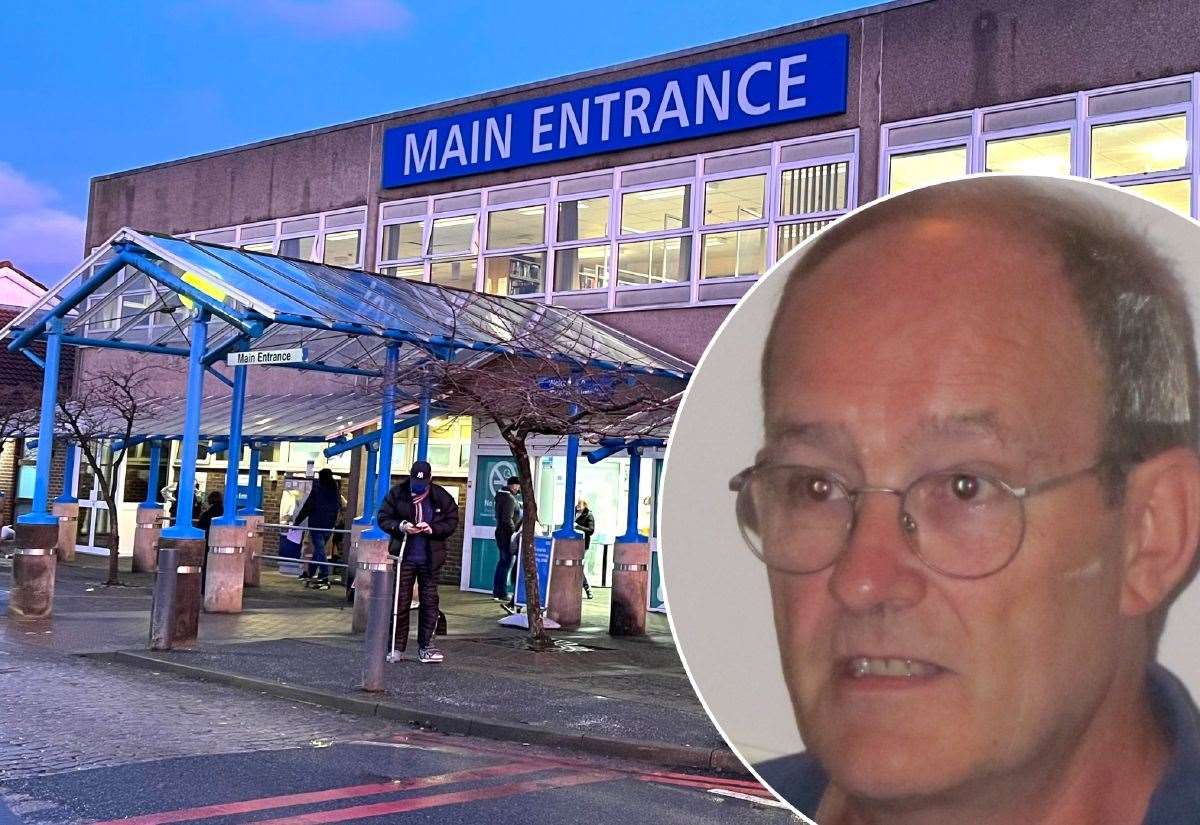

Health campaigners say Kent’s largest hospital trust “needs to weed out deadwood” after bosses confirmed they are inviting staff to resign.
East Kent Hospitals (EKH) is offering employees one-off payments to leave their jobs as part of a Mutually Agreed Resignation Scheme (Mars).
 East Kent Hospitals – which operates Ashford’s William Harvey – is running a Mutually Agreed Resignation Scheme (Mars). Picture: Barry Goodwin
Chiefs say they need to make “difficult decisions” in order to “significantly reduce costs”, and stress roles which “contribute to delivery of services” will not be removed.
But campaigners say while there is a need to remove members of “middle management”, a more comprehensive reorganisation is still required to cut costs.
It comes as both Dartford and Gravesham NHS Trust and Medway NHS Foundation Trust are also running their own Mars.
Former EKH board of governors vice-chairman David Shortt, founder of campaign group Concern for Health in East Kent (Chek), says he believes “middle management are the ones the trust wants to get rid of”.
“They certainly can’t afford to reduce clinical staff,” he said.
Former EKH board of governors vice-chairman David Shortt, from Herne Bay, says a comprehensive reorganisation is needed
“If they want to reduce costs drastically, I think they’ve got to be prepared to weed out the deadwood.
“There always seemed to be a battalion of people in the trust who didn’t really seem to have proper jobs.”
In an email to employees last week – seen by KentOnline – EKH bosses confirm “some staff will be able to choose to leave the trust in return for a one‑off payment”.
“This may be helpful for staff who are planning a career change or early retirement, or who want to take a long time away from the workplace,” they state.
“The scheme will help the trust reduce its workforce costs because the post will be deleted from the workforce once the voluntary resignation is agreed.
“It will not be backfilled; however, consideration may be given to the post being used to redeploy employees at risk following consultation.”
“It’s cost-cutting by the government…”
The email also stresses that Mars “is not redundancy and is not the same as voluntary redundancy”.
Staff can apply to be part of the scheme until June 11, but must have been employed by the trust for at least 12 months to be considered.
In a statement, a spokesman for the trust – which runs Ashford’s William Harvey, Margate’s QEQM, and the Kent and Canterbury Hospital – stressed there is no target amount of jobs to delete or savings to make.
“Unfortunately, like all NHS trusts, we need to significantly reduce our costs,” they said.
“This requires us to make difficult decisions, which include reducing our staffing levels as this currently accounts for £750 million a year (65% of our annual spend).
Kent and Canterbury Hospital is one of several run by East Kent Hospitals. Picture: Barry Goodwin
“It’s a voluntary scheme and all applications will be carefully reviewed against strict safety and quality impact assessments and eligibility criteria.
“This means we will not approve applications where roles are essential to safe staffing or critical service delivery.”
In December, the trust said it would be making redundancies – separate to the Mars scheme – which were understood to affect less than 1% of the workforce.
No final figures were revealed as consultations were ongoing at the time but corporate departments were affected.
Despite the changes, Mr Shortt believes EKH “needs a radical restructure”.
Citing an incident during his tenure where several wards at Kent & Canterbury Hospital had different procurement systems, he said: “Throughout the NHS, you constantly hear that they are very understaffed in certain areas and yet they seem to be horrendously overspent.”
QEQM Hospital in Margate is another site run by East Kent Hospitals
Mr Shortt, who lives in Herne Bay, recalled a recent incident where he took his wife to A&E at QEQM Hospital in “unbearable” abdominal pain.
“She was triaged quickly and treated as a priority, and then sent to a seating area,” he said.
“And there she sat for about four or five hours.
“She did not see a medic, was given no painkillers, and not told anything.
“Eventually, without explanation, she was moved to majors – to a bay without a bed.
“In the end we just walked out because my wife needed to lie down and she needed pain relief.”
Mr Shortt says the trust was receptive to his report of the incident and requested a meeting to discuss the experience.
But Chek’s current chair, Ken Rogers, says he feels the government “is putting too much pressure on trusts to reduce costs”.
Ken Rogers, chairman of Chek, feels the government is ‘putting too much pressure’ on health trusts
“It’s not just in east Kent,” he said.
“It’s cost-cutting by the government, this is pressure put on them financially by NHS England.”
In March, former Health Secretary Wes Streeting confirmed the trust was one of five to be placed into a new national “intensive recovery” programme.
The selected trusts are said to be at the bottom of NHS league tables, where patients face the longest waits, there is high leadership “churn” and persistent financial problems.
Each trust will receive tailored help, including a change of leadership where necessary, with NHS “veterans” parachuted in.
KentOnline revealed last month how EKH’s chief executive Tracey Fletcher was suspended for two months in November.
The measure has since been lifted but is now subject to an investigation into how it was handled.
A spokesman for Medway NHS Foundation Trust confirmed its Mars is ongoing.
Dartford and Gravesham NHS Trust has been running its own since December last year.
In a follow-up statement sent the day after this story was published, EKH’s acting chief executive, Dr Des Holden, said the trust needed to think “about how we staff our services” and that it does “not regard any staff as surplus to sustainable health care delivery”.
It added: “Doing the best we can for our staff and patients is central to difficult decisions.”