
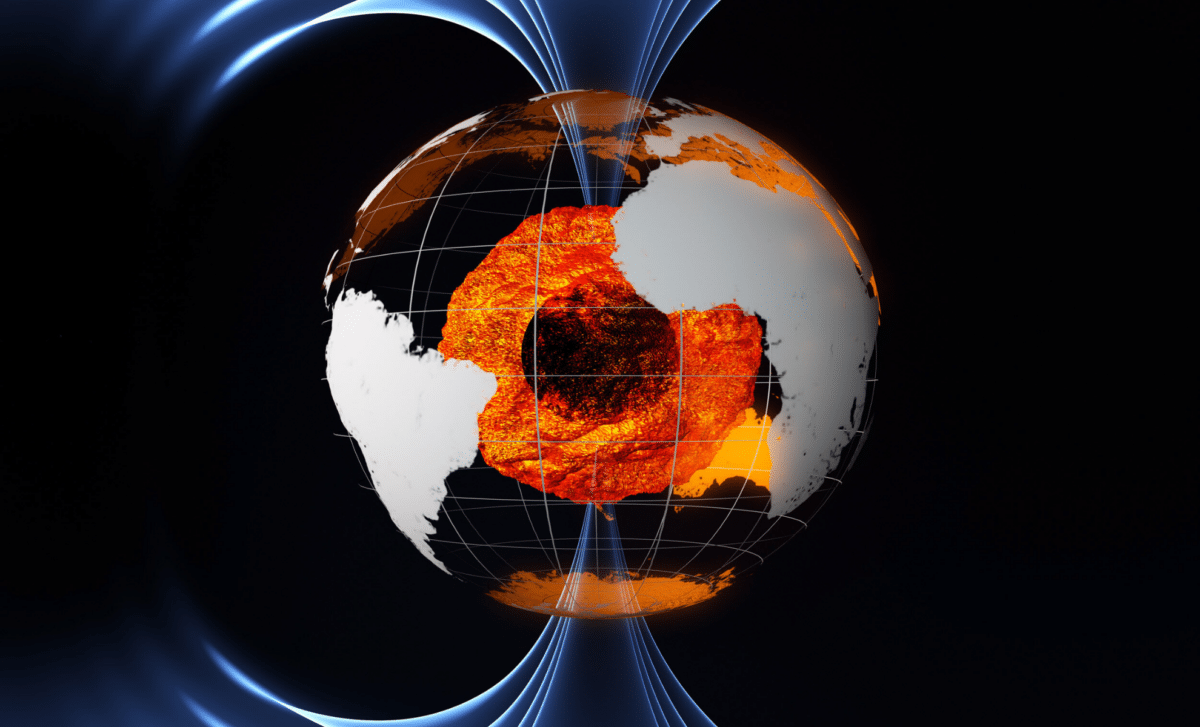
In a remarkable revelation published in the Journal of Studies of Earth’s Deep Interior, scientists have confirmed that a large section of Earth’s liquid outer core beneath the Pacific Ocean unexpectedly reversed direction in 2010. This phenomenon challenges long-held assumptions about the stability of Earth’s deep interior and offers a rare glimpse into the turbulent dynamics driving our planet’s magnetic field.
Unraveling The Mystery Of The Core’s Sudden Reversal
Earth’s outer core, a seething ocean of molten iron lying roughly 3,000 kilometers beneath the surface, generates the planet’s magnetic field. For decades, geophysicists assumed its flow to be relatively stable, circulating predominantly westward. However, satellite and ground-based observations spanning 1997 to 2025 revealed a dramatic shift in 2010: molten iron beneath the equatorial Pacific suddenly surged eastward.
Frederik Dahl Madsen, lead author of the study, published in the Journal of Studies of Earth’s Deep Interior, and a researcher at the University of Edinburgh, School of Geosciences, remarked,
“The large-scale flow reversal beneath the Pacific raises new questions about the behavior of Earth’s deep interior. Scientists now want to understand whether the reversal represents a short-lived fluctuation, part of a repeating oscillation, or a new stable equilibrium for core circulation. Continued monitoring will be essential to determine how the flow evolves over the coming years.”
According to Madsen, models indicate that the strong eastward flow has weakened since 2020. “The rise of the strong eastward flow in the Pacific is contemporary with a change in behavior in the inner core, as inferred from geodesy and seismology, and we hypothesize that these changes in the deep interior are associated with the changes in flow beneath the Pacific,” he explained.
These findings underscore the outer core’s surprising variability, hinting at complex interactions between the liquid outer core, the solid inner core, and the lower mantle.
How Satellites Unlock Secrets Of Earth’s Deep Interior
The discovery owes much to ESA’s satellite missions, particularly Swarm and CryoSat, which provide unprecedented precision in measuring Earth’s magnetic field. Launched in 2013, the three Swarm satellites fly in coordinated orbits, distinguishing subtle magnetic signals from the core against interference from the crust, oceans, ionosphere, and magnetosphere.
Elisabetta Iorfida, ESA’s Swarm Mission Scientist, noted,
“This study shows that regional changes can emerge rapidly within just a decade. The findings may also help scientists investigate possible interactions between Earth’s outer core, inner core, lower mantle and, therefore, give more insights into core-mantle boundary, which is a critical region for the deep Earth dynamics.”
“This research raises intriguing questions about how Earth’s deepest layers are dynamically connected. As the magnetic field continues to evolve, satellite missions are providing an increasingly detailed view of the dynamic processes unfolding deep inside our planet, revealing that Earth’s core may be far more variable and complex than once believed.”
By tracking minute variations in the geomagnetic field, scientists were able to reconstruct the reversal event and detect wave-like accelerations and rapidly evolving flow structures, otherwise invisible through ground-based observatories.
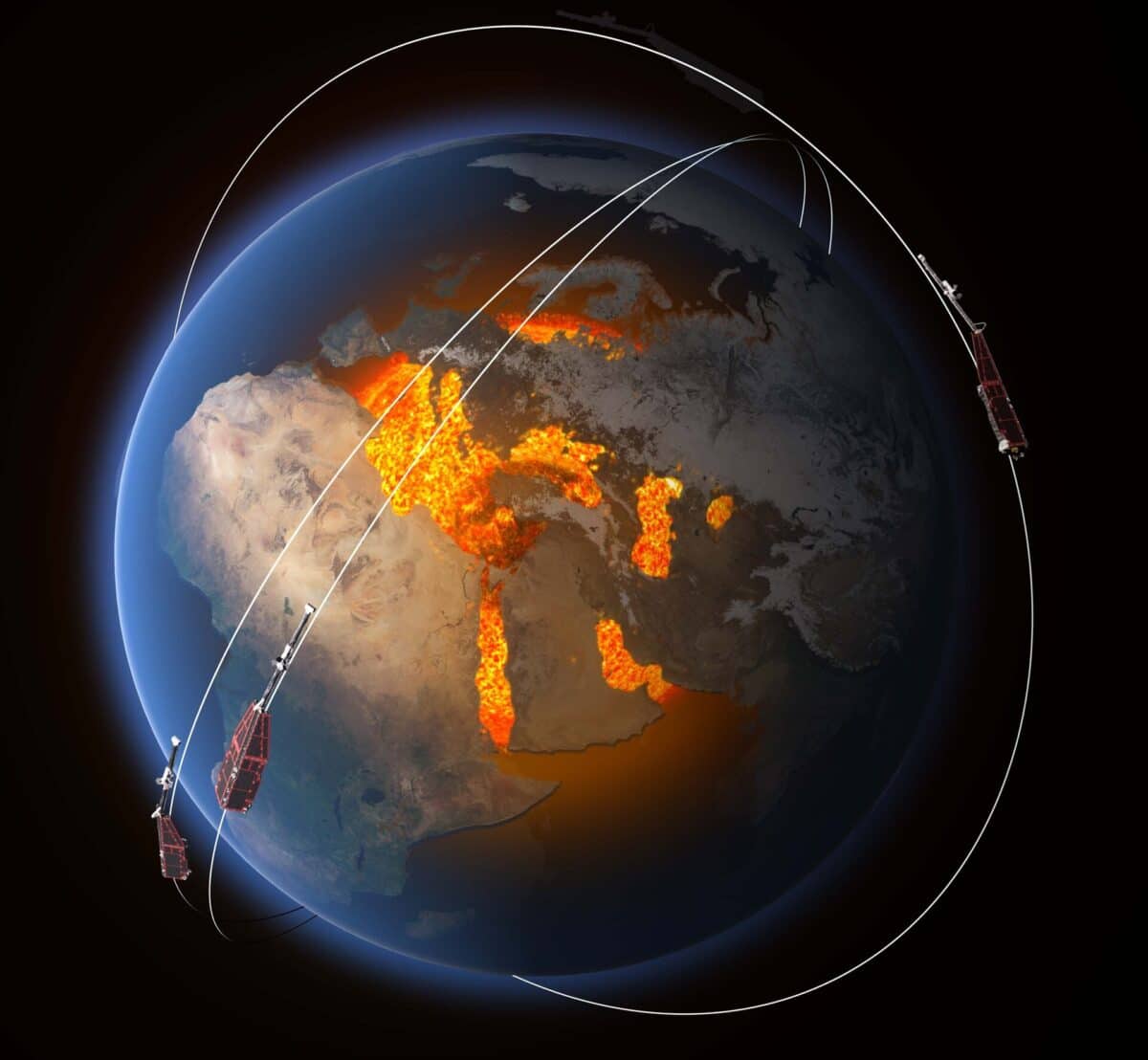 Swarm constellation
Credit: ESA/ATG Medialab
Implications For Earth’s Magnetic Shield And Technology
The movement of liquid iron in the outer core does more than churn beneath our feet; it sustains the geomagnetic field that shields Earth from harmful solar radiation. Changes in the core’s flow, though deep underground, have cascading effects on navigation systems, satellite operations, and near-Earth space weather modeling.
A sudden reversal like the one beneath the Pacific provides researchers with a natural experiment to test geodynamo models, improving our understanding of long-term magnetic evolution. The findings also suggest that regional shifts in flow can occur far more rapidly than previously assumed, potentially influencing patterns of magnetic field variation across decades.
A Window Into The Planet’s Deepest Layers
The 2010 reversal is not merely a curiosity; it hints at fundamental dynamics linking the outer core, inner core, and mantle. Researchers aim to determine whether the observed eastward surge was a temporary oscillation, part of a recurring cycle, or the start of a new stable flow pattern.
By combining decades of magnetic data from ESA satellites, German CHAMP, and Ørsted missions, scientists can now monitor the geodynamo with increasing resolution. Continued observation will be critical to understanding how Earth’s deepest layers interact and evolve over time. The study underscores that Earth’s interior is not static but a highly dynamic system with far-reaching consequences for life and technology on the surface.