

A few years back, during her run as Evie Gallant in Ryan Murphy’s series American Horror Story: Apocalypse, Joan Collins, then a mere 84 years old and trussed up in a lace corset, was filming a night scene on a Paramount lot in Hollywood, Los Angeles. “It was so cold,” Collins says. “And the chairs we sat on in between takes had no backs so it was very uncomfortable too.”
Having completed her scenes with her co-star Sarah Paulson, Collins woke up in the night in “screaming agony”. Immediately, her husband, Percy Gibson, picked up the phone and dialled not 911 but a private number for their friend Larry — Lawrence D Piro, MD, at Cedars-Sinai hospital.
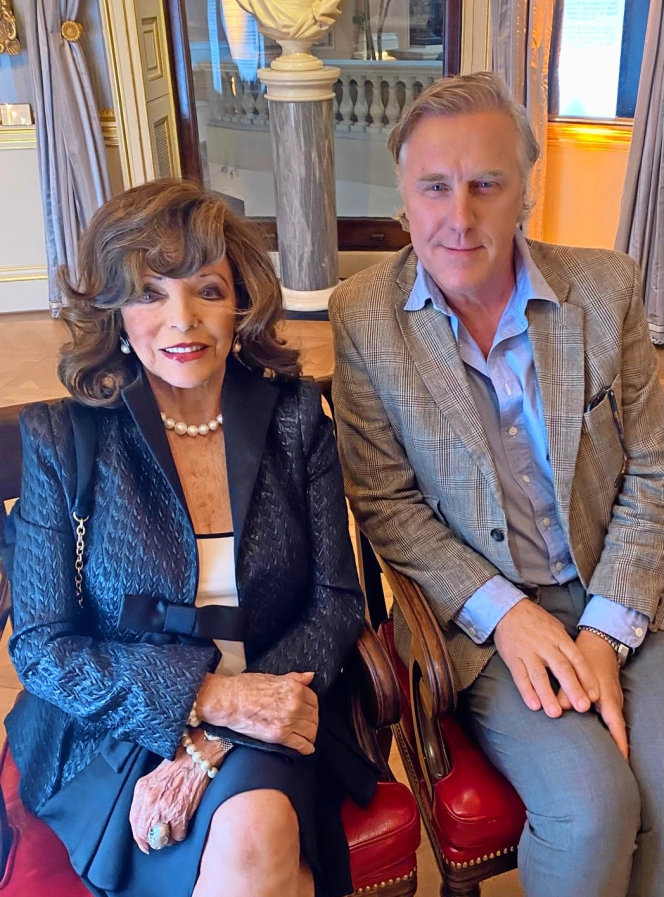 Simon Mills with Joan Collins
Having been recommended the Cedars by her old pal Ryan O’Neal, Collins knew that this would be the best option in an emergency. “Within five minutes, an ambulance had arrived and I was being taken care of,” Collins says. “Wonderful.”
She now goes back to the Cedars for regular check-ups. “And if I have a pimple on my face that hasn’t gone away after two months, I go and have them check out that too.”
How did the world-famous “hospital to the stars” diagnose Collins’s pain? That most Hollywood of problems: a painful cracked rib caused by an over-tightened whale-boned garment on an over-running night shoot in a cold studio backlot. “Cedars kinda saved my life that night,” Collins says.
She’s telling me all this during a drinks reception at the Wallace Collection on Manchester Square, close to Harley Street in London, where Cedars-Sinai has opened its first clinic outside America.
Prior to the champagne and canapés and the cute Cedars-Sinai-branded Ladurée macarons, before Collins could kick back and enjoy herself with her table of friends — Jeffrey Archer, Christopher Biggins, Evie Bricusse, Piers Morgan, Ivan Massow — the party is given a tour of the new Harley Street facility.
What’s it like inside? Heaven as styled by the set design team at Wallpaper magazine. The reception has the white, photoshopped cool of a South Beach boutique hotel lobby. Upstairs, there is a waiting room that could easily double as a private jet departure lounge in Monte Carlo.
Consulting rooms are a little bit of LA in W1. Which means that the crusty, time-honoured aesthetics of the Harley Street practices — Chesterfield sofas, creaky staircases, dog-eared piles of Country Life — give way to a look that engenders calm and control. Floors are glossy parquet. There is Aesop hand wash on the sink top. Furniture, by the brand Cattelan Italia, is the stuff of a slick, hedge fund office laid out in developers’ chic style. (Cedars has an in-house architecture and design staff of more than 75.)
“There are no stairs to climb, you get a doctor who has the talent to tell you exactly what is wrong and whether you need an x-ray. And when they want you to lay down on the bed,” Collins says of the LA hospital, “it’s not all horrible cracked old leather. It’s a soft beige Italian leather.”
The converted Edwardian townhouse isn’t just a clinic but a “conductor of the orchestra” of patient care to “de-segment” treatment, says Dr Sandeep Kapur, medical director of Cedars-Sinai Clinic London. Which is, I think, a posh way of talking about “referrals” and “GPs”.
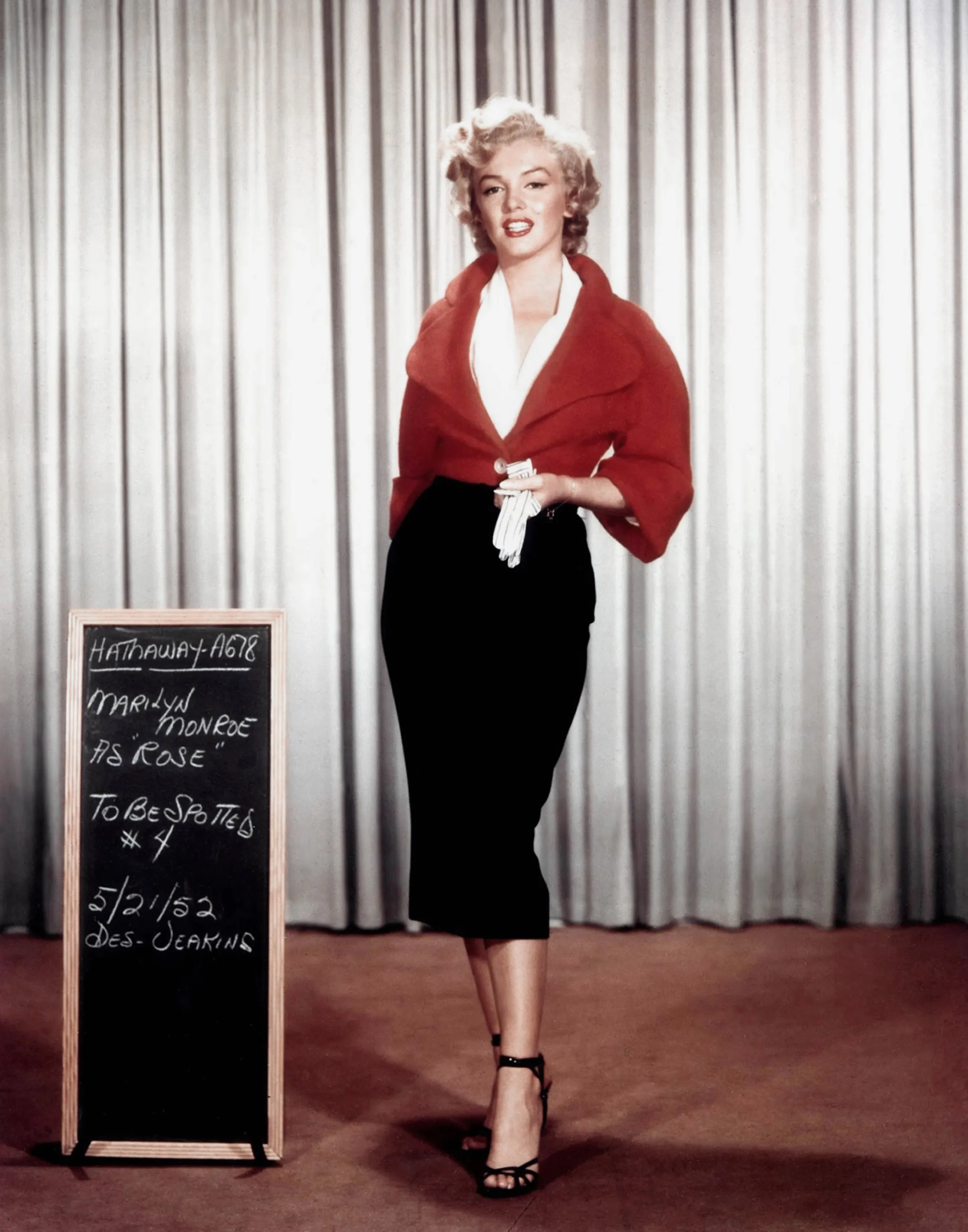 Marilyn Monroe had her appendix removed at CedarsGetty images
Of course, over in Los Angeles, Cedars is the dernier cri in world-class medical facilities. Established in 1902, the Beverly Boulevard hospital — walls adorned with Picassos, Warhols and Hockneys — is where Patrick Swayze was treated for pancreatic cancer, Madonna’s hernia was fixed and Marilyn Monroe’s appendix removed. (Under her gown, Monroe left a note taped to her abdomen, asking, “I know it seems vain… please do whatever you can to prevent large scars.”)
Kourtney Kardashian, Jessica Simpson, Victoria Beckham, Kate Hudson, Penélope Cruz and Pink have all had babies delivered there. Its wards and medical schools are named after celebrity donors such as David Geffen, Steven Spielberg and Barbra Streisand. Frank Sinatra, River Phoenix, Lucille Ball and Elizabeth Taylor died at Cedars.
Yes, patient discretion and client confidentiality is one of the brand’s core tenets, but gold star-insured Hollywood A-listers seem happy to flaunt their Cedars patronage like an Academy Award.
And it’s not cheap. There is no official price list — each Cedars patient requiring bespoke treatment — but a breakdown of fees published in the fiscal year 2019-20 has a heart transplant estimated at $3.3 million, while an allogeneic bone marrow transplant would stiff you some $1.04 million.
Patients with the necessary insurance policies get a whopping 84 per cent discount off the list prices. Non-billionaires are welcome too. Recently the hospital’s charity care policy has expanded to provide eligibility for free medical care to patients with household incomes up to 400 per cent of the federal poverty level, which is $49,960 for an individual and $103,000 for a family of four. Cedars also offers discounted care to those with incomes up to 600 per cent of the federal poverty level.
For stars and civilians, in LA and London, modern, first-world ailments have become increasingly avoidable. In the basement of the new property (there’s an elevator, obviously) is a sci-fi Dexa scanner that measures body and visceral fat percentages and, crucially, bone mineral density. This machine has become an essential for the Cedars clientele, Dr Vikas Mehta, head of executive health, explains. Why? With so many people taking rapid weight-loss medication, pounds are shed and bones experience less stress from carrying body weight, triggering the body to reabsorb bone tissue leading to an elevated risk of bone density loss and osteoporosis. (“I would never do Ozempic,” Collins scoffs. “When I arrived at Fox as a 20-year-old, they told me I was too fat — I was just nine stone! I went on a bananas and milk diet.”)
 Patrick Swayze was treated for pancreatic cancer at Cedars-SinaiJamie McCarthy/WireImage
At Cedars, says Piro, a handsome, messy-haired Nordic type who looks like a fourth member of A-ha, they want to catch anything nasty (and overly skinny) before it gets too serious — this is the modern, private medical way. Think prevention. Care. Concierge. A “high-touch” (hands-on) patient experience. A secret entrance at the back if you don’t want to get papped on admission. They don’t want you to come only when you are ill — they want to help you before you get ill.
The Cedars’ lexicon has even replaced the buzzword “longevity” with a new term: “Healthspan is all about quality of life. Longevity is a numbers thing,” Piro says.
“The patient experience is so important for us,” he adds. “That’s why we have clinics filled with art and music, light and beautiful surfaces, and all the things that make you feel comfortable and that you are going to get well, right?
“If you go into a place that is all dark and perhaps not so clean, and as Joan was saying, with torn leather furniture, you are not going to get well. You actually feel sicker than when you arrive.”
Staff are central to the Cedars magic-carpet experience too. “Our people undergo hospitality-type training, so they greet you by your name so you feel like you are coming home rather than visiting somewhere scary and unwelcoming,” Piro says.
To get a little taste of the Cedars, when everyone has moved on to the next room on the clinic tour, I have a quick lie-down on the taupe upholstery of the Italian Lemi bed. It feels lovely, expensive, capable, safe and privileged. This, I decide, is how the other half live… longer.