
Back to Article List
A trio of planets stand in line in the evening sky after sunset: Jupiter, Venus, and Mercury, all visible in the twilit sky.
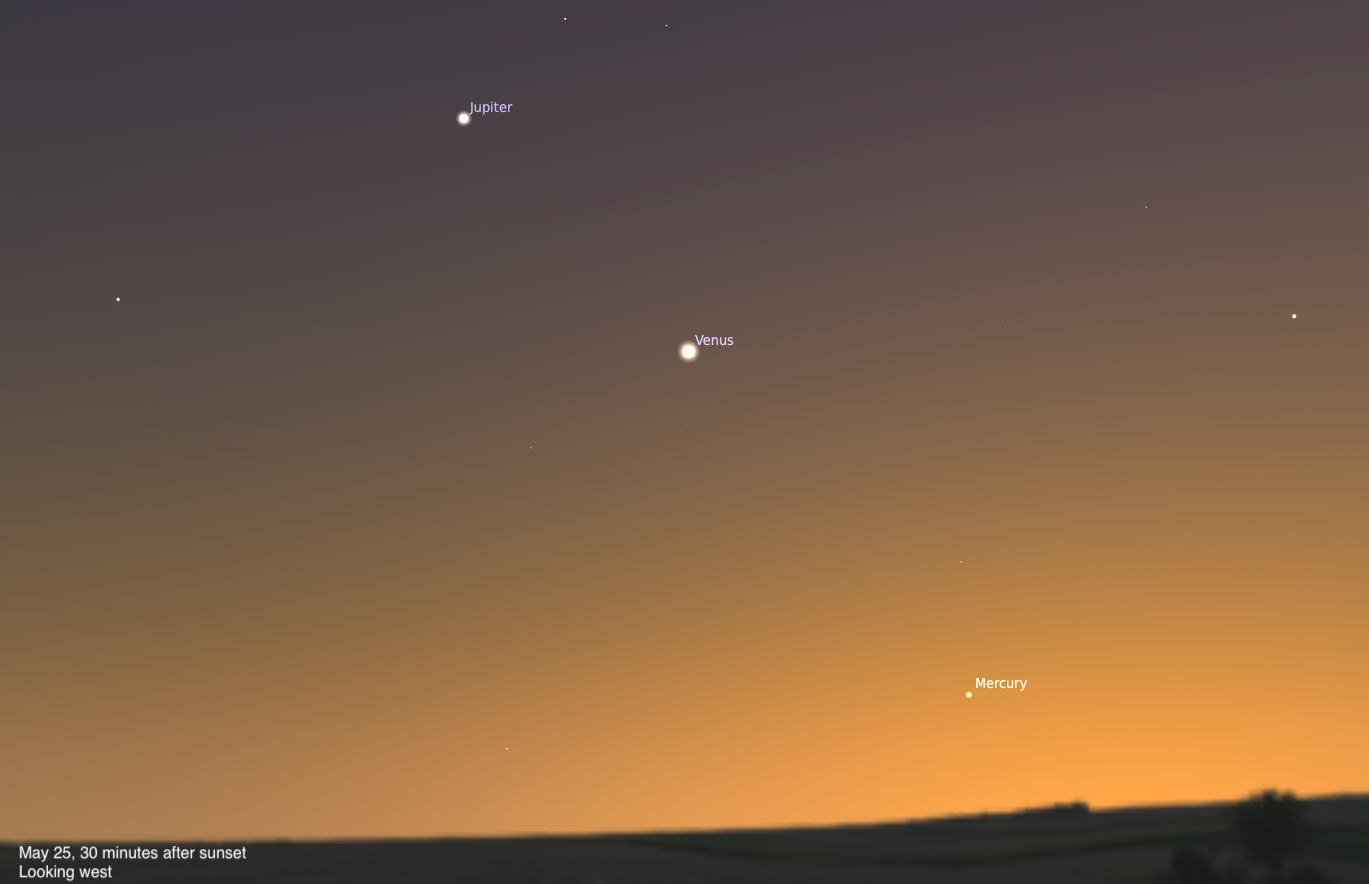
By May 25, Mercury is readily visible in the evening sky for a short time after sunset, standing in line with fellow planets Venus and Jupiter. Credit: Stellarium
Looking for a sky event this week? Check out our full Sky This Week column.
May 24: Egeria slides on by
After reaching superior conjunction midmonth, Mercury is increasing in visibility and should be easily identifiable now in the evening sky. Just half an hour after sunset, step outside to see if you can spot the solar system’s smallest world, now shining at a respectable magnitude –1.1. It should be 6° above the western horizon.
You will, of course, also spot brighter Venus and Jupiter. Jupiter is highest in the sky, now in eastern Gemini and shining at magnitude –1.9. Venus, a little lower, sits closer to the Twins’ feet and lies between Jupiter and Mercury, shining at magnitude –3.9. If you have trouble spotting Mercury, simply draw a line from Jupiter down through Venus and continue it toward the horizon. Mercury lies along that line.
Through a telescope, compare the sizes and illuminated extents of Venus and Mercury. The former now appears some 13” across, with 81 percent of its visible disk (cloud tops) lit. Mercury is a slightly more illuminated at 84 percent lit, but it’s less than half the size of Venus, stretching only 6” wide in our sky.
Sunrise: 5:37 A.M.
Sunset: 8:17 P.M.
Moonrise: 3:05 P.M.
Moonset: 2:30 A.M.
Moon Phase: Waxing gibbous (76%)
*Times for sunrise, sunset, moonrise, and moonset are given in local time from 40° N 90° W. The Moon’s illumination is given at 10 P.M. local time from the same location.