
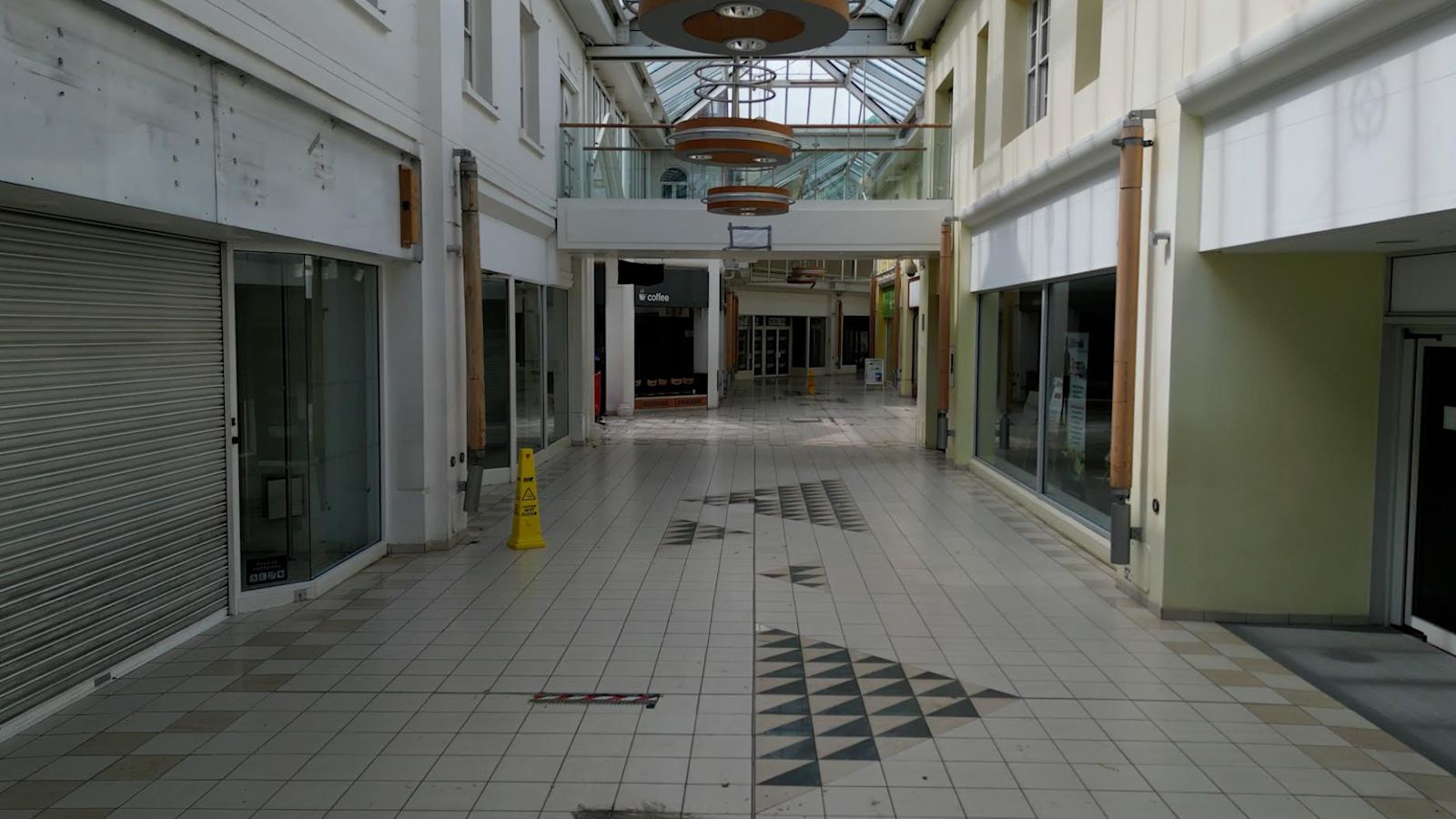
Deserted, dilapidated, and desperate.
Today, the scale of the crisis facing our struggling high streets is laid bare as an investigation by ITV News Central reveals more than a third of shops in some parts of the Midlands are standing empty.
Challenges including the cost of living crisis, high business rates, and street crime have all been cited as reasons for the number of shuttered shops – with some estimates suggesting our town centres are losing between 30 and 40 shops every day.
“People haven’t got enough money”
Steven Smith is a market stall holder in Bolsover in Derbyshire.
In the 15 years he’s been running a stall, he told us how he’s seen business spiral.
“There’s not an awful lot for people to come here for, really,” he said.
“You get regular customers, and they’ll come back. But if you’re not getting new customers, you’re only ever going to lose money over time.
“It’s tough, because I don’t think there is much that can be done. I don’t see that anybody’s going to do anything.
“People haven’t got enough money. People’s habits are changing, they’re using online more, using supermarkets, out of town shopping centres.
“I just don’t see what anybody can do to turn it around.”
It’s a bleak picture – but one echoed up and down the country.
Exclusive data shows the state of retail vacancy rates in some parts of the Midlands Credit: ITV News Central
Under the Freedom of Information Act, I asked councils across the Midlands for figures on the number of empty shops in their areas.
Of 56 local councils, only 35 were able to provide those figures – but they paint a deeply worrying picture.
Of just under 71,000 retail units, almost 7,000 are standing empty – that’s 9.7%, or around one in every 10 shops.
And in some places, it’s much higher.
Rugby in Warwickshire, has a vacancy rate of around 12% – while East Staffordshire Borough Council reported a rate of 21.2%.
North East Derbyshire was similar, at 21.4%.
And Bolsover is one of the worst affected – it has the highest shop vacancy in the Midlands, at more than 36%.
Bolsover High Street Credit: ITV News Central
For leaders in Bolsover, the challenge has been trying to find new ways to bring people in, and keep them coming back – including how to spend a £15 million town centre grant awarded by the government.
Cllr Tom Munro, the leader for growth at Bolsover District Council, said the authority had invested in shop fronts, and a Saturday market – and insisted there’s more to come.
“We’ve also encouraged cultural events in the town, and that’s brought more people in,” he said.
“We’ve also purchased old buildings and buildings that are not currently in use, and are planning other uses for those.”
That includes the former Co-op supermarket, just around the corner from Market Square.
He said the council is now looking into converting it to a mixed-use building, working alongside the local health board to introduce health facilities.
Other parts of the building, he added, could be used for arts and creative activities.
The move towards mixed-use for town centre buildings is being explored by a number of councils.
Evesham in Worcestershire has a vacancy rate of 12% overall – but its town centre sits in the shadow of the carcass of shops gone by.
The Riverside Centre has been labelled “Britain’s saddest shopping centre” by one national newspaper, with only one store – a Home Bargains – still open and operating inside.
The others have all been abandoned.
“Many towns across the country are the same as Evesham – people are driving out of them instead of into them,” the deputy council leader, Cllr Emma Kearsey, told us.
“The most time that people probably spend in Evesham at the moment, sadly, is when they’re queuing in traffic to go through it.”
But Wychavon District Council has a plan. Earlier this year, it bought the Riverside Centre – and now has plans to raze it to the ground, replacing the empty shop units with a mix of housing, retail, and leisure.
A reflection, she said, of the way people’s habits have changed.
“What we want to do is for people to actually come to Evesham, for it to be that destination,” she said.
“Years ago we had lots of coaches come in, people all come into the Riverside. And we have thousands and thousands of people that come to the Battle of Evesham event that we have”.
“So we want it to be that what’s in the town, is what people want to come in for – for their spending habits, and what they want to do for leisure, so that it’s all inside the town. “So it brings Evesham back to being a town that you want to go to.”
High Street crisis
The decline of the high street is a huge concern for people.
Former Chief Secretary to the Treasury Liam Byrne, who’s also the MP for Birmingham Hodge Hill and Solihull North, has been researching the issues which voters are most concerned with – and empty shops comes up time and time again.
“A lot of people right now think that actually that communities are in real decline and the barometer of that, if you like, is just the state of the local high street,” he said.
“So if you’ve got shops that are shuttered or if you’ve got fly tipping, maybe you’ve got some community facilities there that have been closed down for a long time, and you don’t feel like in any control”.
“There’s nothing you feel that you can do to change that. And actually that makes you feel that it’s not just your community – it’s the country that’s going backwards.”
As for what can be done to fix it, he has some ideas.
“We need to get really tough on high street crime”
“Labour costs are going up. Energy costs are going up. Crime costs are going up. Business rates are going back up. The VAT threshold is in the wrong place.
“Any one of those things, you could probably handle – but all of those things together, it’s just proving too much for people.
“And that’s why you’re seeing shop units shutting down all over the country. High streets are maybe losing around 38 shops a day because of this combined pressure that’s now on them.“It’s not like one thing [that’s needed].
“There’s actually a big package of things, and it probably starts with getting business rates down. Online giants are frankly getting away with paying too little when high streets are paying too much.
“We need to get really tough on high street crime. We’ve got to bring energy costs down. We’ve got to give local government more power to actually work out who owns all of the shop units so that they can actually drive through regeneration much more ambitiously.”
Subscribe free to our weekly newsletter for exclusive and original coverage from ITV News. Direct to your inbox every Friday morning.
A spokesperson for the Ministry of Communities, Housing, and Local Government said:
“High streets are not just the beating heart of our economy, they are at the centre of our communities and that’s why we’re backing them and ensuring they can thrive.
“We are investing £300 million to revitalise them, introducing powers to allow councils to tackle long-term vacant properties, and cracking down on high street crime with more to come through our High Streets Strategy.”
Sandwell Council is among those investing in making its town centres more appealing. Its spent almost £3m of government grant money in Blackheath widening pavements, creating more crossings, and a new bus interchange – while in August last year, it opened its new indoor market in West Bromwich, to great fanfare.
On opening day, queues snaked through the market itself, out the door, and down the street.
Of particular interest was the return of iconic Black Country brand Firkins – bucking the trend and reopening a high street store after 10 years as an online-only business.
Managing director Rob Green said it had “overwhelmingly” been the right decision.“Opening day was unbelievable. The queue was around the block for three to four weeks after we opened, and it continued like that right the way through till Christmas,” he said.
“Obviously it’s gone back to a normal level now – which is still more than we could have anticipated to start with. “You can’t get that connection to customers by being online,” he added.“But times are getting tougher on the high street. Everyone’s feeling the pinch. “Things are up and down all over the place in the economy at the moment. But I’m confident that we’re in a good place. We’re a strong, viable business.”
And some areas have seen success. In Leicestershire, Oadby and Wigston Borough Council reports an empty shop rate of around 9% – slightly below average, according to our figures.
But on Wigston High Street itself – it’s the lowest it’s been in a decade, with almost no empty shops to be found.
The council says it’s worked hard to bring in a variety of businesses to fill them.
“People’s shopping habits have changed. The town centres are not just a place for people to come in to shop for few things and go back,” Cllr Samia Haq, the council leader, said. “It’s actually a whole day out where people look for entertainment. They like to socialise and they like to, at the same time, go to the shops and buy whatever they need.
“So we have a good variety of shops here. We have cafes, restaurants, and we have some service providers as well, as well as your traditional retailers in the town centre. That makes people spend more time in the town centre – and in turn, it helps our traders.”
“It’s the community that makes us so great”
Among the businesses to move in is the Peony Cafe, a Turkish eatery run by Hatice Akta and her children, which recently celebrated its first anniversary.
Hatice’s daughter Betul helps out behind the counter, and said it was the community which helped businesses in the town thrive.
“When we first opened, my family were complete strangers to them. But now we know our customers – we know their names, “ she said.
“We’ve seen unimaginable support from all the community members here. They’re all really supportive. They know that my mum opened this cafe as a single mum. Honestly, it’s been incredible.
“It’s the community that makes us so great to be in this part of Leicester.”
And their customers agree.
One diner told me: “I love spending my time in Wigston. If there’s one thing I wouldn’t move from Wigston for, it’s the town centre. It’s very convenient. Everything is available at hand. I just love the town.”
So it’s not all doom and gloom. But as businesses, councils, and shoppers know all too well, the combination of investment, and customer support – which appears to be helping businesses in Wigston – is hard to come by.
Reporting History sees journalists join News At Ten anchor Tom Bradby to revisit their remarkable on-the-day reports of the defining events of the modern age. Listen to the episodes below…