
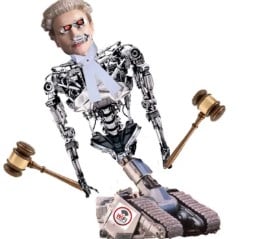
“On second thoughts, this AI tool might need a bit more work”.
Pinsent Masons has been slammed by the court for sending “misleading” AI-generated letters to the court which told the judge to follow a made-up rule.
It’s been a salutary tale on the pitfalls of using AI, as Pinsent Masons’ clients have switched to another firm – Irwin Mitchell – as a result of concerns highlighted by the judge in the ruling.
When RollOnFriday asked if the firm had been ‘ditched’, a Pinsent Masons spokesperson said they were “not able to go into further detail but it’d be incorrect to say the client ditched us”. So, perhaps it could be described as a ‘conscious uncoupling’. Regardless of the terminology, Pinsent Masons is also paying its former clients’ costs arising from the court’s query into the matter, including the costs of instructing Irwin Mitchell.
The issue arose as Pinsent Masons had been instructed on an insolvency matter to prepare a ‘block transfer’ application at the Insolvency and Companies Court (ICC), which is usually uncontested and dealt with on papers.
In March, Pinsent Masons wrote to the court citing a purported statutory rule which gave the court the power to release outgoing liquidators from liability. However, it was wrong, as a Pinsent Masons junior (anonymised as ‘LA’) had used AI to draft the letter, and the program had hallucinated and come up with bogus wording.
The letter “came as a surprise” to ICC Judge Mullen, who said that he was “unaware” of the provision, and upon checking the statute, found it said “nothing of the sort.”
The judge queried Pinsents’ request, but the firm maintained its position by sending a second letter (again with the help of AI) stating that its first letter was a “summary conclusion” of the rules.
The flabbergasted judge said he “was astonished” by the reply, and suspected AI must have been used by the firm in it’s attempt to “explain it away in what appeared to be an untruthful manner”.
In a ruling examining Pinsent Masons’ conduct, the court was provided with a transcript of the ‘chat’ between the junior lawyer and the AI tool. The judge deemed that LA’s conduct was “very troubling” as they had “almost entirely outsourced the thinking process to the program”.
The AI was “on a large number of occasions…plainly wrong or, at the very least, extremely misleading”, the court heard. And the junior lawyer seemed “to have almost exclusively relied upon AI to provide the answers and did not check its references, even when told to do so by the AI itself”.
Had LA followed the warnings to check the actual law, “it would have been readily apparent that the AI was producing nonsense and was unreliable,” said the judge.
It also emerged from the chats, that when drafting the second letter, the AI provided a draft which included an “unreserved apology” to the court. But LA replied: “I don’t think we should apologise – no.” The judge said “this in itself raises questions about LA’s judgment” as the AI then removed the apology in the next draft.
The firm was slammed for taking a “cavalier attitude” on “the accuracy of the material”. The judge found that the supervising associate, Samantha Poulton, and partner, Steven Cottee had failed to supervise the junior properly, saying it was “incumbent on the more senior lawyers to check LA’s work”. Albeit, the judge noted that they had not intended to mislead the court.
In remarks that will resonate across the profession, the judge said that juniors using AI “should check all references given by AI and be candid, when reporting the result of their research to their supervisors, as to whether AI had been used in that research and whether the content generated by the AI had been checked.”
The judge said that Pinsent Masons would not face contempt proceedings, noting that the firm had been publicly admonished in the judgment and had referred itself to the SRA.
A spokesperson for the SRA said: “We are aware of the report that Pinsent Masons have made, and we are looking into it before deciding on any potential next steps.”
A Pinsent Masons spokesperson said: “We have apologised unreservedly to the Court and are taking steps to strengthen our processes and oversight to ensure this does not happen again. As the matter has been before the Court, it would not be appropriate to comment further.”
The firm confirmed to the court that it is now reviewing its AI policies and “safeguards”. RollOnFriday asked Pinsent Masons about the AI tool used to create the letters, but the firm said it would not comment about the program.
While Pinsent Masons is not alone in getting caught out by AI hallucinations, the firm appears to have been keen to push the use of AI in the workplace, as highlighted in its ‘AI in Action’, newsletters.
In one post, titled ‘Our Great Copilot Journey: Sparking a firmwide AI Movement‘ (which appears to have been written almost entirely by AI) the firm stated: “It’s more than just training – it’s facilitating a cultural shift.” Continuing its word salad, the AI tool firm said: “The journey was as much about culture as it was about capability. It normalised experimentation, celebrated curiosity, and made AI feel less like a black box and more like a teammate.”
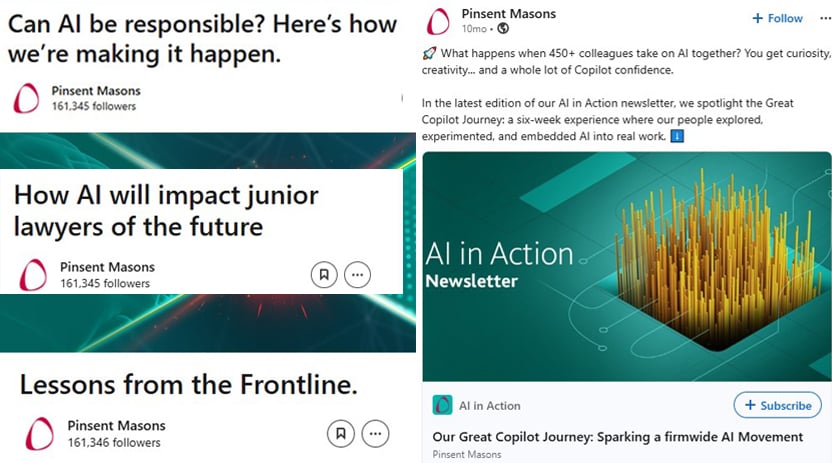
Some previous headlines from the ‘AI in Action’ newsletter, are a bit on the nose in light of the ruling
Another post, How AI will impact junior lawyers of the future, said: “The impact of AI and technology on junior lawyer resourcing is profound and multifaceted. Law firms must embrace these changes, rethinking their training and resourcing models to ensure they remain competitive and capable of meeting the demands of the future. By doing so, they can cultivate a new generation of lawyers who are not only technically proficient but also adaptable, innovative, and ready to lead in a rapidly changing world”.
Following the judgment, the AI in Action newsletters should probably be updated to include a section in bold capitals, highlighted in neon, and underlined three times, about juniors not “entirely outsourcing the thinking process” to AI.