
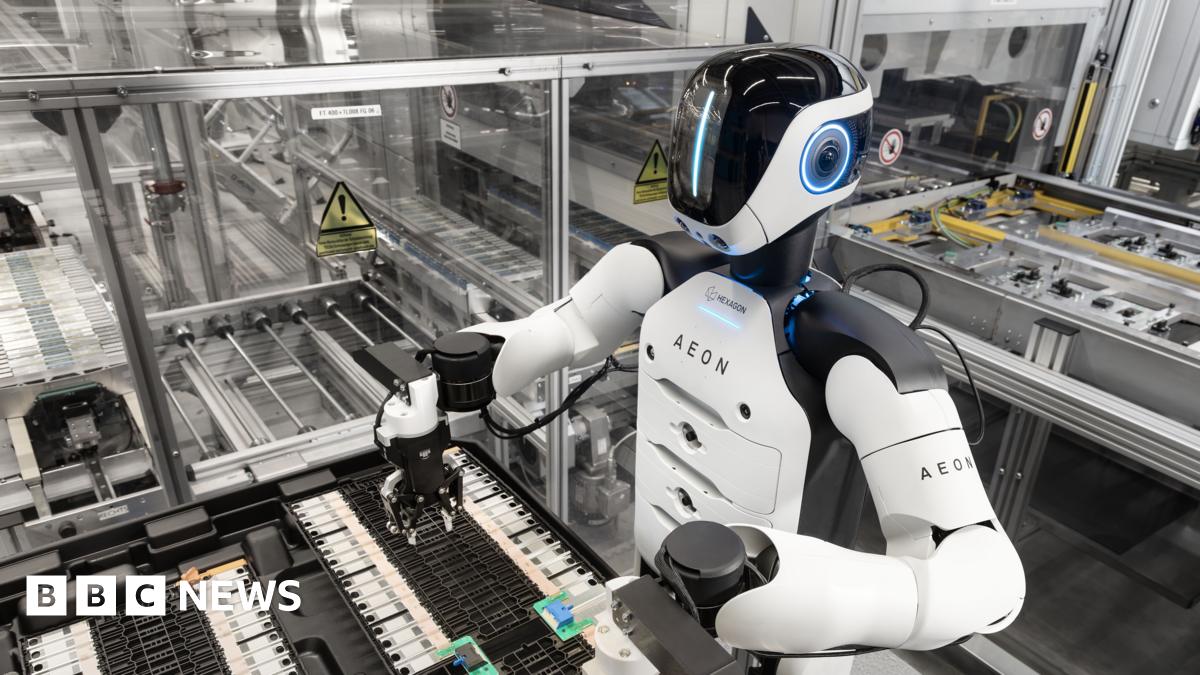
The robots have been welcomed by staff, Nikolaides says. He imagines people will give them names, as they have done for older non-humanoid robots.
“If it doesn’t have a name, it’s a machine,” says Gartner’s Ray. “If it gets it wrong, it’s broken. If it has a name, then people expect it to make mistakes. People forgive it. One of the things we say to companies is to give your robots names.”
Aeon doesn’t have a human face but does have a display area on the front of its head, which shows symbols, such as a line when performing a task and a circle when listening.
“We’re still working on that [visual language], but we feel very strongly that Aeon needs to be signalling in a way that’s natural to humans,” says Robert.
Humanoid robots are starting to enter workplaces alongside humans, but Ray believes the robots have been overhyped, especially with high profile demonstrations.
“The primary use case for a humanoid robot today is to walk on stage and artificially inflate your share price,” he says. “Robots dancing or whatever: That’s not that difficult to do.”
There’s a risk of people overestimating a robot’s capabilities, he says.
“When you see a humanoid robot walking, you assume it can run, it can climb, it can jump. It can’t do any of those things, but your brain fills in those gaps. We’re having unrealistic expectations when people deploy these robots.”