
June heralds the Solstice and the start of astronomical summer plus we witness a full Strawberry micromoon.
The Sun begins the month in Taurus (The Bull) and ends in Gemini (The
Twins) but recedes by 403,084 km (0.003 AU). The (northern hemisphere)
Summer Solstice occurs on 21 June at 9:24 am and marks the Sun’s most
northerly altitude and the beginning of astronomical summer which will last
for 93 days 15 hours and 40 minutes. In Edinburgh and Lothian, the Sun will
reach 57.5 degrees at 1:14 pm. Step outside—if you can stand the heat—at
that time and cast your shortest shadow of the year. This, the longest day
of the year, will last 17 hours 36 minutes and 24 seconds. Some 3.5 hours
after the Solstice, though, the Sun leaves Taurus (The Bull) and enters
Gemini (The Twins) and recedes from Earth by 397,520 km over the remainder
of the month. Daylight lengthens from 17:12 (17.196 hours) on 1 June to
17:31 (17.518 hours) on 30 June so we lose 19 minutes of twilight by the
end of June.
Since the Sun will be at its shallowest point below the northern horizon in
June, and Edinburgh and Lothian sits in the 50–65 degrees band of
latitude, we can observe ‘polar mesospheric clouds’, also known as
‘noctilucent clouds’ from the Latin for ‘night shining’. Noctilucent
clouds form in the mesosphere around 80 km above the Earth. They are
visible after sunset and before sunrise when the observer is still within
twilight but the clouds are sunlit from below. Typically they are to be
found between north-east and north-west lying below 15 degrees altitude.
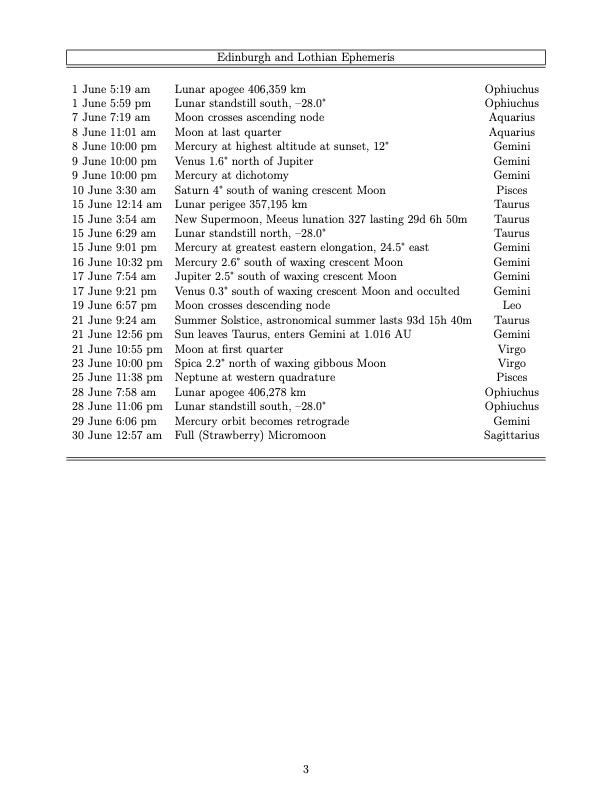
The Moon begins the month in Ophiuchus (The Serpent Bearer) and ends in
Sagittarius (The Archer) and approaches by 2,574 km (0.000 AU). The first
Lunar apogee (furthest from Earth) occurs on 1 June at 5:19 am and takes
the Moon to 406,359 km away from Earth—around 21,959 km further than
average—subtending an angle of 29.4 arc-minutes. The Moon enters last
quarter on 8 June at 11:01 am in Aquarius (The Water Bearer). Lunar perigee
(closest to Earth) occurs on 15 June at 12:14 am and finds the Moon some
357,195 km away from Earth—around 27,205 km closer than
average—subtending an angle of 33.4 arc-minutes. The new Moon appears on
15 June at 3:54 am in Taurus (The Bull) beginning a new synodic month which
will last 29 days, 6 hours and 50 minutes. Since it is at ‘perigee syzygy’,
it is a new supermoon. It is also the closest new supermoon of the year.
The first quarter Moon shows up on 21 June at 10:55 pm in Virgo (The
Maiden). The second Lunar apogee (furthest from Earth) occurs on 28 June at
7:58 am and takes the Moon to 406,278 km away from Earth—around 21,878 km
further than average—subtending an angle of 29.4 arc-minutes. Finally, we
have the full Strawberry Moon which makes an appearance on 30 June at 12:57
am in Sagittarius (The Archer). Since it is at ‘apogee syzygy’, it is a
full micromoon.
The waxing gibbous Moon conjuncts with Spica in Virgo (The Maiden) on 23
June after sunset at low altitude in the south.
For the inferior planets: Mercury begins the month in Taurus (The Bull) and
ends in Gemini (The Twins) but approaches by 73,028,344 km (0.488 AU). The
swift planet decreases in magnitude from -0.51 to 2.23 (12.57 times in
brightness) over the month. Mercury will be bathed in civil twilight pretty
much all month and difficult, but not impossible, to observe. The best
evening will be 8 June when Mercury will be at the highest altitude at
sunset. On 15 June, Mercury reaches greatest eastern elongation, some
24.5 degrees east of the Sun. The following day, Mercury will be 2.6 degrees
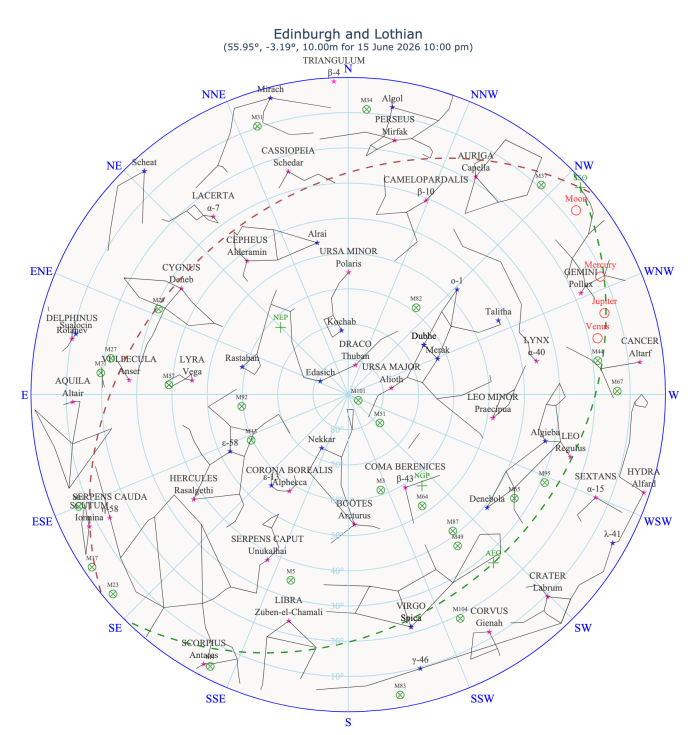
south of the waxing crescent Moon after sunset. Indeed, our skymap shows
Mercury, Venus and Jupiter lurking near the western horizon after sunset
and this, broadly speaking, will be valid for several days each side of
mid-month. Mercury’s orbit becomes retrograde on 29 June. Venus begins the
month in Gemini (The Twins) and ends in Leo (The Lion) but approaches by
31,876,853 km (0.213 AU). The evening star planet increases in magnitude
from -3.95 to -4.05 (1.10 times in brightness) over the month. On 9 June,
Venus will lie 1.6 degrees north of Jupiter. On 17 June, Venus will be
occulted by the waxing crescent Moon as it sets.
For the superior planets: Mars begins the month in Aries (The Ram) and ends
in Taurus (The Bull) but approaches by 11,600,765 km (0.078 AU). The red
planet decreases in magnitude from 1.27 to 1.30 (1.03 times in brightness)
over the month. Mars is leading the Sun but it may be visible in the twilit
dawn rising an hour before the Sun at the start of the month growing to 2
hours by month’s end. Jupiter begins the month in Gemini (The Twins) and
ends in Cancer (The Crab) but recedes by 38,675,691 km (0.259 AU). The gas
giant planet decreases in magnitude from -1.88 to -1.81 (1.07 times in
brightness) over the month.
Saturn remains in Pisces (The Fishes) all month but approaches by
70,077,561 km (0.468 AU). The ringed planet increases in magnitude from
0.88 to 0.78 (1.10 times in brightness) over June. On 10 June, Saturn will
be 4 degrees south of the waning crescent Moon an hour before sunrise. Uranus
remains in Taurus (The Bull) all month but approaches by 28,263,784 km
(0.189 AU). Uranus increases in magnitude from 5.83 to 5.81 (1.02 times in
brightness) over the month. Neptune remains in Pisces (The Fishes) all
month but approaches by 73,753,187 km (0.493 AU). Neptune increases in
magnitude from 7.78 to 7.76 (1.02 times in brightness) over the month.
Neptune reaches western quadrature on 25 June. This makes the orbital angle
between Sun, Earth and Neptune exactly 90 degrees.
This may be the last chance for Jean Schneider’s prediction of integer
orbit accretion to result in the Blaze Star, T CrB in Corona Borealis (The
Northern Crown), flaring into the recurrent nova we anticipate. Not the
best viewing month (even if T CrB is high in the sky overnight) but, after
June, we have no real idea if or when this event will occur!
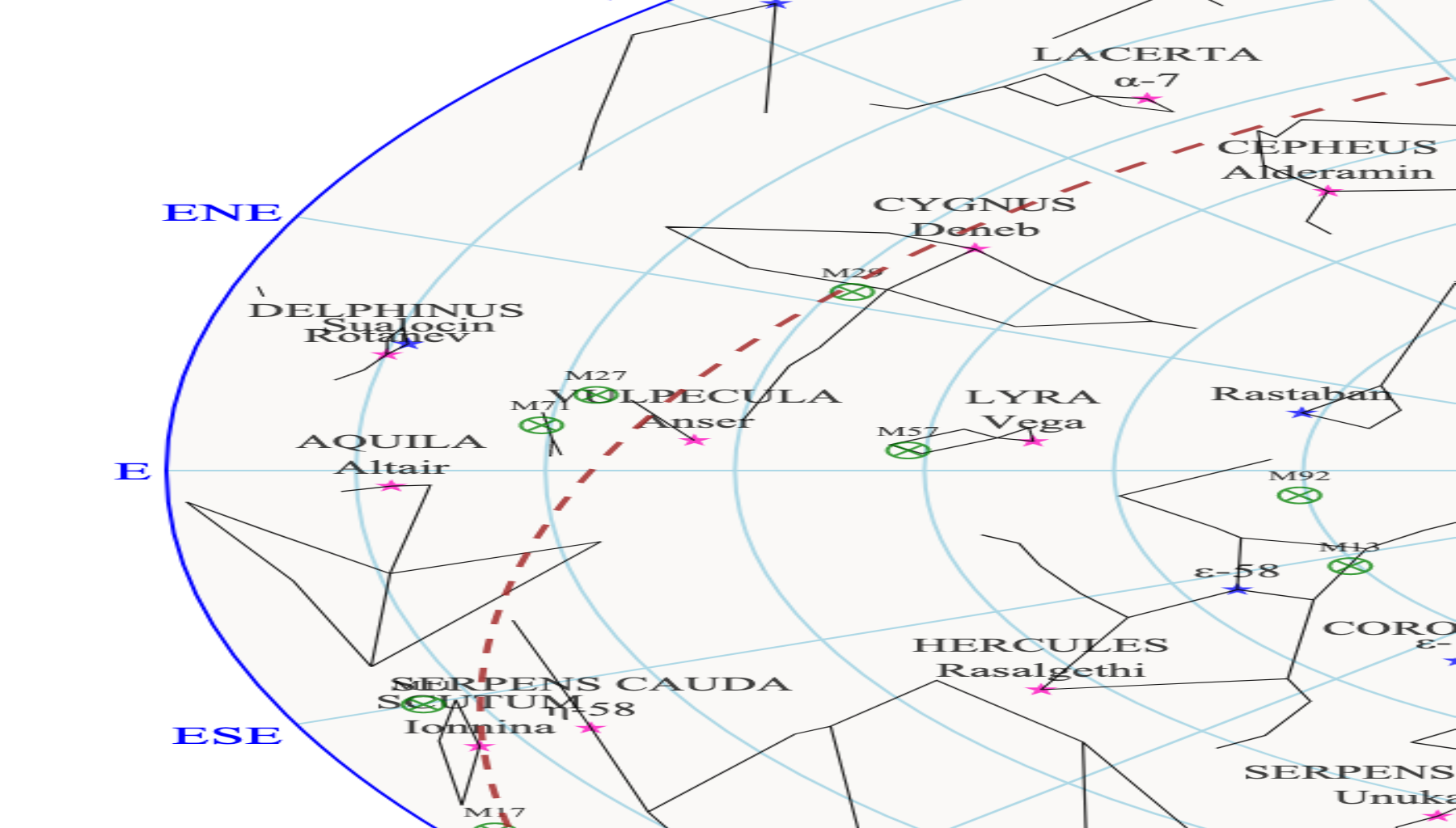
At the time of our sky map, some constellations visible are Draco (The
Dragon) at zenith, Perseus (The Hero) in the north, Cygnus (The Swan) in
the east, Leo (The Lion) in the west, and Serpens Caput (The Snake’s Head)
in the south. The ecliptic hosts Ophiuchus (The Serpent Bearer), Scorpio
(The Scorpion), Libra (The Scales), Virgo (The Maiden), Leo (The Lion),
Cancer (the Crab) and Gemini (The Twins).
The ‘Summer Triangle’—Deneb in Cygnus (The Swan), Vega in Lyra (The Lyre)
and Altair in Aquila (The Eagle)—rises in the east. The ‘Spring
Triangle’—Arcturus in Bootes (The Herdsman), Denebola in Leo (The
Lion) and Spica in Virgo (The Maiden)—is also visible in the south.
Circumpolar constellations—always above the horizon at the latitude of
Edinburgh and Lothian—include Cassiopeia (The Seated Queen),
Camelopardalis (The Giraffe) and Lacerta (The Lizard).
Related