
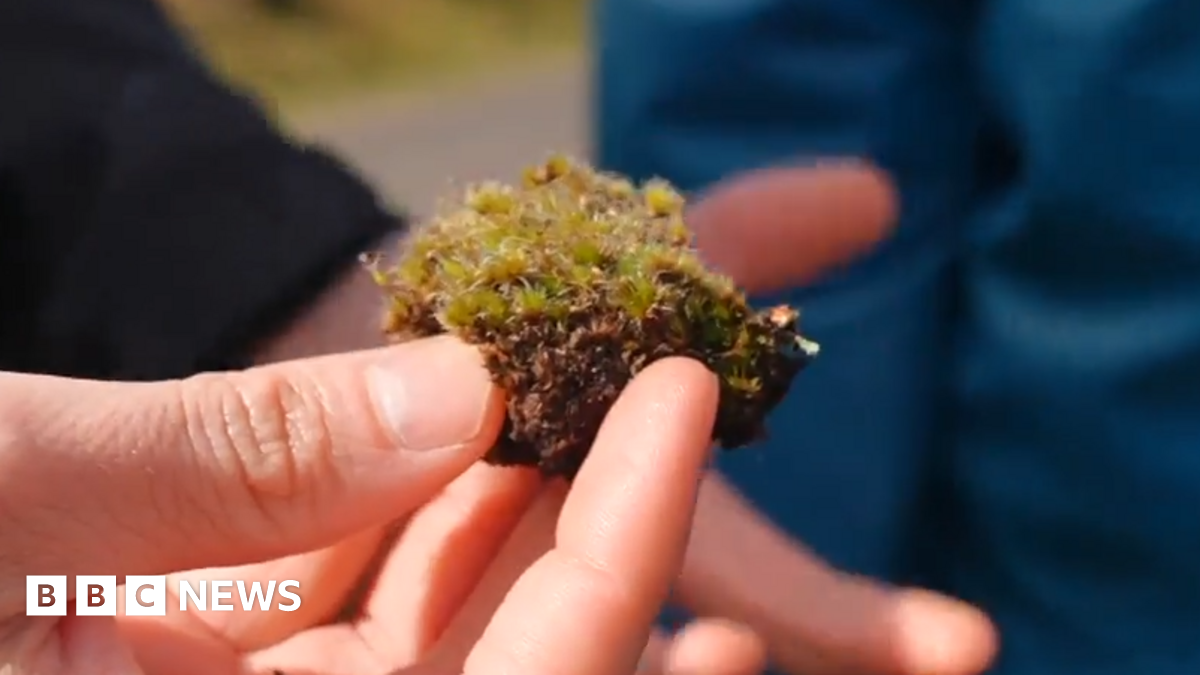
There are more than 1,000 types of moss in the UK. They are the backbone of our most precious habitats like rare temperature rainforests (damp coastal woodlands) and peatlands that store carbon. But they are threatened by non-native plants.
The heath-star moss sends out spores far and wide and reproduces quickly, making it a successful invader.
“The first time I saw it, I had no idea what it was. I threw it in the bin,” says Grieff, who has been working at Amgueddfa Cymru museum in Cardiff.
He’s guiding me along a path in the Bannau Brycheiniog national park near Abergavenny, south Wales.
“In heathlands like this one, native mosses have gone locally extinct or reduced significantly in their populations,” he says.
His eyes are fixed to the ground. He scans the low banks for “patches of death”.
His talent for quiet, careful observation of plants no taller than our ankles is on show.
Just a few metres into our walk, Greiff finds what I’ve come to see. “It’s a big as my hand,” he says, spreading his fingers over a brown ring of dead moss.
Honestly, it is less dramatic than I expected. But our cameraman Gwyndaf Hughes has brought a macro lens, and when I peer through, I see white blobs suspended on the moss tips. It is the fungus at work.