
STRONG INTERESTS:
Officials emphasized the UK’s responsibility to its allies in the Indo-Pacific region, saying that it would ‘stand with those partners when they come under threat’
By William Hetherington
/ Staff writer, with CNA
The UK sends naval vessels through the Taiwan Strait to demonstrate freedom of navigation and uphold the UN Convention on the Law of the Sea (UNCLOS), a senior Royal Marines officer said on Saturday.
The UK also does not oppose vessels from any country transiting the English Channel, General Rob Magowan, commander of the UK’s Cyber and Specialist Operations Command, said during the Shangri-La Dialogue security forum in Singapore. The summit was hosted by the International Institute for Strategic Studies (IISS).
“UNCLOS enables that free flow of trade and people to enable [the] global economy. There should be no no-go areas. The United Kingdom is not proposing that the North Sea or the English Channel or the Irish Sea are no-go areas. These are free and open seas for the global commons,” he said.
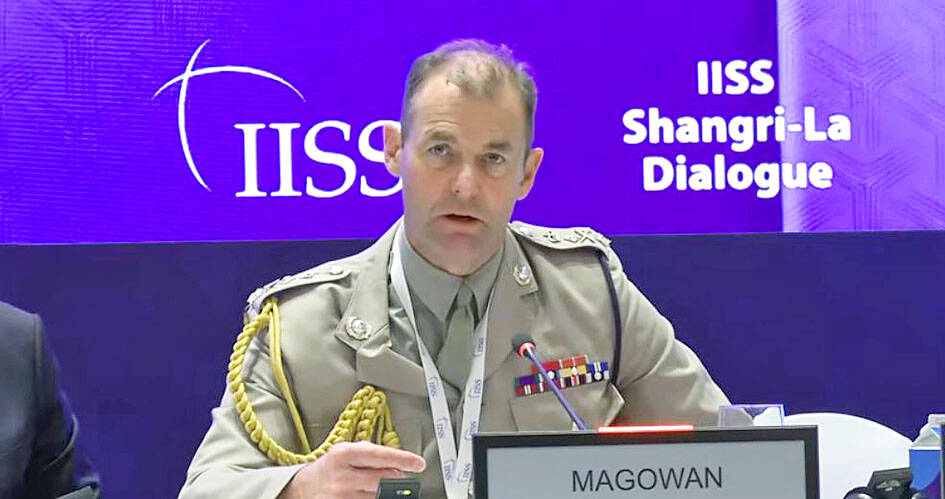
Photo: Screen grab from the International Institute for Strategic Studies’ Web site
Asked by host IISS-Asia executive director Veerle Nouwens on why the UK sends ships through the Strait, Magowan again related the issue to upholding UNCLOS, including in waters near the UK.
“We don’t object to vessels from any nation transiting the English Channel. One or two nations might invite a polite escort from the Royal Navy, but we’re certainly not objecting to enabling that freedom of movement to enable the global economy to prosper,” he said.
Magowan also emphasized the responsibilities of the UK to its allies and partners in the Indo-Pacific region, saying it was determined to stand with those partners when they come under threat. To this end, the UK has a strong interest in the region, he said.
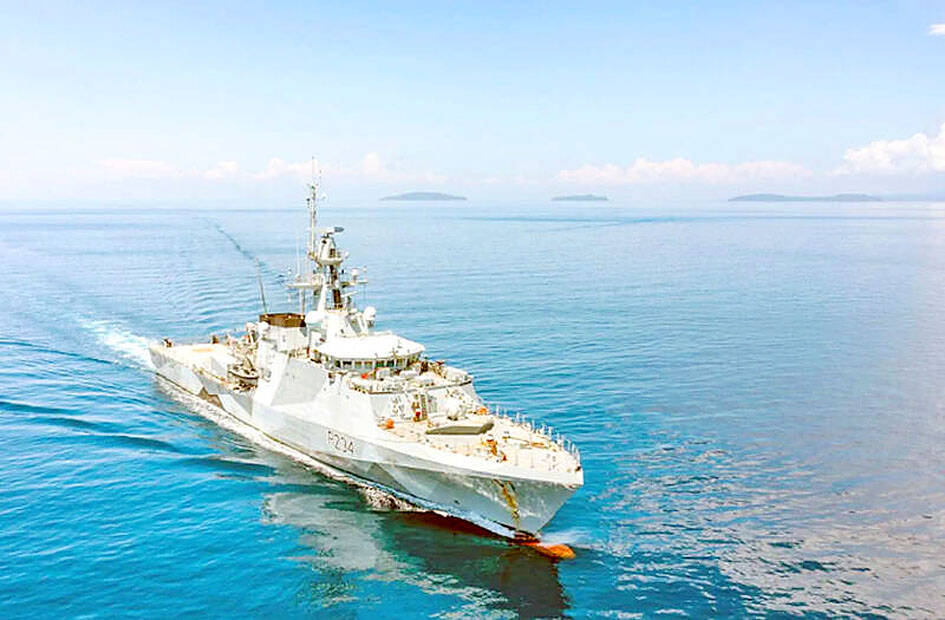
Photo: Screen grab from the British Royal Navy’s Web site
During the panel’s question-and-answer session, Meia Nouwens — who is an IISS senior fellow for Chinese security and defense policy — directed a question at speaker Cui Tiankai (崔天凱), former Chinese ambassador to the US.
Given that Cui has expressed concerns about the blockade in the Strait of Hormuz, which is disrupting the global economy, she asked whether he could provide any reassurances regarding a potential Chinese blockade of Taiwan.
In response, Cui said the conflict in the Strait of Hormuz, which is an international conflict, differs from any potential scenario in the Taiwan Strait because both sides of the Taiwan Strait are “Chinese territory.”
“The question of Taiwan is of an entirely different nature. This is a matter of territorial integrity and national unity for China,” he said.
Cui said that China would be more concerned about a disruption in the Taiwan Strait than anyone else, because trade passing through would be carrying goods that involve “trade with China or by China.”
“But the solution is not very complicated. Actually it’s very straightforward. If the one China principle is upheld, if [there is] no external interference into China’s process of national reunification, then Chinese living on the two sides of the Taiwan Strait would be fully capable of finding a solution and achieving national reunification,” he said.
Cui also criticized foreign navies that transit through the Taiwan Strait saying that such transits remind China of colonial days.
At last year’s forum, former UK chief of the defense staff Admiral Tony Radakin made similar comments to Magowan, saying that maintaining UNCLOS and the principles of freedom of navigation in the Indo-Pacific region were as important to the UK as preserving those principles in the English Channel.
That is why the Royal Navy exercises freedom of navigation rights in the Indo-Pacific region, including in the Taiwan Strait and the South China Sea, Radakin said.
The head of the Chinese delegation at last year’s forum, Lieutenant General Hu Gangfeng (胡鋼鋒), vice president of China’s People’s Liberation Army National Defense University, was seated alongside Radakin during the discussion.
US Indo-Pacific Command Deputy Commander Lieutenant General George Rowell, who also participated in Saturday’s panel, said the US similarly conducts freedom of navigation operations not only in the Taiwan Strait, but around the world, and that such operations are not focused solely on potential adversaries.
Rowell added that the US still hopes to strengthen military-to-military communications with China, although progress has been less than satisfactory.