
Doom Loop
Starmer’s leadership has been dedicated not just to avoiding but to actively suppressing any attempt to take the United Kingdom’s problems seriously.
James Stafford ▪ June 1, 2026
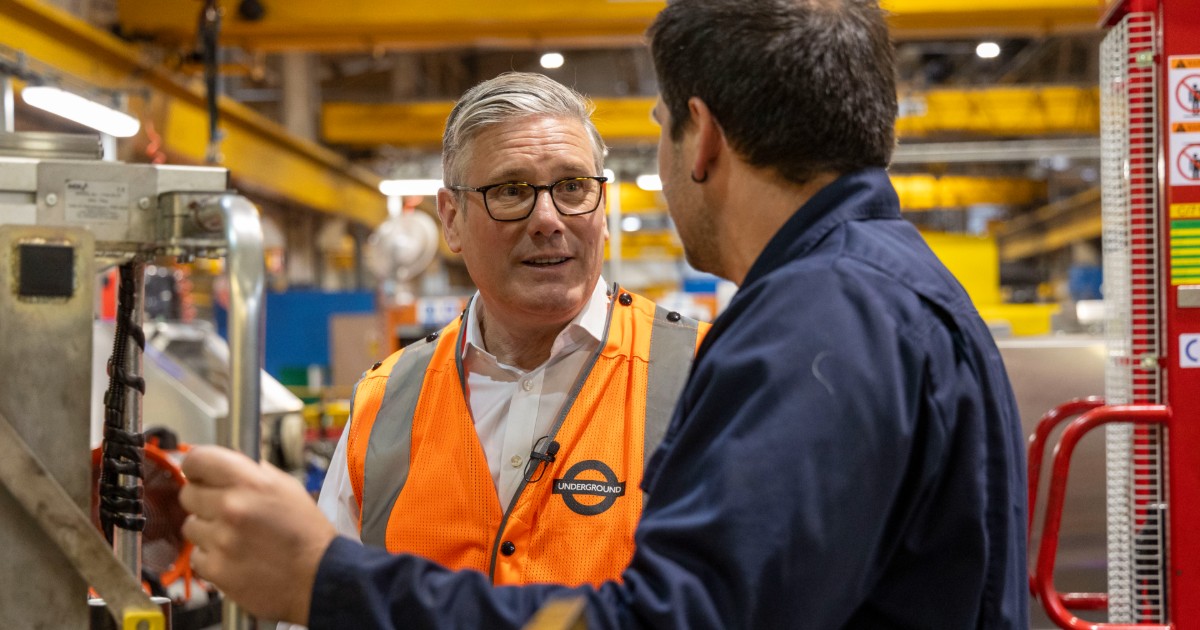
Britain’s Prime Minister Sir Keir Starmer visits apprentices in Chiswick, west London (Simon Jones – WPA Pool/Getty Images)
Less than two years after winning one of the biggest majorities in British political history—411 out of 650 seats in the House of Commons—the governing Labour Party is on the cusp of defenestrating its leader, Keir Starmer, and installing the United Kingdom’s seventh prime minister within a decade. This seems, on the face of it, baffling. Starmer’s administration is deeply unpopular, but it still has three years left in its parliamentary mandate. With a bleak inheritance from the Conservatives compounded by the disaster of the second Trump presidency, even the most daring and effective program would be unlikely to show quick results. Yet under Britain’s highly centralized system of government, a determined Labour administration could use its remaining time to legislate on pretty much anything it wanted to, with a freedom only dreamed of by fragile European coalition governments and a deadlocked U.S. legislature. A putsch, however, risks a party civil war, a bond market revolt, a disastrous early election, or all three. Why court those dangers? How bad can Starmer be?
Worse, it turns out, than anybody imagined. In the May elections for devolved and local authorities, Labour suffered near-annihilation in Wales, deepening marginalization in Scotland, and a precipitous loss of council seats across its erstwhile heartlands in Central and Northern England. Nationally, the party now polls in the teens, half of its tepid yet efficiently distributed vote share in the 2024 general election. It appears increasingly likely that Reform UK, the latest vehicle for Mar-a-Lago courtier Nigel Farage, will form the next government.
Starmer’s Labour promised to bring the United Kingdom a restoration of normalcy much like Joe Biden’s Democrats, upon whom they unwisely modeled themselves. After the wild years of Jeremy Corbyn and Brexit, the grown-ups were back in charge. Now we know, if we didn’t already, that there are no adults in the room. Starmer’s premiership has been defined by confusion and indecision, leavened only by flashes of vindictiveness. Legislation on questions great and small has been repeatedly delayed, botched, and withdrawn; advisers, ministers, and civil servants have been fired and moved around with callous abandon; and a large, inexperienced cohort of Labour members of Parliament has been hectored and threatened rather than humored and managed in the usual fashion. The promise of “stability” that anchored the government’s cautious economic policies has proven illusory, and Labour’s vast majority is no longer a working one, capable of implementing a consistent legislative program.
Defenders of Starmer’s administration—there are some—emphasize that no government, least of all a Labour one, could enjoy popularity under the United Kingdom’s current circumstances. Years of underinvestment in energy, defense, infrastructure, and public services can’t be reversed overnight. The Whitehall machine is underpowered and underpaid, obsessed with procedure and compliance and hollowed out by management consultants. Many essential services are privatized and in foreign hands, as are core state capacities in data management, energy, transportation, and security. The United Kingdom is a heavily indebted importer of energy, food, and investment capital, facing down its third major inflationary shock of the decade. Its government can’t just wish away financial constraints.
Nor, however, can it pretend that orthodox policies can break the country’s doom loop of collapsing living standards, political instability, and rising borrowing costs. The pursuit of alternatives—tax reform, expanded public ownership, a radical constitutional overhaul—demands pugnacious optimism, combined with an appetite for risk and confrontation. What we have instead is a government that seems content to mirror and to magnify the nation’s resentment and despair.
Labour’s political position on entering office was never as strong as it seemed. Cynical to a fault, the party’s 2024 election campaign did not succeed, as its proponents claimed, in bringing working-class Brexit voters “home” to Labour. Instead, it demobilized and depolarized the electorate at large. Starmer’s unthreatening profile meant that depressed Tories felt released to opt for Reform UK or abstain, while anti-Tory tactical voting ensured the efficient distribution of an unenthusiastic Labour vote. Having polled around 45 percent for the previous eighteen months, Labour slumped to a final score of 34 percent, with overall turnout the lowest in a generation. A revolt in Labour’s safest inner-city seats, where prominent allies of the leadership saw their majorities slashed or eliminated by Greens and pro-Gaza independents, was a sign of things to come. Spread thinly across a wide variety of districts—including rural counties that had never elected a Labour MP—this meager plurality gifted the party two-thirds of national representation, the most disproportionate result in British political history.
In government, Labour’s agenda has been shaped by a range of competing projects that betray an absence of coordination, let alone vision. Efforts to deregulate and boost private investment are stymied by harsh immigration restrictions, which constrain labor supply across the vital health and care sectors and foreclose any serious revision of the post-Brexit settlement with the European Union. Welcome, albeit compromised, improvements to workers’ and tenants’ rights have been offset by welfare cuts, increased payroll taxes, and a dependence on private developers for desperately needed housing. Workerist rhetoric coexists uneasily with AI boosterism, as the government rolls out the red carpet for energy-hungry data centers built by the U.S. tech giants. With the retail and hospitality sectors struggling in the face of depressed living standards, unemployment—especially among the young—is creeping up. Despite the piecemeal reconstruction of a publicly owned rail network, investment in transportation infrastructure continues to languish outside the capital. The rolling financial crisis decimating universities is studiously ignored.
The fiscal policy pursued by the Treasury of Chancellor Rachel Reeves, meanwhile, has been panicked and reactive. With no clear electoral mandate for the radical tax changes needed to put public services on a sustainable footing, temporary cash infusions for the military, the National Health Service, prisons, and public schools have been financed by a grab bag of targeted levies and accounting tricks. These stopgap measures have aggravated a range of political constituencies without generating the funds needed to make a tangible difference in how the electorate experiences public services. An egregious attempt to raise extra money by cutting disability benefits was sunk by a major backbench rebellion, saddling the government with the political costs of cruelty without securing any fiscal benefit. The same dynamic unfolded when the government sought to cut winter fuel payments for pensioners and maintain a Tory policy limiting child tax credits for large families. Because the government’s fiscal policy is both improvisational and deeply unpopular, it has failed even in its primary task of reassuring the bond markets: interest rates on government borrowing have crept upward throughout Labour’s time in office.
The one glimmer of structural transformation, an ambitious agenda to drive the decarbonization of electricity generation using a state-owned clean power firm, has been hamstrung by Treasury-imposed funding constraints. UK industrial energy costs remain the highest in Europe, while the government’s efforts to drive electrification in domestic heating and transport are restricted to underfunded subsidy programs and tax breaks. While renewables now account for around half of electricity generation, fossil fuels still supply nearly three-quarters of Britain’s final energy consumption. As a result, the country is unusually vulnerable among its European peers to price spikes and shortages caused by the U.S.-Israeli war on Iran.
While Labour has been cautious when pursuing economic reform, it has been strikingly determined when it comes to upholding the interests of the UK foreign policy and security establishments. The legalist sensibilities of the prime minister are flattered by rote appeals to the necessary pieties: symbolic recognition of Palestine, formal adherence to the European Convention on Human Rights, implausible insistence that U.S. warplanes bombing Iran from British territory are doing so for merely defensive purposes.
Beyond these rhetorical gestures, the drift of many government policies has been toward pure reaction. The Home Office is fighting a quixotic legal battle to proscribe the activist network Palestine Action under anti-terror legislation. Sharp restrictions on jury trials are planned to get through a backlog of criminal prosecutions caused by the budget cuts of the previous administration. Increasing military spending, sold as a means of boosting sovereign autonomy, deepens the country’s dependence on unreliable U.S. suppliers and contractors. Following a wave of anti-refugee riots and Reform’s polling surge, the government is currently seeking a near-elimination of the right of asylum and a radical tightening of the criteria for permanent residency. Home Secretary Shabana Mahmood—the first Muslim woman to hold the position—insists that such measures are necessary to protect “people who look like me” from street violence, which is a product of “legitimate concerns” about weak border control rather than racism. “White liberals” who don’t agree, she told a live podcast audience a few weeks ago, could “fuck right off.”
Many of them, it seems, have done exactly that. At this year’s elections, the Greens picked up hundreds of council seats from Labour in urban England, while the Scottish National Party (SNP) recovered from its 2024 drubbing. Ironically, defections from Labour to the Greens also lay behind many of the party’s losses to Reform, with Farage’s party winning seats in tight five- or even six-way contests. As this suggests, multiparty politics is continuing to play havoc with Britain’s first-past-the-post election system, producing perverse outcomes that further disconnect representation from the popular will.
The most devastating result for Labour came in elections for Wales’s devolved Senedd parliament, which unlike the English councils uses a system of proportional voting. Labour was reduced to a rump of nine representatives, with the left-nationalist Plaid Cymru forming its first ever administration. As every member knows, Labour’s greatest historic achievement, the NHS, was inspired by the medical mutual aid society in Labour Health Secretary Aneurin Bevan’s home village of Tredegar in Blaenau Gwent. Now, the Senedd district containing Tredegar is represented exclusively by Plaid and Reform. The pattern was repeated throughout the southern Welsh valleys and the port cities of Cardiff and Swansea. The result upended the half-century old configuration of Welsh politics, which had largely confined Plaid to the Welsh-speaking uplands while Labour dominated the postindustrial south and the Tories and Liberal Democrats contested the border counties. An immediate push for independence, however, is not on the cards. Instead, Plaid has taken over from Labour as the guardians of a distinctively Welsh social democratic identity, based on a shifting amalgam of class and linguistic allegiance. Wales’s tradition of Brexit-supporting, authoritarian unionism is meanwhile represented by Reform, which holds more than a third of the seats in the Senedd while flirting with its abolition.
Reform also succeeded in corralling a portion of the unionist vote in Scotland, profiting more than Scottish Labour from the travails of an exhausted and scandal-ridden SNP government. It is Reform’s strength in small-town and peri-urban England, however, that places it in pole position for the 2029 general election. Once named “the Brexit Party,” the core of Reform’s current appeal on the right is the claim that the Tories betrayed Brexit by engineering a post-COVID surge in legal migration. This alleged “Boriswave” is conflated in the mind of the right with the trickle of desperate irregular migrants arriving via small boats on the beaches of southern England, creating a powerful image of a nation under siege. Yet Farage seems aware that immigration is not the only issue where Reform could set the agenda. In 2025, he assiduously cultivated older working-class voters, pledging utility renationalization and the reopening of Welsh coal mines and steel mills, and opposed (though only temporarily) Labour’s stance on child benefits and winter fuel payments. Perhaps unsurprisingly, this was the period when the party reached its polling peak of around 30 percent: enough, in a fragmented political environment, for an outright majority next time. Since then, however, its support has slipped back. Emboldened by a series of Tory defections, the party has returned to its neo-Thatcherite comfort zone, promising radical spending cuts in an effort to secure elite consent for a Reform-led government. Its proximity to Trump, once seen as a strength, has become a heavy liability since the attack on Iran; so too its reliance on dodgy donations from offshore crypto and hedge fund billionaires to fund its increasingly slick campaigning operation—not to mention its leader’s lavish lifestyle.
With the election of Zack Polanski as leader of the Green Party in England and Wales last September, meanwhile, Reform lost its monopoly on the anti-system vote. Polanski’s self-styled eco-populism weaves environmental themes into a Corbynite argument about how landlords and privately owned utility firms profit from the never-ending squeeze on the cost of living. Experiences like the recent heatwave, which saw near-bankrupt privatized water firms unable to supply homes in southern England, make the party’s argument for it. Benefiting from widespread revulsion with Labour’s ongoing support for Israel and its broader authoritarian drift, the Greens have made a direct ideological pitch to key Labour voting blocs like younger women and Muslims, while also remaining competitive among low-engagement, Reform-curious voters. With its membership and poll numbers surging to equal and even surpass Labour’s in recent months, the Greens emerged from the May elections with hundreds of new councilors and outright control of several London boroughs, alongside the historic towns of Norwich and Hastings. They made comparable inroads in Greater Manchester, Glasgow, Edinburgh, and Cardiff, securing their status as potential coalition partners for incoming nationalist governments in Wales and Scotland. As with Reform, however, there are factors in play that could set limits to the Greens’ appeal. Its policy demands are still works in progress, and a loosely organized party structure has yet to metabolize a sudden influx of members, ideas, and campaigning energies from the formerly Corbynite left.
As in much of continental Europe, the cosmology of the British party system thus resembles a cluster of minor planets orbiting a fascist death star. Across the United Kingdom as a whole, Reform has roughly a quarter of the vote, with Labour, the Tories, the Liberal Democrats, and the Greens scrapping for shares between 10 and 20 percent. Refusing to accept that fragmentation and polarization are the new normal in politics across the West, Labour has sought to build a hegemonic centrist position by triangulating with the far right. In so doing, they have alienated their core voters while failing to offer a distinctive agenda of their own, focused on what Green, Reform, SNP, and Plaid voters all have in common: deep frustration with the British political economy. There is now every likelihood is that the 2029 election will be a dark mirror image of 2024, with divisions on the left allowing a radicalized right to win a parliamentary majority on a small plurality of the national vote. Should this come to pass, Starmer and his lieutenants will bear much of the blame.
For now, however, Labour is going nowhere fast. With three years still left in power, the decisions the party makes now could make the difference between a surprise comeback and outright extinction. The most straightforward path to a revival lies with the man who is, for now, the nation’s best-liked—or least disliked—politician, Andy Burnham. A former New Labour cabinet minister, Burnham claims to have been radicalized by a decade presiding over the Greater Manchester conurbation (the third-largest in the United Kingdom) as its first directly elected mayor. His national pitch rests on a willingness, still unusual among senior Labour politicians, to mount systemic critiques of the British political system: he is a full-throated advocate of expanded regional devolution, proportional representation, and the abolition of the House of Lords. Supporters on the left tout his re-municipalization of Greater Manchester’s transit network, which has enabled fare-capping and other social measures, as a successful test-case for the cost savings that might be possible if water, gas, and energy were nationalized and public housing were built at scale.
Burnham, however, needs a seat in the House of Commons if he is to challenge Starmer for the premiership. Making his stand in Makerfield, a coalfield constituency on Manchester’s peri-urban fringe, he is betting that his genial brand of economic populism can win back voters from both Reform and the Greens. If he succeeds, a swift coronation beckons; if he fails, a long and acrimonious leadership contest, potentially involving Starmer himself alongside a range of less obvious challengers, will likely ensue. In the meantime, Labour’s cabinet faces an economic and political situation that eerily parallels the one faced by Liz Truss when she succeeded Boris Johnson in 2022. Then as now, a price shock created by a pointless and criminal war of aggression threatens to reduce domestic politics to crisis management. We face the chilling prospect of a listless government, drained of all legitimacy, presiding over scarcity and shortages as far-right street thugs and bond vigilantes circle.
The Iranian fiasco is yet another warning that the United Kingdom can no longer rely on neoliberal globalization and the Atlantic alliance to backstop its economy and security. Amid the crisis, however, the lineaments of a popular social democratic political program are becoming visible. It would begin with urgent temporary measures to stabilize household incomes, combining support for energy and fuel efficiency with targeted subsidies to contain coming cost increases. It would also use the crisis as an argument to increase resilience in energy, water, and housing by developing what Mathew Lawrence, the director of the Commonwealth think tank, calls a “productive state,” capable of reducing costs and increasing reliability through public control and coordination. It would fund that state (in the first instance) with new taxes on land values, capital gains, and other forms of unearned wealth, while also expanding the scope for long-term public investment by founding new state-owned and municipal enterprises, and reforming relations between the Treasury and the Bank of England.
A defense industrial policy focused on the cost-effective development of basic sovereign capacities—rather than on spending big bucks to please the Pentagon—would be the natural complement to such a strategy. So too would a cautious opening to Chinese investment and expertise in clean manufacturing, as modeled by Lula’s Brazil and Pedro Sánchez’s Spain. Tough anti-corruption measures, followed by changes to the voting system to enable it to accurately reflect Britain’s multi-party politics, could start to rebuild political legitimacy, freeing the electorate from wildly disproportionate results and endless tactical voting. The whole ensemble would be tied together by a popular politics of anti-fascism, which resonates with the broad swath of the population still enamored of the myths of liberal Britain, directed against the suitably odious quartet of Trump, Farage, Netanyahu, and Putin. On such a basis, it might even be possible to build a durable national consensus around rejoining the European Union—assuming, that is, that far-right takeovers in Paris and Berlin do not further scramble the bloc’s politics.
The sad thing is that the need for something like this approach has been obvious for years. The right’s disarray following the Conservative crack-up of 2022 offered Labour a generational opportunity to secure a governing majority for a radical, long-term reform project that responded to the realities of the 2020s. At the time, however, Starmer was busily engaged in purging every trace of popular energy and policy innovation from the party’s ranks, in the service of a hollow electoralism that has left Labour without a base and without a governing strategy. Content to punch the bruise of Tory incompetence, the party leadership forgot that economic decay and international chaos would one day come for them as well. The results of that complacency are now plain to see. Starmer’s leadership has been dedicated not just to avoiding but to actively suppressing any attempt to take the United Kingdom’s problems seriously. Now the hour is late, and the sky is darkening.
James Stafford teaches modern European history at Columbia. He co-edited Renewal: A Journal of Social Democracy from 2015 to 2020.