
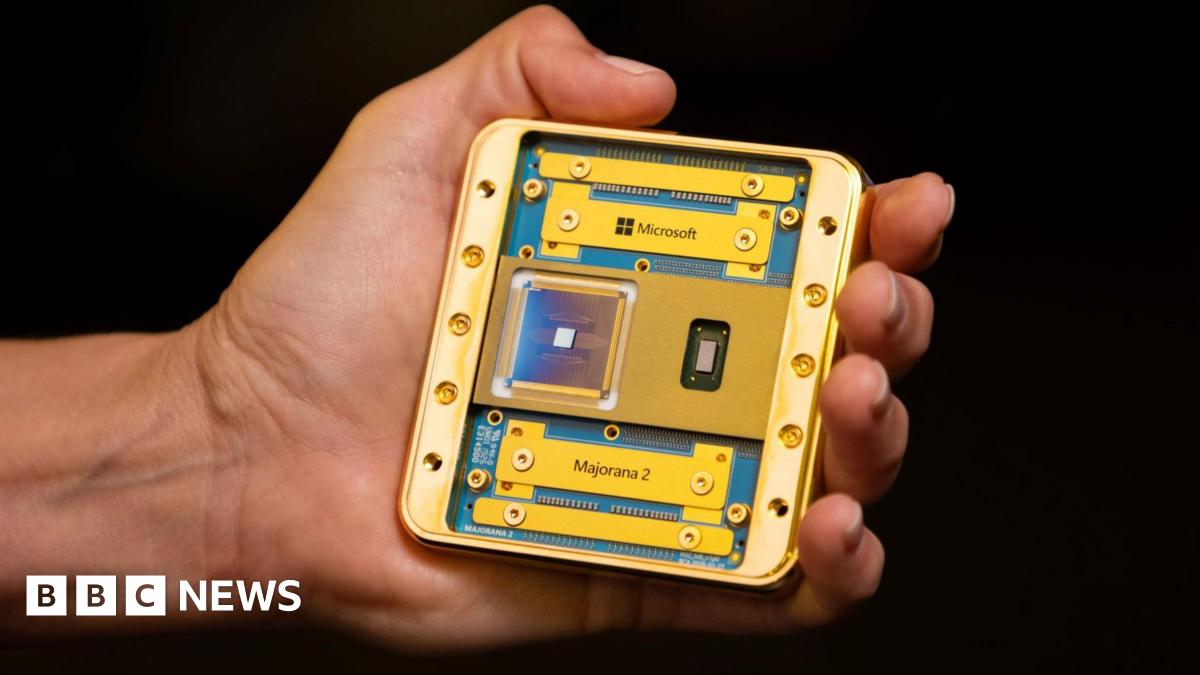
Microsoft’s hoped-for timeline raises the possibility of its quantum computers taking on problems which could take decades to solve, such as getting rid of microplastics, or coming up with better fertilisers for food production.
Zander said he could see a role for humans, AI and quantum computers.
“If you look at removing forever chemicals, getting rid of microplastics, things like that, those are things traditionally, if we take 15, 20, 30 years to figure out that’s a very long time,” he said.
“We want to compress that time cycle as much as possible, and so being able to have humans with AI move quicker and compress that timeframe, I think is actually great.
“So it’s not about eliminating humans, it’s about giving humans tools that can help them accelerate that process, that’s actually going to help society, I think.”
But holding that process back is the fundamental difficulty of quantum computing.
Qubits are extremely fragile and even tiny changes in temperature or a small vibration can affect them and cause errors.
Keeping them going for longer is a big challenge for the entire quantum industry.
Quantum machines are in their infancy and while many companies are racing to build a scalable computer, nobody is known to have succeeded yet.
Some also think we may have written off the computers of today too soon.
“We don’t know what the limit [of classical computers] is,” Sir Demis Hassabis, the co-founder of Google Deepmind, recently told author Sebastian Mallaby in the book The Infinity Mind.