
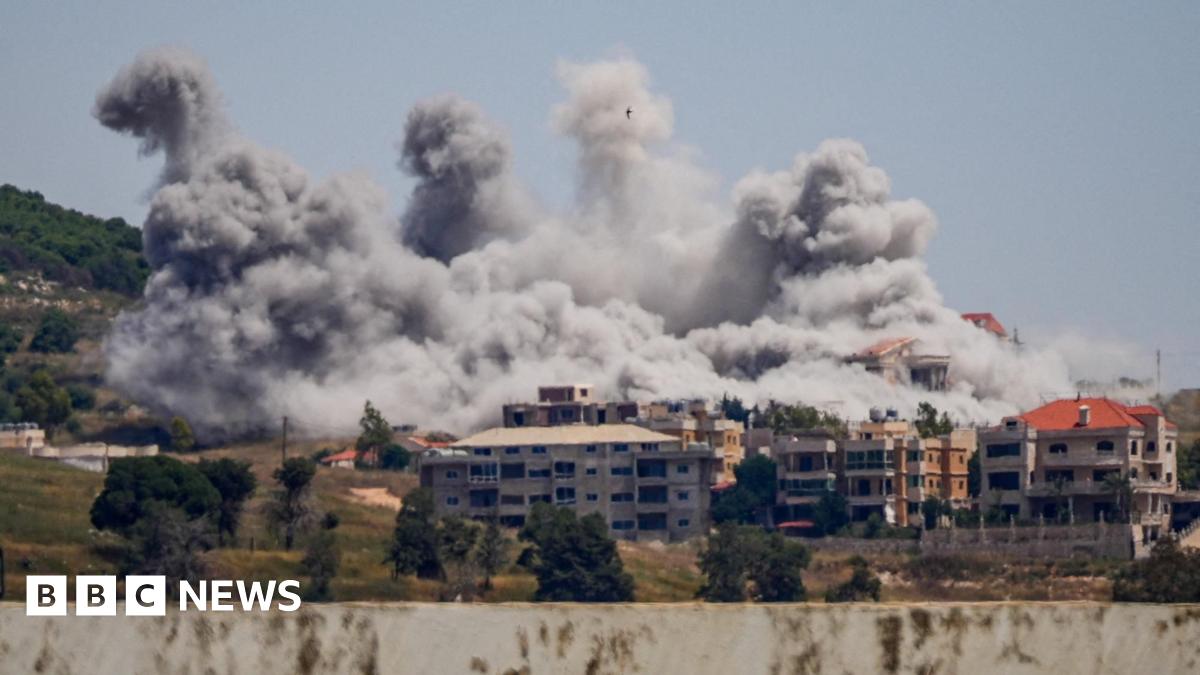
Israel’s leaders have warned that its military would resume strikes on the Hezbollah stronghold of Beirut’s southern suburbs, known as Dahieh, if the group launched cross-border attacks on northern Israeli communities.
According to the Lebanese government, the partial ceasefire agreed on Monday states that “Israel will not launch a broad offensive on Beirut in exchange for Hezbollah refraining from launching attacks against Israel”.
The government said Hezbollah had confirmed its acceptance, but a member of the group’s political council, Mahmoud Qamati, told the BBC on Tuesday: “There was no ceasefire agreement, just the protection of Dahieh.”
Qamati also insisted that Hezbollah would not abide by any commitments made at the Lebanese-Israeli talks in Washington.
“We think these negotiations do not concern us, nor do we recognise their findings or decisions, because we have rejected them on principle,” he said.
At Beirut’s waterfront, where thousands of displaced people are living in tents with limited access to food, clean water and bathrooms, Mariam Hessa said she wanted a ceasefire that covered the whole country.
“I don’t think it’s fair, because always the south is being bombed, and the houses [are] being damaged, destroyed, people are dying,” the 23-year-old student told the BBC.
“I want the ceasefire to be for all Lebanon, not just for an area like Dahieh or even the south. No, it’s for all Lebanon. We need this.”
The partial ceasefire was announced by US President Donald Trump, who on Wednesday appeared to confirm a report that it was brokered after he had called Netanyahu “crazy” in an expletive-laden call prompted by the prime minister’s order to bomb the Lebanese capital.
“I was a little bit perturbed at his constantly fighting with Lebanon,” Trump told the New York Post’s Pod Force One podcast. “At some point, I said: ‘Bibi [Netanyahu], we’ve got to stop this.'”
Netanyahu subsequently agreed to hold off from striking Beirut, but he stressed that the Israeli military would continue operating in southern Lebanon.
When asked about the call in an interview with CNBC, Netanyahu said: “Sometimes, like the best families, we have these tactical disagreements. We always find a way to resolve them.”
Trump is said to be concerned that further escalation in Lebanon could jeopardise a wider deal to end the war between the US, Israel and Iran.
Iran has warned the US that any regional ceasefire must include Lebanon.