
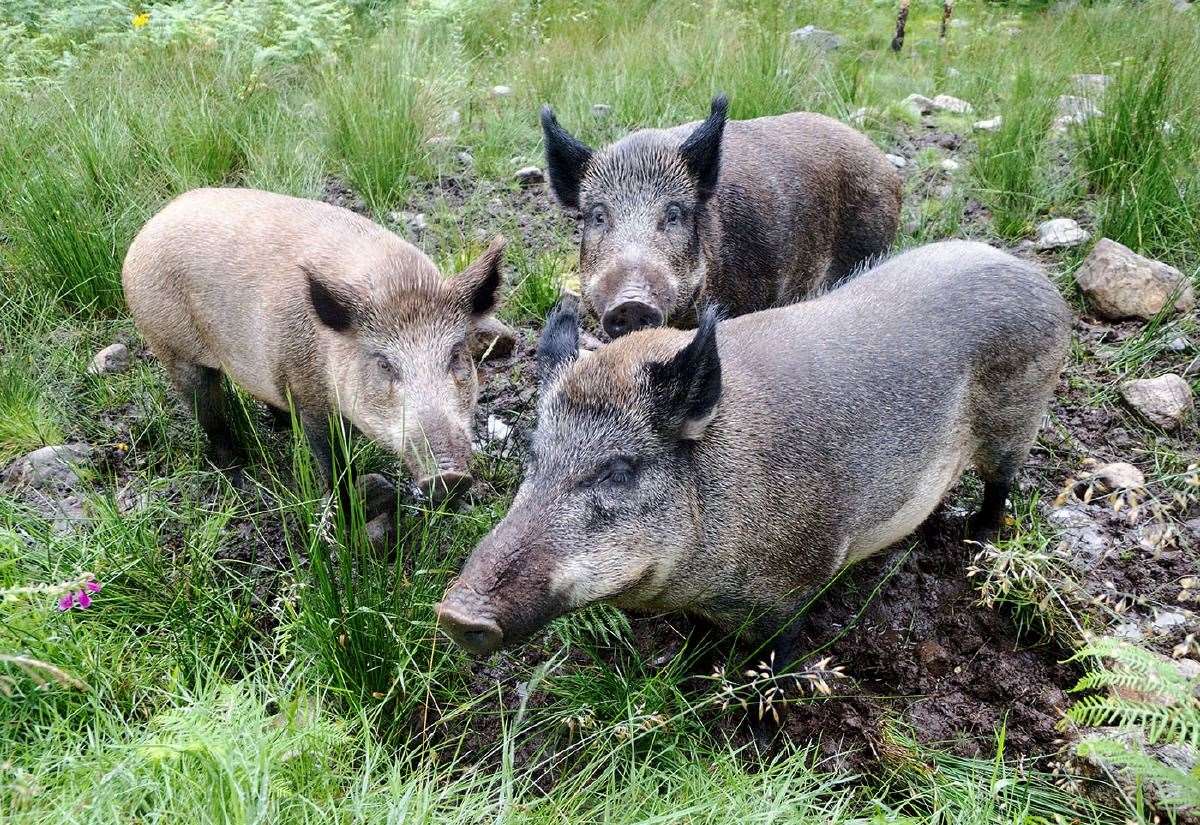
 Wild boar pictured in the Highlands by Julian Paren, CC BY-SA 2.0
Wild boar on a Highland estate have been culled by a rewilding company after recording a “substantial increase” in numbers.
Highlands Rewilding, founded by former director of Greenpeace Jeremy Leggett, said the growing herd of free-roaming boar on Bunloit Estate, near Inverness, had caused “particularly heavy disturbance” to local habitat.
Wild boar were once extinct in the UK but began to re-establish themselves in the 1970s and can now be found in the west Highlands and Dumfries and Galloway.
Less well known populations of wild boar can also be found across Perthshire, north Stirling, Moray and Aberdeenshire.
They likely returned to the wild as a result of accidental escapes and illegal introductions.
And wild boar numbers across Scotland are set to rise significantly over the next 50 years, according to a report last year.
Researchers said numbers are expected to rise from 1472 today to about 2400 by 2075 – an increase of more than 60 per cent.
Their modelling also shows that the animals will explore an additional 131 sq km (50 sq miles) each year.
The research was carried out by the James Hutton environmental research institute, King’s College London and the Zoological Society of London.
Wild boar can help ecosystems by rooting through soil and can support communities through tourism and hunting.
But they can also cause issues such as disease transmission, injury to pets, loss of crops, and damage to land and gardens.
Highlands Rewilding part-owns the 500-hectare estate which operates primarily as a rewilding and nature-restoration project and the company’s “primary scientific test-bed.”
In its annual report, estate workers said a drone survey completed earlier this year found a estimated minimum of 39 wild boar on the land.
The report, published on Tuesday, read: “This count, combined with the regular camera trap surveys, showed a substantial increase in numbers and activity, resulting in particularly heavy disturbance on the pastures.
“As a result, we have undertaken a cull of a small number of boar for the first time this year and will continue to monitor their numbers and behaviour, as well as carry out the transect and quadrat surveys to assess impacts on vegetation.”
Some wild boar were culled by Forestry Land Scotland last year after they were illegally dumped in the Cairngorms.
Wild boar used to be a native species in Scotland before being eradicated in the 13th century because of over-hunting and habitat loss. It is believed there is no such thing as wild boar left in the UK, and the wild roaming hogs are feral pigs.
However, genomic research from Europe suggests that it is difficult to draw clear boundaries between pure and hybrid wild boar.
Calls have been made repeatedly over the last decade by farmers and land managers to introduce a policy to manage numbers in areas with higher numbers given there is no financial or practical support in Scotland, despite some businesses facing damage.
Highlands Rewilding used to own three estates: Bunloit, Beldorney in Aberdeenshire and a 514-hectare estate across Ulva and the Isle of Danna on the Tayvallich Peninsula, all purchased between 2020 and 2023.
By September 2024, Mr Leggett, announced all three had to be sold to pay back a loan he had taken for land restoration work.
Local communities were given first refusal as buyers but with “a very short timeline” of about four months to raise millions.
Mr Leggett said he had hoped to replicate a successful sale of part of the Tayvallich estate, on the west coast, to the local community trust across the other estates, but it did not happen.
Community Land Scotland (CLS) at the time said communities interested in buying one of the estates faced “an almost impossible challenge in funding” in the short timeframe given.
Click here for more environment news.
Do you want to respond to this article? If so, click here to submit your thoughts and they may be published in print.