
The council was forced to install signs warning motorists joining King Street that they should look both ways for hazards, despite the route still being one-way for cars.
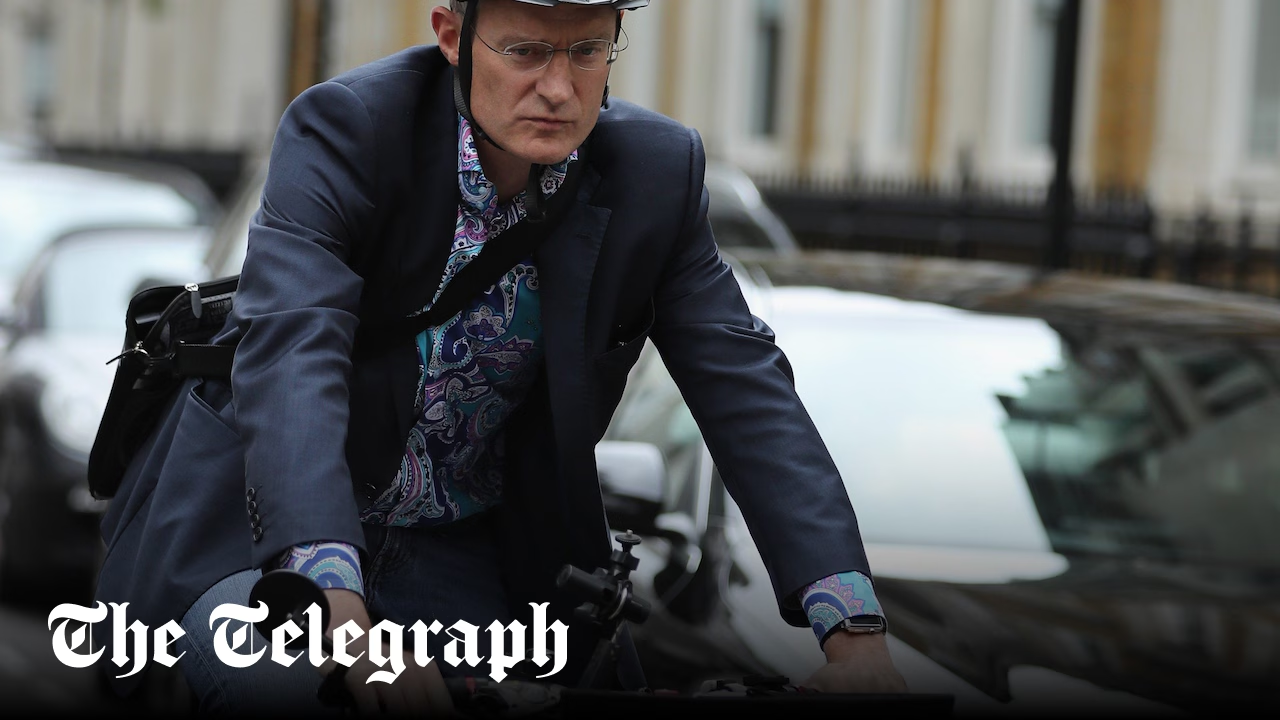
But Vine, the BBC broadcaster and keen cyclist, praised the project, saying cyclists could use the lane confidently at a roundabout that had previously been like “a scene from Ben Hur”.
The collision research, by the Save Our Streets Action Group, has prompted a formal complaint to be lodged with the Local Government Ombudsman. It claims the Labour-run Hammersmith and Fulham council is “falsely” describing the route as being safer.
The group, made up of residents opposed to a series of controversial council and Transport for London (TfL) policies for west London, obtained police summaries of each collision to spot patterns in bike collisions.
It found the majority of cyclist accidents after 2021 took place at junctions, and noted examples of elderly pedestrians being injured at zebra crossings.
An increasing number of cyclists in accidents were categorised as being on a “journey as part of work”, suggesting they were fast-food delivery couriers, although the majority were understood to be commuting cyclists.
The group analysed Department for Transport statistics collated by Crashmap, an online road-safety tool and database.
It found all types of accidents involving bikes increased from 53 in the four years to 2019, to 122 in the four years after the cycle lane was introduced, a 130 per cent rise.
‘They fail to see pedestrians’
A spokesman for Save Our Streets Action Group said the cycleway might be “luring cyclists into a false sense of security” with some “putting their heads down to cycle faster”.
He added: “It means they can fail to see pedestrians, while motorists turning at junctions may not see them.
“The safety issue is compounded by part of the cycleway being a bi-directional bicycle track on a one-way road for cars, resulting in bicycles coming from a direction that drivers don’t expect.
“We have presented this compelling evidence to TfL and the council, but both continue to ignore it, instead pushing ahead with cycle schemes that are likely to be more, not less, dangerous.”
A study of the King Street route by The Telegraph revealed that one third of commuting cyclists rode the wrong way up the one-way street during the morning rush hour.