

World weather forecasting has been “completely upended” by artificial intelligence over the past three to four years, an Oireachtas committee has heard.
Professor Andrew Parnell, Met Éireann Professor of Data Science for Climate and Weather, told the committee that traditional weather forecasts, based on mathematical and physical equations of the atmospheric system, “served us well for the last 70 years”.
However, he said that while advances in this method have saved countless lives, he also noted the remarkable advances that AI has had on forecasting.
“In 2022 the centre for medium range weather forecasting, which is funded by 23 countries including Ireland, introduced its AI weather forecasting system AIFS,” said Prof Parnell, who is also Director of the AIMSIR research institute at UCD.
“Depending on the metric used it beats the latest weather forecasting approaches by 10 to 15%. That is equivalent to a decade of research in a couple of years.”
He said it is in operation since last year and it contributes to daily weather forecasts.
“Perhaps the most remarkable statistic about these new AI methods, it is estimated to be a thousand times more efficient at producing a weather forecast than our previous physics based approaches,” he told the Oireachtas Committee on AI.
“AI weather forecasts can be obtained in a fraction of a second,” he said.
He outlined the advantages, which include that it is open to anyone and those who have the right level of computing can train a new model.
As Prof Parnell continued to outline the benefits, he said the whole field of AI-based weather forecasting started in 2021 by one person who wanted to apply some new methods to data that was available online.
The environmental impacts of Artificial Intelligence was also due to be discussed throughout the committee hearing.
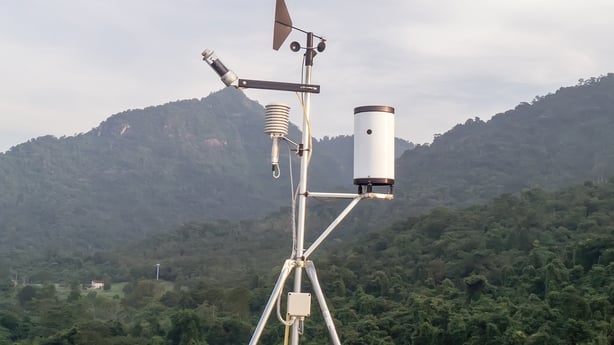
The committee heard that AI has had remarkable advances on forecasting
Prof Parnell explained that it is important to note the difference between this type of AI used for weather forecasting compared to large language models.
“The data sets, they are far smaller, the emissions footprint, even during the training of the AI model is tiny compared to a large language model and smaller than what is already being used to created a traditional weather forecast.”
He said that these models fall outside the remit of the EU AI Act.
He also said that Ireland has excelled at data-driven AI such as research centres and training.
Prof Parnell hopes the committee will continue to support and encourage this.
He said that while there is a lot of negative aspects heard around AI such as data security, defence and use of natural resource, he said this needs support.
The committee heard that the data sources through which Met Éireann contributes are enormously important for international weather forecasting.
He spoke about keeping Ireland at the forefront of the data driven prediction aspect of AI.
Projections show Ireland on track to exceed carbon budgets, cttee told
The committee also heard from Hannah E Daly, Professor in Sustainable Energy and Energy Systems Modelling at UCC.
In her opening statement, she stated that current projections say Ireland is on track to significantly exceed carbon budgets and fail to meet a range of climate commitments.
She said Ireland is the among the first countries in the world to experience the consequence of large scale growth of data centres which are now growing rapidly to serve AI growth.
“Unfortunately Ireland is being viewed as a cautionary tale rather than a model to follow,” Prof Daly said.
She said that while a common claim is that data centres support Ireland’s renewable transition, the evidence to date does not support that conclusion.
“Since 2017, growth in electricity demand from data centres has approximately matched or exceeded the growth in renewable generation meaning that increased renewable supply has not translated into equivalent reductions in fossil fuel use.”
She said that while new policy will require data centres to finance renewable projects, she believes it is likely to lead to significant new gas demand and emissions.
She said current national energy and emissions projections do not account for the implications of additional data centre demand that may arise under the LEU connection policy.
Prof Daly warned how Ireland has adopted legally binding carbon budgets while simultaneously adopting economic policy which facilitates a pattern of energy demand growth which is not compatible with achieving them.
“The issue is whether we are willing to acknowledge different forms of growth have consequences and whether those consequences are being honestly accounted for in the development of public policy, “she said.
She outlined her recommendations which included independent analysis of data centre energy use and emissions and renewables procurement placed as a priority.
She said at the moment decisions are being made without long term implications.
Today’s committee meeting is being chaired by Fine Gael TD James Geoghegan after Fianna Fáil TD Malcolm Byrne said he was stepping down as Chair of the Joint Oireachtas Committee last week.
It followed his arrest on suspicion of drink driving.