
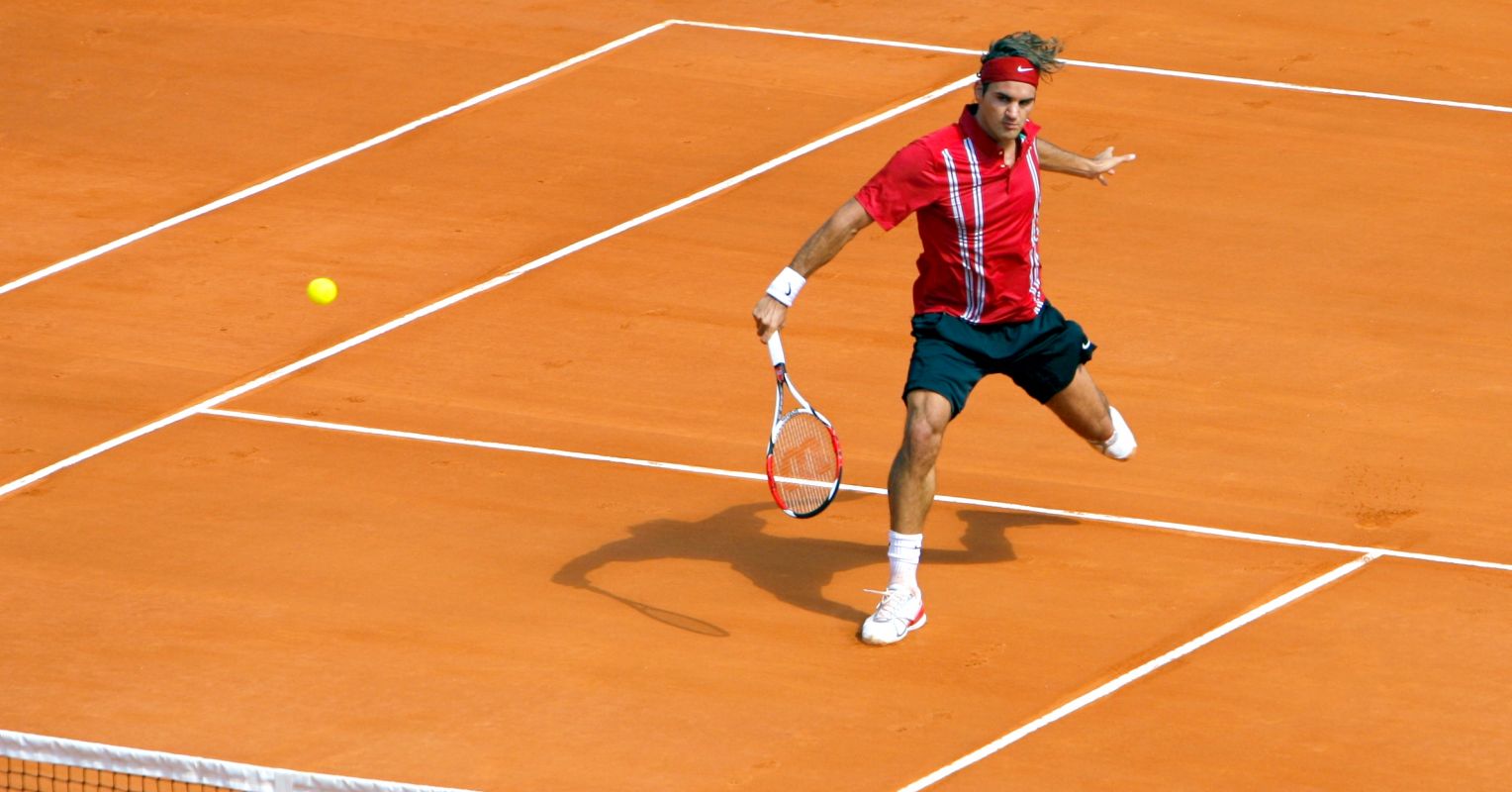
When Roger Federer gave the commencement address on a rainy Sunday at Dartmouth in 2024, he said something the graduates did not expect from a man whose tennis game was so smooth people frequently called it “effortless.”
He hated that word.
“Effortlessness is a myth,” he told them. He had won almost 80 percent of the 1,526 singles matches he played — but across all of them, he had won only 54 percent of the individual points. One of the greatest athletes who ever lived lost nearly half of every point he ever played.
What he had built was a psychological skill: the capacity to lose a point, release it, and walk to the next one with a quiet mind. To fail at the highest possible rate and stay regulated enough to keep going. It is the work of building a self that can tolerate failure.
I think about this a great deal, because we are quietly building the opposite. The conversation about young people and technology has narrowed to a worry: What are screens and chatbots doing to their attention? I want to ask a different question: What happens to a mind that is rarely allowed to struggle?
The Children I Worried About Most
In more than 20 years as a child psychiatrist, some of the young people I worried about most could not bear the feeling of not knowing. The moment something turned hard — a problem they couldn’t solve, a page they couldn’t follow, a feeling they couldn’t name — they reached for relief. They quit, or came apart, or handed the difficulty to someone else.
Effort has a feeling, and it is an uncomfortable one. It is the friction of trying something you cannot yet do, the frustration that rises when the answer won’t come, the small voice that says you are not the kind of person who can do this. Psychologists have a dry name for the ability to stay with that feeling: Distress tolerance. I think of it more simply as the capacity to remain in difficulty without fleeing it.
It develops slowly, through experience, by being inside hard things and discovering, again and again, that we came out the other side. A mind that has never been asked to tolerate difficulty grows fragile. It reads ordinary effort as a threat.
The wish to escape that feeling is one of the oldest things in us. AI changed how easy the escape has become. A young person can now be handed a finished answer to almost anything, instantly, before the discomfort of not knowing has a chance to do its work.
What the Mind Is Actually Building
Every time a person works through something they were sure they couldn’t, they learn something about themselves that no one can simply tell them: I can do hard things. That belief is the residue of having actually done it. It is laid down one difficult experience at a time, and it cannot be installed from the outside.
No One Struggles Alone
The studies of expertise — the ones Malcolm Gladwell popularized as the 10,000-hour rule — were never only about hours. What mattered was the structure of those hours: time spent on what you cannot yet do, effortful and uncomfortable by design. But the research never fully asked the question that has tugged at me for years: Who keeps people coming back after they fail?
In every story like this, there is such a person.
For Federer, it was Peter Carter, the coach who worked with him from age 10 to 14 and taught him how to lose a point and stay calm enough to win the next one. Federer has said that without him, he would not have become the player he became. What Carter built in that hot-headed boy was regulation — the capacity to quiet his own alarm before it hijacked the next moment.
I know it from the inside, too. Before I understood any of this, I was a slow reader and a slower memorizer in medical school, and I survived it by sitting in the library night after night, converting everything I read into outlines in my own hand until the words finally got into my brain with meaning. What made those nights bearable were the people who had seen something in me before I could see it myself — my psychiatrist and the teachers and friends who refused to let me believe I was destined for less.
A child can tolerate a great deal of frustration when she is not facing it alone. Take the relationship away, and the same difficulty becomes unbearable. The connection is what makes the struggle possible.
What a Machine Cannot Do
We do not know what happens to a mind that was meant to be built through years of effortful practice when the practice is replaced by an instant answer. But I know what a mind requires, and none of it is produced by ease.
A student who asks an AI tool to summarize a paper she never struggled to understand has not done the thing that changes a person. Her attention never narrowed to one hard idea for an hour. She never got to the far side of I can’t do this and discovered that she could. A week later, she will remember reading about the paper, not the paper itself. She will not have collected the evidence that she is someone who can sit with something hard and prevail.
I am not against these tools. I use them, as many of you do. But we have to be honest about what they cannot do. They can give us the answer. They cannot give us the experience of having found it. What you practice, you build. What you offload, you lose.
Staying Through Struggle
The impulse to spare the people we love from struggle is one of the most loving impulses there is. When a child pushes the hard thing away, every instinct says to step in, soothe, solve. But the most generous thing we can do is harder: to stay close while they stay in the difficulty, to be the steady presence that makes it survivable.
The reach for something just past what you can do is the moment a mind grows. And the discovery on the other side — that you did not fall apart, that you are more capable than you feared — is something no tool can hand to a person. It has to be earned. Our job is to be there while they make it.
Federer’s “effortlessness” was a myth because every shot had been earned, in struggle, with a coach beside him who taught him how to lose. He left the graduates with a charge. You are going to lose a lot, he told them — you can’t win everything, and no single point decides anything. What matters is the whole match, the whole adventure. “Go for your shots. Play free. Try everything.”
That is the inheritance we are deciding whether to pass on. We can hand young people the answer to everything and ask them to struggle with nothing, and raise a generation that never finds out what it can survive. Or we can do the harder thing: stay close while they go for their shots and miss, while they lose the point, while they try something and fail — and discover, one hard thing at a time, that the losing did not break them.
That, not the winning, is the whole match.