
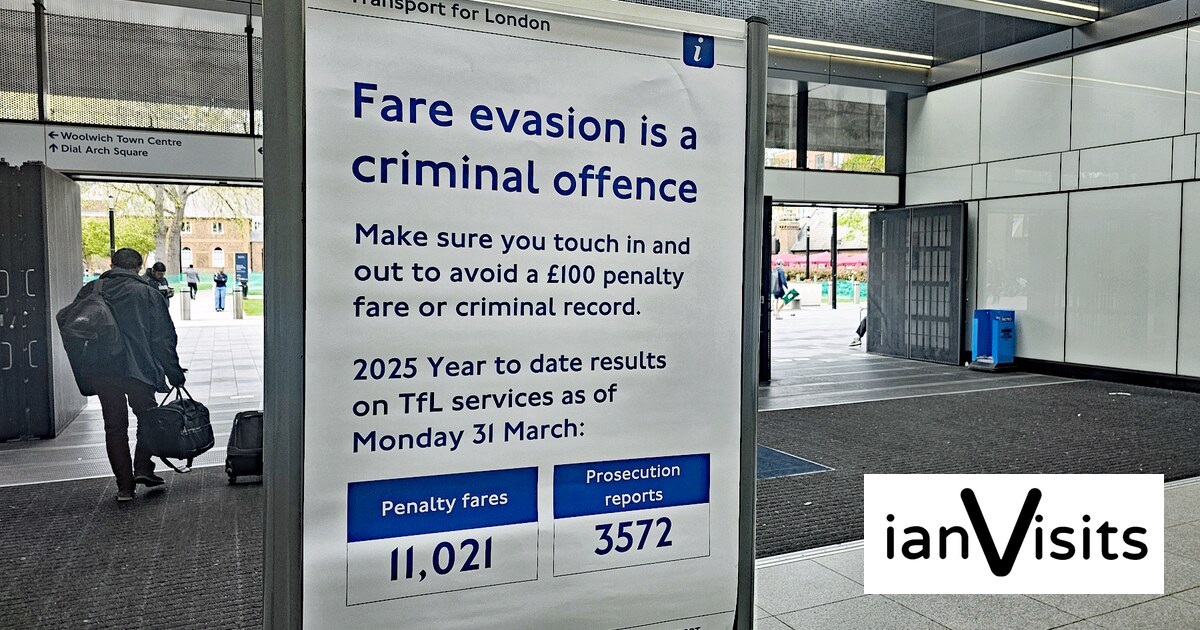
A fare evader who admitted to 181 offences after repeatedly travelling using a bank card on TfL’s denied travel list has been convicted as Transport for London (TfL) steps up enforcement across its network.
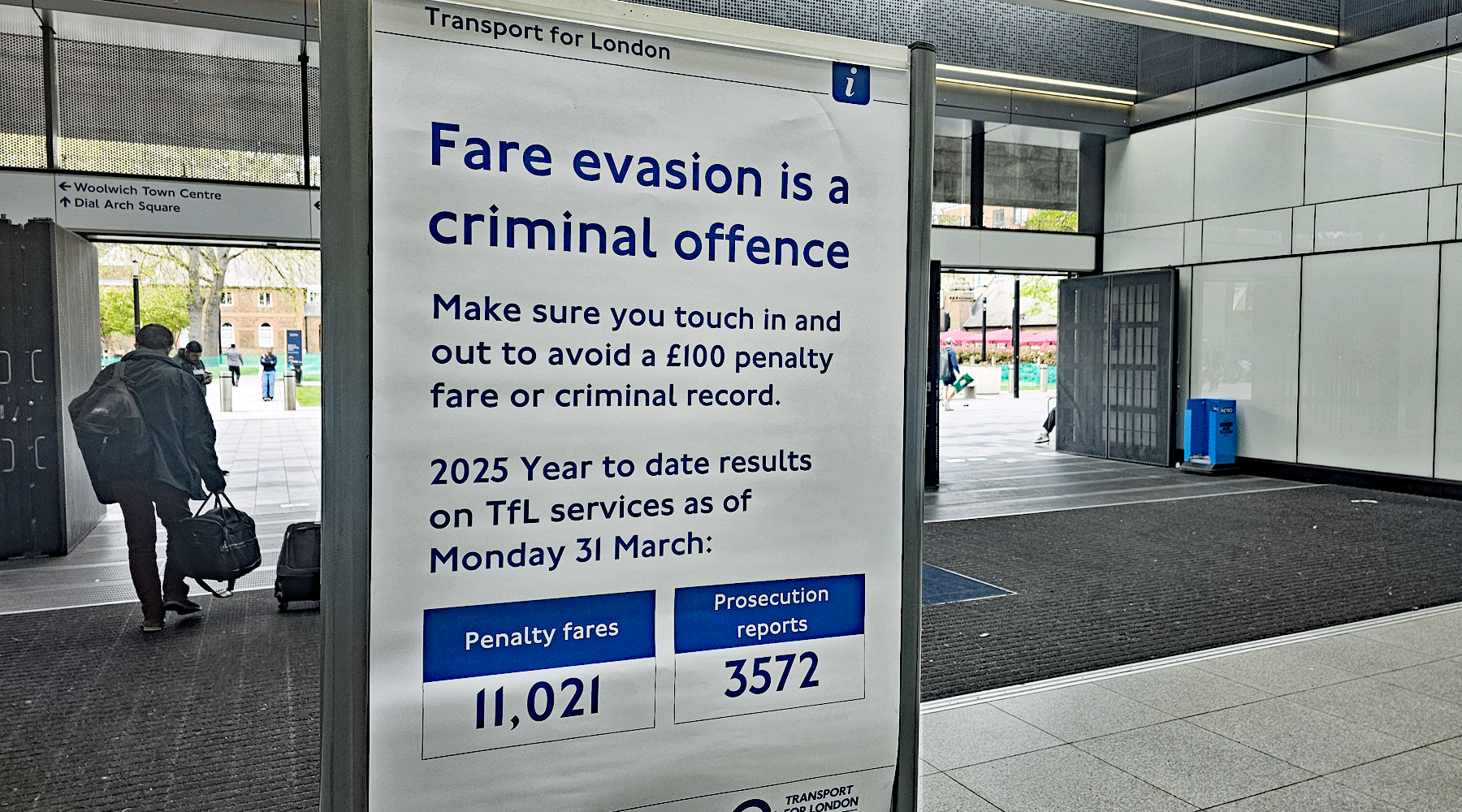 TfL fares evasion poster (c) ianVisits
The individual pleaded guilty at court in February following an investigation by TfL’s dedicated fare evasion team and was ordered to pay £2,131 in costs and compensation, most of which will be returned to TfL.
The case comes as newly released figures from TfL show that it significantly increased fare-evasion enforcement during 2025/26 as part of its strategy to reduce fare evasion to below 1.5% by 2030/31. In the year to March 2026, TfL says it increased the number of card checks by over 50%, to 6.9 million inspections. They also checked 3.3 million bus passengers, around 400,000 more than the previous year
As a result, just over 69,000 penalty fares were issued – up by 9% on the previous year, and 21,522 reports for possible prosecution. TfL also secured 14,406 fare evasion convictions during the year, 955 more than in 2024/25, helping to increase court awards by 24.6% to £2.6 million.
TfL says that contactless payment fraud has become a major focus for its enforcement teams, with investigators increasingly targeting repeat offenders and identifying suspicious travel patterns through data analysis.
The transport authority is also continuing its efforts to tackle more visible forms of fare evasion. During the past year, enforcement officers reported 4,428 people for possible prosecution for gate-pushing, where passengers force their way through ticket barriers without paying.
For safety reasons, barriers need to be able to be pushed open. Although TfL has been trialling a design that might be more resistant to this, it is still necessary to ensure that they can be easily pushed open.
Staff are explicitly told not to stop people from doing that, as it can put them in danger of assault. Revenue disputes are linked to around 40% of all reported incidents of work-related violence and aggression towards frontline staff. It’s safer and more effective to pass CCTV footage to the enforcement teams.
To support increased enforcement, TfL is expanding its Transport Support Enforcement team by 50 officers, including 36 dedicated to night-time duties.
TfL estimates that fare evasion in London now stands at 3.5% of journeys, down from 3.9% in 2022/23. The authority says London’s rate remains lower than that of many comparable cities worldwide.
The figures are the first full-year results since TfL launched its fare evasion strategy in April 2025, introducing a more intelligence-led approach combining targeted investigations, expanded enforcement activity and data-driven analysis to identify repeat offenders.
TfL recently revealed that it is running a trial where it can revoke the “implied permission” to use public transport from people who are arrested for violent behaviour but are still waiting for trial.
A formal ban from public transport usually requires a court conviction, but TfL can revoke the implied permission on its own and has been working with the British Transport Police (BTP) to see whether this can act as a deterrent. The 12-month trial is being conducted at several stations in west London.