
Your support helps us to tell the story
From reproductive rights to climate change to Big Tech, The Independent is on the ground when the story is developing. Whether it’s investigating the financials of Elon Musk’s pro-Trump PAC or producing our latest documentary, ‘The A Word’, which shines a light on the American women fighting for reproductive rights, we know how important it is to parse out the facts from the messaging.
At such a critical moment in US history, we need reporters on the ground. Your donation allows us to keep sending journalists to speak to both sides of the story.
The Independent is trusted by Americans across the entire political spectrum. And unlike many other quality news outlets, we choose not to lock Americans out of our reporting and analysis with paywalls. We believe quality journalism should be available to everyone, paid for by those who can afford it.
Your support makes all the difference.Read more
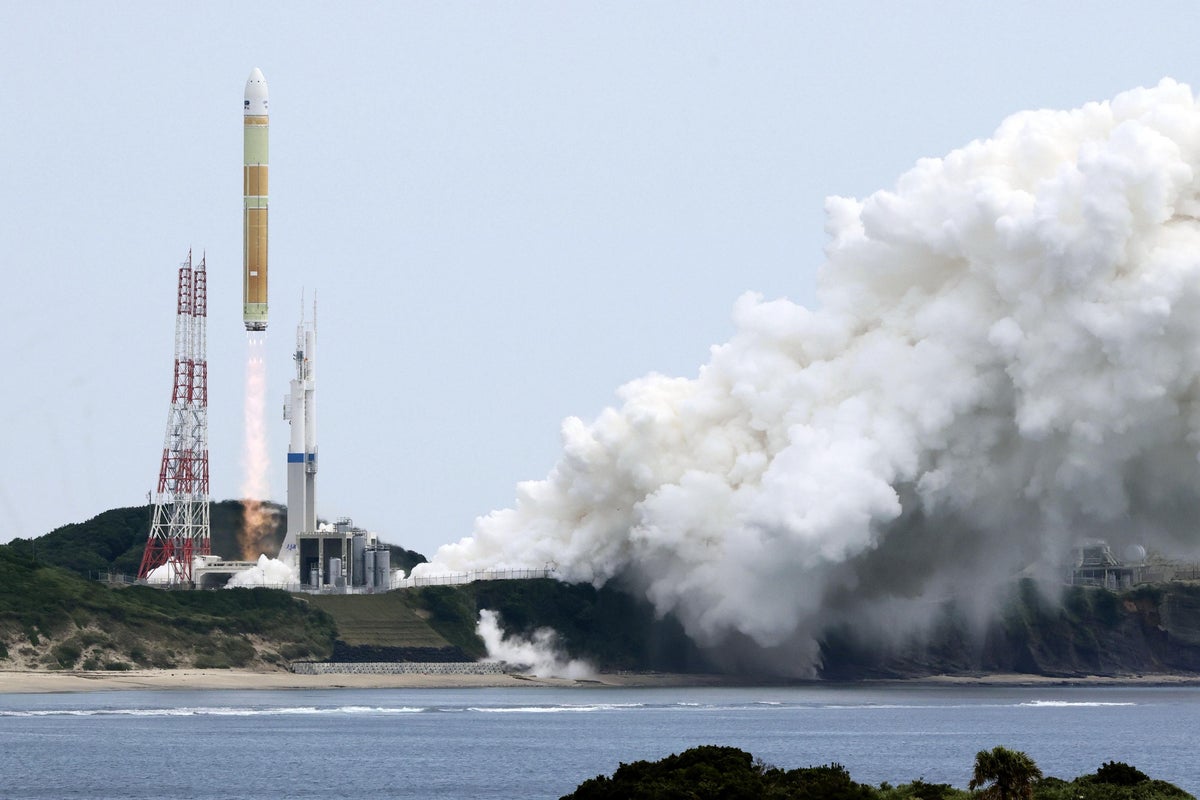
Japan’s H3 rocket returned to flight Friday with the debut of a new low-cost variant, a badly needed success for the country’s new flagship rocket that has struggled with mission failures while facing an increasingly competitive space industry.
The H3 rocket took off from the Tanegashima Space Center on a southwestern Japanese island Friday morning and its second stage successfully reached a targeted orbit, the Japan Aerospace Exploration Agency said during its livestreaming.
Six small satellites developed by universities and other organizations carried by the vehicle also were believed to be successfully separated, JAXA said.
Friday’s mission marked the debut for the H3’s new “30 configuration” equipped with triple liquid-fuel LE-9 engines and no rocket boosters, which is intended to be a low-cost version making the series more competitive. The variant is one of three designed to accommodate a wide range of customer needs.
The sixth successful launch comes after two failures for the new model that replaced the mainstay H-2A, which had a near-perfect success record.
The H3 rocket is designed to be more cost effective in the global space market dominated by Elon Musk’s SpaceX. Japan sees a stable, commercially competitive transport capability as key to its space program and national security.
During its debut flight in March 2023, the H3 failed to ignite its second-stage engine. Then in December, the rocket launched with a navigation satellite but failed to put the payload into a planned orbit due to a malfunctioning second-stage engine.
The H3 had been grounded since December and a third failure on Friday would have been a major blow to Japan’s future space projects, including a Mars mission planned for 2028. A smaller Epsilon S series also has been delayed since it caught fire during a test in 2024.
JAXA and Mitsubishi Heavy Industries, which are co-developing the rocket, hope eventually to launch H3 six to eight times annually.