
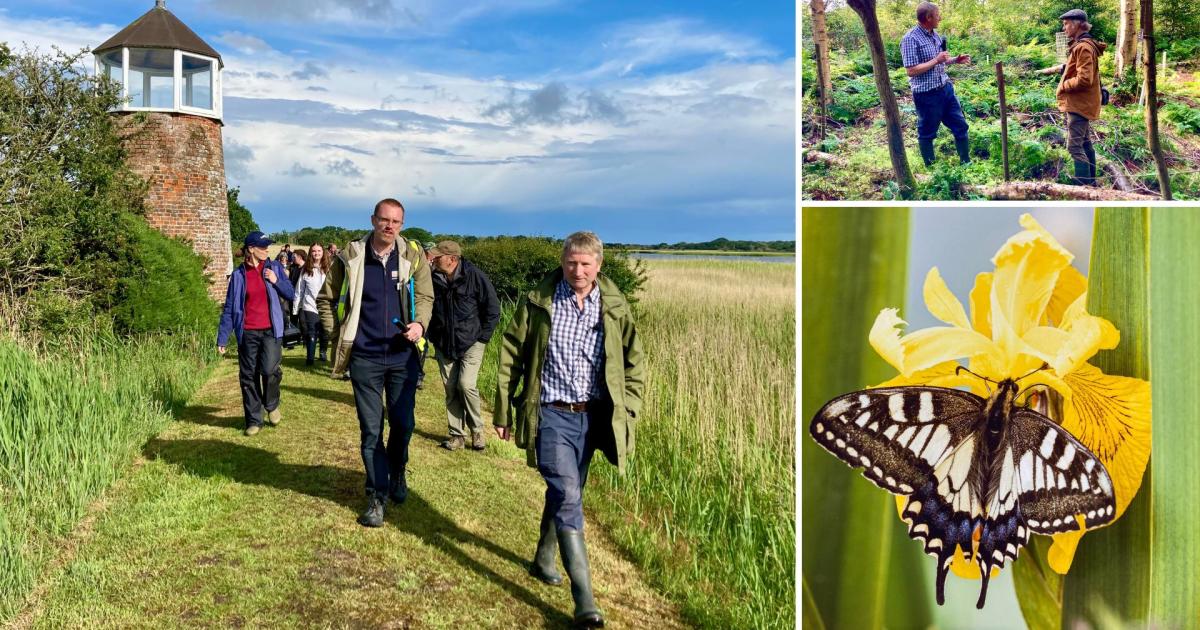
Willow Farm at Hickling is this year’s winner of the Ian MacNicol Memorial Trophy, awarded annually by Norfolk FWAG (Farming and Wildlife Advisory Group) to recognise farms which successfully integrate conservation within commercial food production businesses.
Farmer James Tallowin said his family felt a sense of duty to protect the “special” biodiversity on their land, which borders Hickling Broad and its Norfolk Wildlife Trust reserve.
James Tallowin led visitors on a tour of Willow Farm at Hickling, winner of the 2025 Ian MacNicol Memorial Trophy for farm conservation (Image: Chris Hill)
Parts of the farm have been managed under stewardship schemes since 2005 and, in the last 20 years, 180 bird species have been recorded along with 11 bat species and 650 types of moth.
But while conservation efforts are focused on woodlands, hedgerows, field margins, reed beds and grazing marshes, the business retains its focus on commercial food production.
About 80pc of the 230ha farm grows arable crops, and it also operates a poultry unit housing 80,000 broiler chickens.
“Although we have prioritised conservation on our farm, we are still farming the middle of the fields quite intensively to try and grow the best crop we can, and we are giving wildlife space around the edges,” said Mr Tallowin.
James Tallowin led visitors on a tour of Willow Farm at Hickling, winner of the 2025 Ian MacNicol Memorial Trophy for farm conservation (Image: Chris Hill)
“When I was brought up here, I think the love of nature came because we were in this special habitat.
“We’ve got the biggest of the Norfolk Broads on one end of the farm and the nature reserve on the other with the rare species like the bitterns and the cranes. We have seen these rarities come and we feel it is part of our responsibility to look after them. There is definitely some motivation coming from that.
“Arable farms can complement a nature reserve, and I think we have illustrated here how they can work together.”
James Tallowin outside the poultry sheds at Willow Farm in Hickling (Image: Chris Hill)
Mr Tallowin said he was keen to offset the environmental footprint of the poultry business, and its high energy consumption – installing 120kW of roof-mounted solar panels on the poultry sheds, a 200kW battery to store surplus renewable energy, and a 550kW biomass boiler.
“In most people’s eyes that would be considered intensive farming, but the other side of high efficiency farming is the fact that it spares more land for conservation,” he said.
Mr Tallowin welcomed visitors for a farm walk to celebrate the award, leading a tour that included flower-rich field margins, areas of managed woodland and grassland grazed by cattle.
James Tallowin led visitors on a tour of Willow Farm at Hickling, winner of the 2025 Ian MacNicol Memorial Trophy for farm conservation (Image: Chris Hill)
He said: “It was a great honour to win the award, and nice to be recognised, both as farmers and as conservationists.”
A Norfolk FWAG spokesman said: “At Willow Farm the judges were impressed by the range of grassland and fen habitats managed by the farm for biodiversity, where an amazing array of wildlife has been recorded. In addition, the farm manages a busy commercial arable and poultry farm whilst recognising their responsibilities to protecting neighbouring nature reserves.
“The farm are keen to balance the needs of their crops with the needs of the environment, and therefore manages its use of inorganic fertilisers carefully.
“The farm also undertakes a number of educational visits on farm to explore the history of farming in the area, using an old converted barn, and has created a permissive access path for local villagers to help bypass a busy road. They are deserving winners of the 2025 award.”
A kingfisher at Willow Farm in Hickling (Image: John Tallowin)
A swallowtail butterfly at Willow Farm in Hickling (Image: John Tallowin)
Cattle on the grazing marshes at Willow Farm in Hickling (Image: Chris Hill)
James Tallowin of Willow Farm in Hickling, winner of the 2025 Ian MacNicol Memorial Trophy for farm conservation (Image: Chris Hill)
One of the 650 species of moths found at Willow Farm in Hickling (Image: Chris Hill)
A red kite at Willow Farm in Hickling (Image: John Tallowin)