
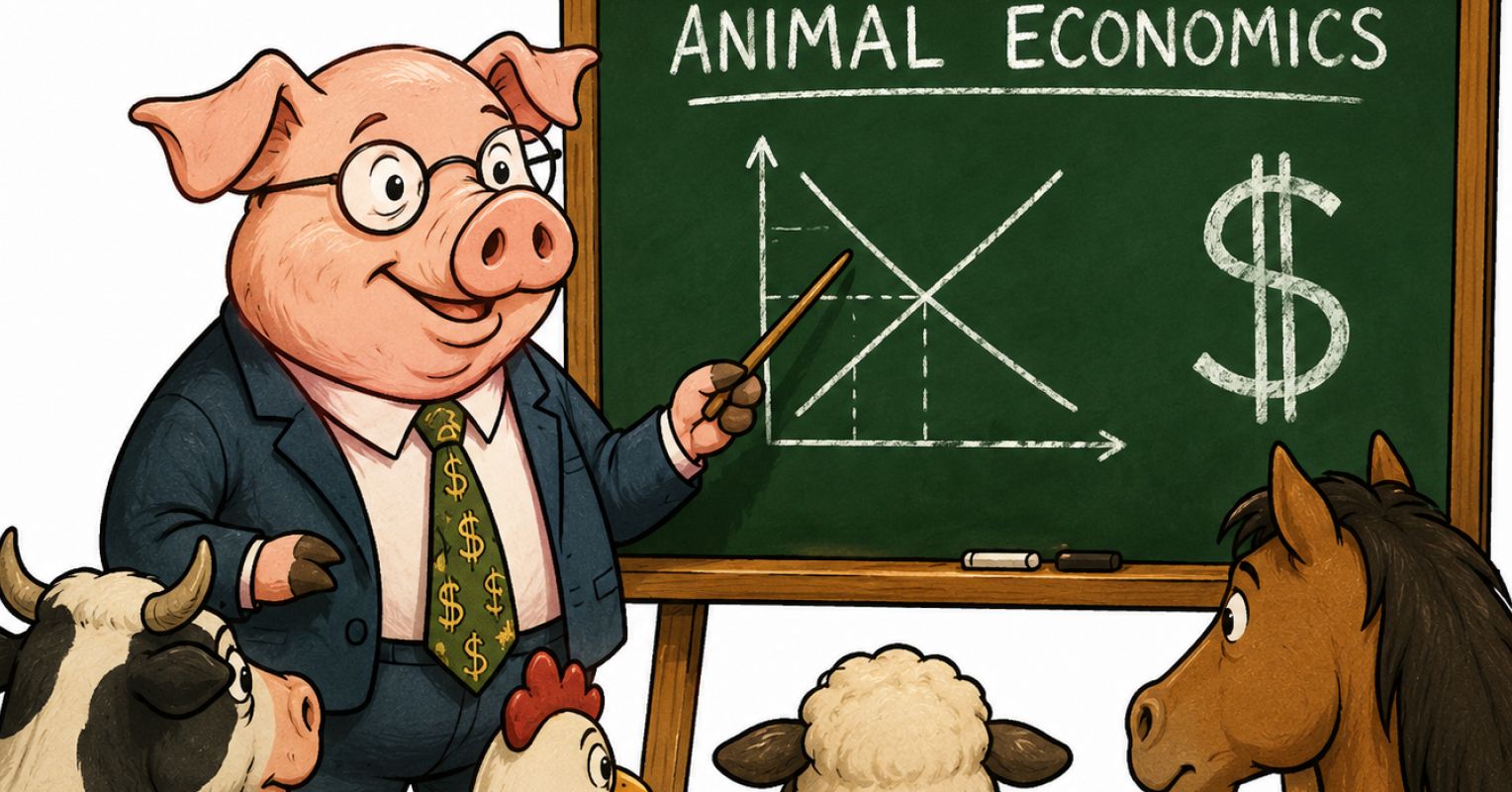
Caring about animal welfare has psychological and economic costs. While a good deal of research has centered on topics such as compassion and empathy fatigue, there have been few detailed studies of economic aspects.1 For this and other reasons, I was thrilled to learn about Nicolas Treich’s recent book, Animal Economics: Directly and Indirectly Accounting for Animal Welfare, in which he “explores the complexity of the behavioral attitude of humans toward animals using behavioral economics and explains how existing economic theory can be applied to understand animal welfare as an externality.”2 Here’s what he had to say about his deeply thoughtful and highly-acclaimed work.
Marc Bekoff: Why did you write Animal Economics?
Nicolas Treich: Mostly because there is a gap in my discipline: economics. We usually do not talk about animals. And when we do, for instance in agricultural or environmental economics, animals are treated as food, resources, or biodiversity. That is, they are treated as things, like other inputs or commodities. We therefore ignore what is most important about them: they can feel, have emotions, and thus, can experience welfare. The book is about the economics of animal welfare.
MB: How does your book relate to your background and general areas of interest?
NT: My background is in decision theory, which later extended to more applied fields such as environmental economics, benefit-cost analysis, and behavioral economics. I have been working on animals for about ten years. This background helped me write a book that draws on several areas of economics relevant to the study of animals and their welfare. The book also goes beyond economics, especially into psychology and philosophy.
MB: Who do you hope to reach?
NT: First, colleagues in economics, especially those in agricultural economics, environmental economics, or even public economics. My hope is that some colleagues include a chapter or two on animals in their courses and possibly use my book as a teaching resource. Second, colleagues from other disciplines (such as psychology, philosophy, ecology, or ethology) who are interested in animals and curious about what economics can contribute to the topic.
MB: What are some of the topics you consider, and what are some of your major messages?
NT: First, it is important to stress that the book has two parts: the direct approach and the indirect approach. The direct approach considers that animals have intrinsic value. They have moral status. To use the jargon of economics, the welfare of animals is directly included in the social welfare function, namely in the social objective. This approach is non-anthropocentric. By contrast, the indirect approach is anthropocentric. Animals matter only because they matter to humans. In short, if we protect a whale, the direct approach considers the impact of this protection on the welfare of the whale, while the indirect approach considers the impact on the welfare of humans who care about the whale.
I believe that this distinction between the direct and indirect approaches is useful as a pedagogical device. These two approaches are indeed conceptually very different, and they rely on different methods. The direct approach is closely connected to philosophy. I show how economic tools can provide a new perspective on some philosophical issues, such as the notion of anti-speciesism or the replaceability argument. I also show how this approach can be operationalized, and even how animal welfare can be monetized and used in policy evaluation.
The indirect approach is more behavioral. It is mostly about understanding pro-animal concerns, and its implications for individual choices and policymaking. I build on research in psychology and economics to present what we know, and what we still don’t know, about human perceptions and attitudes toward animals. I can give one example: the vote-buy gap. Research shows that people tend to be more animal-friendly when they vote than when they shop. We still do not fully understand this gap. In the book, I present possible explanations based on recent studies.
MB: How does your work differ from others that are concerned with some of the same general topics?
NT: Again, research on animals in economics is scarce. Perhaps the main originality of the book is that it develops a non-anthropocentric approach. I explain how standard tools, such as taxation, can be used and calibrated when externalities concern animals directly. I also discuss new challenges using economics methods, such as population ethics dilemmas and the difficult problem of comparing welfare across species.
Another original aspect is its focus on pro-animal concerns. There is a large body of research in behavioral economics on prosocial concerns. This literature studies people’s beliefs, attitudes, and choices concerning other humans. By contrast, we still have a lot to learn about how people think about and behave toward other animals. One example is the origins of pro-animal concerns. Why do we care about animals in the first place? Is it because some resemble our babies with round faces and big eyes, as pandas do? Or because we have long cooperated with them, as with dogs and horses? And, what is the role of self-image and social concerns in this? Better understanding these origins is important. It can help us decipher our attitudes toward animals and, in turn, design better policies that improve the lives of both humans and animals.
Relationships Essential Reads
MB: Are you hopeful that as people learn more about this topic they will develop a more welcoming mindset about the benefits and costs of a more humane economics?
NT: Whether we like it or not, our world is largely driven by economic forces. Policymakers often use the language of economics. Benefit-cost analysis is a legal requirement in countries such as the US. If we do not count animals, as we count other things in benefit-cost analysis, the risk is that animals simply do not count at all at a policymaking level.
Another example concerns animal advocacy. I have huge admiration for people working on the ground to help animals. Yet it has long been argued that this work is not always very effective. Moral arguments alone are often not enough. They may be weak compared to first-order economic forces in this world, such as the demand for meat or the push for deforestation. What often works better is, for instance, when associations threaten to damage the reputation of firms that treat animals or nature badly. In other words, associations may use economic incentives to advance their agenda in favor of animals. Here again, thinking like an economist may be useful.