
A recent study by Giles-Kaye and colleagues asked 5- to 8-year-olds about how their school could support students’ mental health. Insightfully, students asked that teachers promote kindness and belonging. Students understood the connections between the school’s climate, their behavior, and their learning: “Children reported that it is important for schools to create a culture of belonging and that when school feels like a positive place, children feel calm and relaxed and, therefore, better able to participate in learning.”
Teachers are often encouraged to integrate kindness activities into their classrooms (for a recent scoping review of kindness interventions, see Zanforlini et al.’s research). As teachers head into their summer break, they might find comfort in knowing that students generally see teachers as kind and routinely see teaching itself as a kind act.
To capture young students’ perceptions, researchers often use a drawing-telling methodology. As students aren’t yet ready to fill out surveys or respond to scales, a developmentally appropriate approach is to have them draw illustrations of concepts. As young students’ drawings can sometimes be difficult to interpret (i.e., they can look like chicken scratch), researchers often use an in situ coding technique and write “who?” is in the drawing and “what?” is happening.
I used this approach to ask 652 kindergarten to third-grade students about teacher kindness and asked them to draw a teacher being kind. The results surprised me. As a former classroom teacher and school counselor, I thought students might identify teacher kindness as being given extra minutes at recess or perhaps a candy if they were well behaved. Overwhelmingly, students drew teachers teaching. This has been described as “pedagogical kindness,” kindness embedded in the approach and routines of teachers. It’s not something additional teachers do but rather a routine part of how they teach.
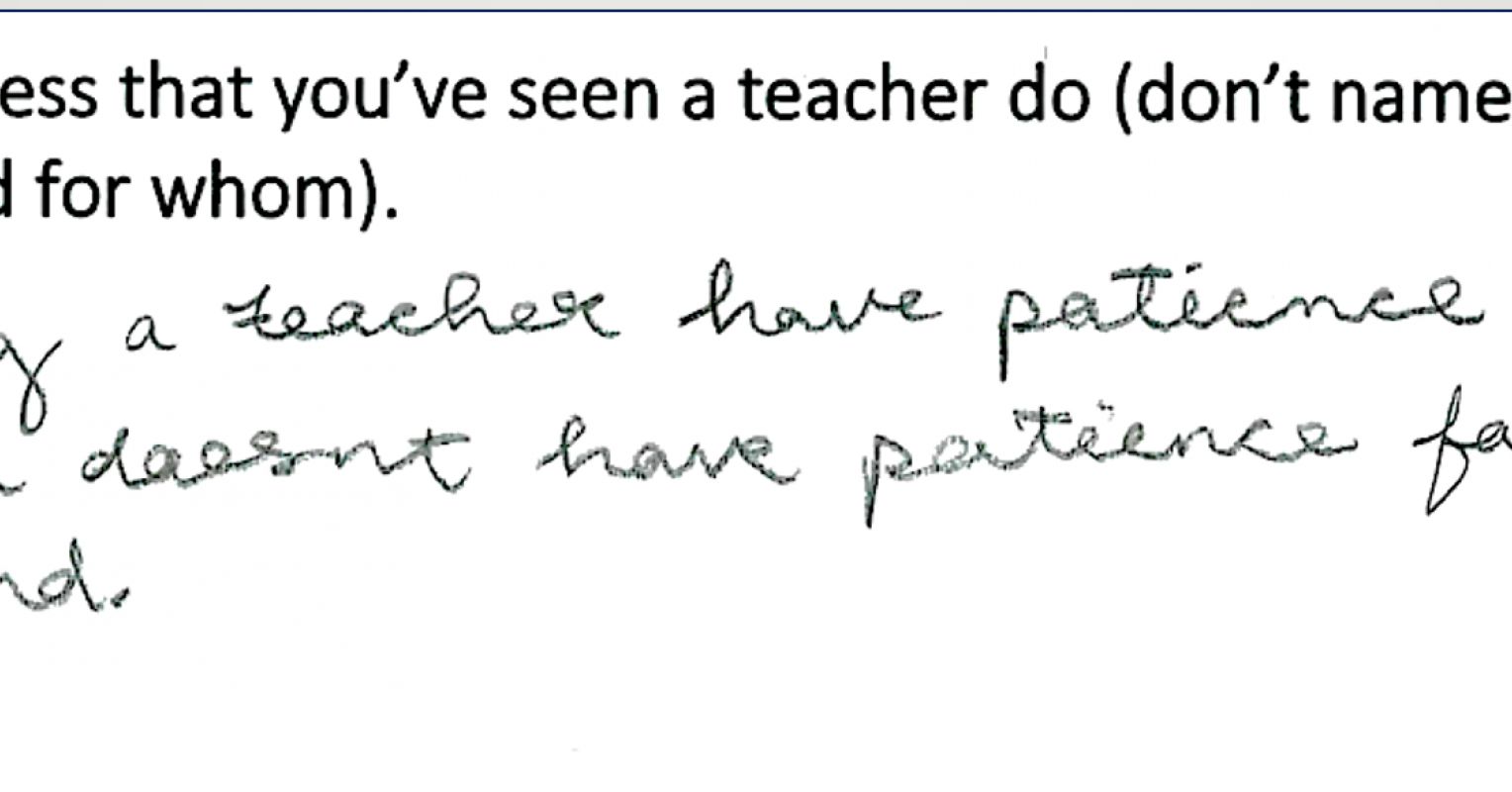
What was surprising in the examples furnished by these young students was their observation of teachers interacting with other students. They certainly recalled instances of the teacher being nice to them and helping them by explaining a concept, yet they also noticed when a teacher helped a fellow student who was struggling to understand something within a lesson. It’s not only young students who notice teacher kindness. In this example, we see a 12th grader notice a teacher supporting a student who is struggling.
As teachers prepare for their much-needed summer break, my hope is that they find these students’ perceptions of teacher kindness comforting. It’s not the elaborately planned lessons, the guest speakers, or the field trips that students notice as remarkable acts of kindness. Rather, it’s teachers doing what they do best—teaching.