
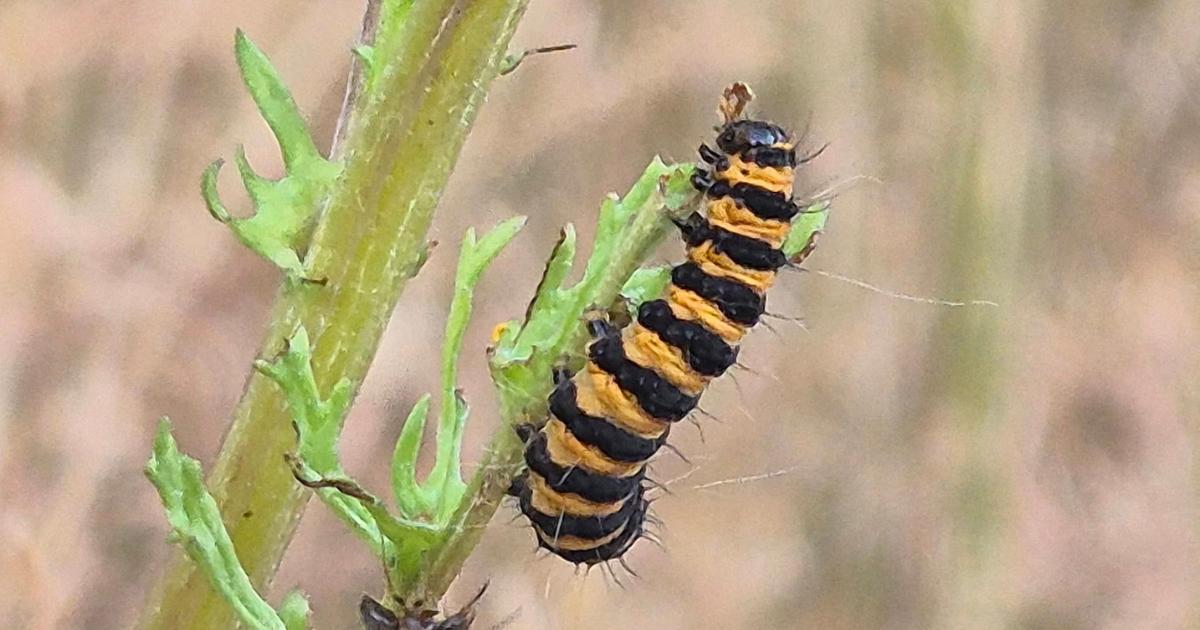
The insect is the larval stage of a moth or butterfly, and is distinctive for its long, worm-like body with six true legs.
Caterpillars can look very different from when they first hatch to when they are ready to undergo pupation (the stage where they transform into a moth or butterfly).
Therefore, they are most likely to be noticeable in the later stages of their growth when they are at their largest.
The summer to early autumn period is a time when many different caterpillars can be spotted around Dorset.
What caterpillars can be spotted around Dorset?
According to the Dorset Wildlife Trust, there are numerous varieties of caterpillar that can be spotted around the county.
Drinker moth
When can they be spotted: August to June in a variety of habitats, such as gardens.
Appearance: Dark and covered with brown hairs and golden speckles. A row of white hairs runs down each side of the body.
Fox moth
When can they be spotted: June to April in heathland and coastal grassland.
Appearance: Hairy, with long dark hairs on the sides of the body and shorter orange hairs on top.
Garden tiger
When can they be spotted: August to June in a wide range of habitats.
Appearance: Mostly black and ginger, with longer white hairs.
Cinnabar
When can they be spotted: July to September in grassy habitats.
Appearance: Black and yellow stripes.
Elephant hawk-moth
The Elephant hawk-moth can be found in a variety of habitats, including gardens (Image: Helen Moore’s Art & Photography/Camera Club)
When can they be spotted: June to September in a variety of habitats, including gardens.
Appearance: A chunky green or brown caterpillar, with several eyespots at the front end and a spiky ‘tail’ at the rear.
Privet hawk-moth caterpillar
The Privet hawk-moth caterpillar is green and chunky, with purple and white stripes (Image: Getty Images)
When can they be spotted: July to September in a variety of habitats, including gardens.
Appearance: Green and chunky, with purple and white stripes on the body and a black and yellow horn on the rear.
Puss moth caterpillar
The head of the Puss moth caterpillar is surrounded by a pink patch (Image: Getty Images)
When can they be spotted: June to September in parks, gardens and wetlands.
Appearance: A green caterpillar with a dark, white-edged ‘saddle’. The head is surrounded by a pink patch, with false eyes making it look like a giant face.
Mullein moth
The Mullein moth is white in colour with horizontal yellow splodges across the body (Image: Getty Images)
When can they be spotted: Between April and July in a range of open habitats, including gardens.
Appearance: White with horizontal yellow splodges across the body and large black spots.
Yellow-tail
Yellow-tail caterpillars can be found between August and June in scrubby habitats (Image: Getty Images)
When can they be spotted: Between August and June in scrubby habitats, including hedgerows, woodland and gardens.
Appearance: Black with long, greyish-white hairs. On top, it has a pair of red lines, with a row of white blotches on either side of them. A red line runs along each side.
Brown-tail
The hairs on a Brown-tail caterpillar cause skin irritation so avoid touching them (Image: Sharon Wheeler/Camera Club)
When can they be spotted: Between April and May in scrubby habitats.
Appearance: Black with long brown hairs, red spots on top and a line of white marks along each side.
Peacock
The Peacock caterpillar is black in colour with black spines and small white dots (Image: Getty Images)
When can they be spotted: Between May and June in a range of habitats where common nettle is present.
Appearance: Black with black spines and small white dots.
Vapourer
Vapourer caterpillars can be found between May and September (Image: Gary Moors/Camera Club)
When can they be spotted: Between May and September in woodland, parks and gardens.
Appearance: Grey and black caterpillar, with large tufts of hair, including a mohawk of yellow tufts on the back.
Pale tussock
When can they be spotted: Between June and October on deciduous trees and other plants, including bramble.
Appearance: A bright green colour, with black bands between its body segments, yellow/whitish hairs, a row of yellow tufts on top and a red tuft at the rear.
Small eggar moth
Small eggar moth caterpillars can be spotted between April and July (Image: Mazz Blehs/Camera Club)
When can they be spotted: Between April and July.
Appearance: Dark reddish-brown in colour with a whitish spot in the centre of the forewings and a whitish cross-line below.
Public urged to look out for oak processionary moth caterpillars
A warning has been issued by the Forestry Commission urging for people to look out for the oak processionary moth when out and about.
Sightings of the moth can be reported via the TreeAlert portal or by email to opm@forestrycommission.gov.uk, including a photo and location.
The caterpillars are predominantly found in south east England.
They descend down oak trees in a head-to-tail procession, earning them their name.
They feed on the leaves as they move which can negatively impact the oaks growth.
This can weaken the tree and leave it more vulnerable to other stresses, such as diseases.
The Forestry Commission adds: “Oak processionary moth caterpillars are covered in long hairs that can cause itchy rashes, eye and throat irritation and should not be touched under any circumstances.
“They also form silky white nests, ranging in size from as small as a 50 pence piece up to a melon.
“These nests discolour over the season, appearing dirty and brown by August.
“The nests also contain the hairs, and similarly should not be touched.
“The nests can be found on the trunk or the underside of branches of oak trees.
“Members of the public are urged never to try and remove or dispose of the nests themselves.”
Have you spotted any caterpillars around Dorset this year? Let us know in the comments.