
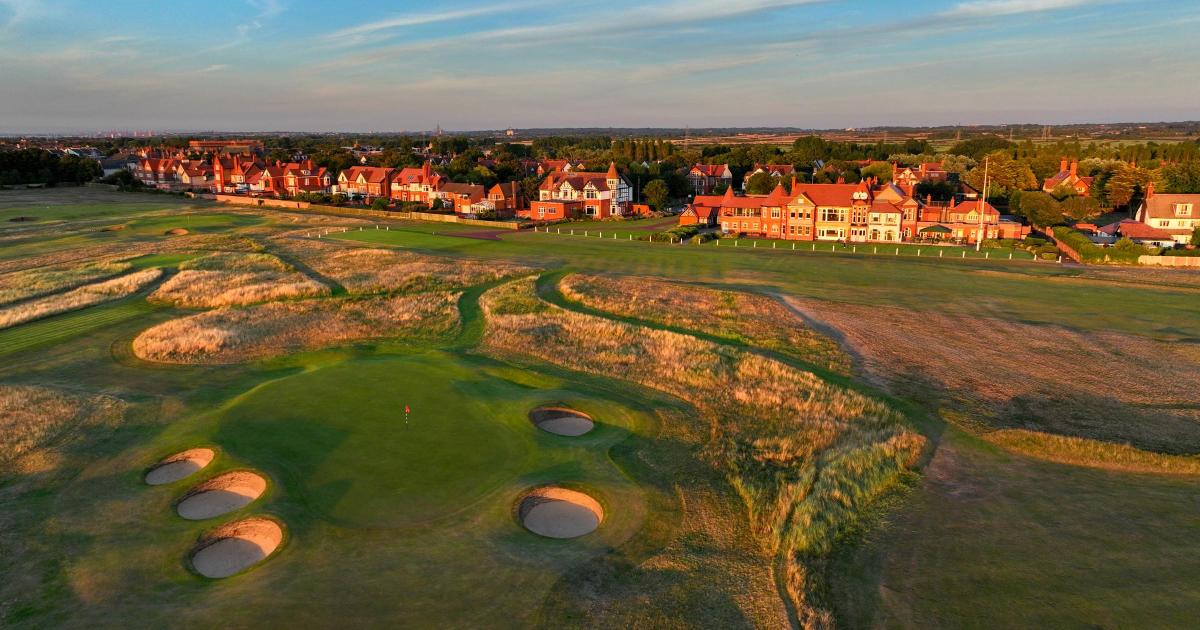
I’ve come to Royal Liverpool Golf Club on this sunny afternoon to meet captain Neil McBurney ahead of the tournament, which was inaugurated more than 140 years ago right here in these hallowed grounds.
He talks me through the history and takes me for a tour of some of the medals, memorabilia and iconic photos that reveal how much, and how little, the game has changed.
And while I come here humbly as someone whose knowledge of golf would fit on a stamp, even I know: there’s nothing “amateur” about this championship.
Neil McBurney, captain (Image: Jack Lyons)
Past masters
The Amateur Championship began at Hoylake in 1885, when a handful of clubs sent their best members to compete for glory.
The success of the tournament spurred the game’s governors to formalise the event, and a year later it was agreed that the championship would rotate between Hoylake, St Andrews and Prestwick.
John Ball and Harold Hilton (Image: Jack Lyons)
Local legend Harold Hilton, one of the club’s great sons – who twice won The Open – claimed the Amateur in the late 19th and early 20th centuries, his name now etched into club silverware and honoured by the Hilton medal.
Another towering figure associated with Hoylake is Bobby Jones, the American amateur who completed the Grand Slam in 1930 and has long been Neil’s “hero” in golf history.
Bobby Jones (Image: Jack Lyons)
Jones’s achievements – including Open and Amateur titles and the founding of the Masters – underline how closely the top end of the amateur game sits to the professional majors.
Today, it remains one of the most prestigious titles in the unpaid game, and returns to Hoylake next week for the first time in 26 years.
Royal Liverpool Golf Club, Hoylake (Image: Gary Lisbon)
You don’t need to look back much further to a time when amateurs held down jobs and had no intention of taking their game any further.
“Even if you go back fifty years, you’d have ‘working amateurs’, people in their mid‑30s with a full‑time job who were also good enough to play,” Neil says.
Royal Liverpool Golf Club, Hoylake (Image: Gary Lisbon)
Nowadays, he explains, the field is increasingly made up of young, up‑and‑coming players using the Amateur as a springboard to announce themselves on the world stage.
And the stakes are clear enough: the winner at Hoylake will earn a place in The Open, which this year is being played just up the coast at Royal Birkdale.
An evocative painting of the club (Image: Jack Lyons)
To get into pre‑qualifying, players must either sit inside the top 1,000 of the World Amateur Golf Ranking or hold a handicap of 4.6 or better – the sort of number that would make them the low man in almost any club medal.
The trophy is significantly bigger than the one handed to winners of the Open (Image: Jack Lyons)
So these are pretty damn good amateurs. In fact, in this context, “amateur” really only means one thing: there’s no prize money.
Neil gives me the tour (Image: Jack Lyons)
One current member at Hoylake, Matthew Dodd, has booked his place in the championship proper, while another, Steve Capper, sits ninth reserve, hoping the call will come.
For Neil, the most important thing about the Amateur Championship for an emerging player is simple: “It gives them a taste of the big stage – are they able to get up there, hold their nerve, and play some nice golf?”
The empty frame awaits this year’s winner (Image: Jack Lyons)
The pressure is high for members, but they have the privilege of knowing every bounce, every awkward lie, every gust that sneaks in off the Dee.
Royal Liverpool Golf Club, Hoylake (Image: Gary Lisbon)
This year is particularly special for any resident or member of a golf club in this region. Aside from the Amateur Championship here and the Open at Royal Birkdale in July, the Women’s Open is being held at Lytham St Annes in Lancashire.
The year 2026 has proved to be, Neil says, a “real coup” for golf in the North West.
Royal Liverpool Golf Club, Hoylake (Image: Gary Lisbon)
Two holes in one – and how golfers got ‘too good’
As we talk, Neil reflects on how the sport itself has shifted since those early Hoylake championships – and how modern players are becoming, paradoxically, too good. “The ball is going too far, basically,” he says.
Equipment, golf balls and the rigorous fitness regimes of modern pros and elite amateurs have combined to produce distances that would have been unthinkable in Harold Hilton’s day.
Royal Liverpool Golf Club, Hoylake (Image: Gary Lisbon)
From an environmental and social responsibility point of view, that creates a problem. “The courses have to get bigger – and the bigger it gets, the more grass you need to grow, the more you need to tend,” he says.
Neil’s view is that the game needs to “keep golf the size it’s at now”, rather than endlessly stretching tees back and carving more land out of the landscape, just to contain the longest hitters.
Right on cue, as he’s making the point about how far top players hit it now, we are suddenly joined by a living example.
Club member David Lewis, still slightly dazed after achieving back‑to‑back holes‑in‑one with his friend Rob at the weekend, sits down to tell the story. He estimates the odds of pulling it off are around one in 170 million.
David Lewis, one half of the incredible hole-in-one duo (Image: Jack Lyons)
“Rob hit a nice wedge and we heard it hit the flag, but you never know after that,” Lewis recalls. “It could carry on. Then I hit a shot which I was quite pleased with but again, you have no idea, it could be short, it could be long.”
(Image: Royal Liverpool Golf Club)
When they reached the green, they discovered both balls had gone in. The pair were in disbelief – and so, David says, were the rest of the club. “If I had a pound for every text I’ve had asking if I bought a lottery ticket…”
(Image: Royal Liverpool Golf Club)
Why the Amateur is a spectator’s dream
If the Amateur has become a proving ground for future stars, Neil argues it has also become something rarer in the modern game: a tournament built for spectators rather than television.
The difference, he says, is most striking once the stroke play is over and the match play stages begin.
Neil McBurney (Image: Jack Lyons)
“During the match play stages, all the spectators – there might be 1,000 or so, not 50,000 a day – can follow the players down the fairway,” he explains. “At The Open, they’ve got the ropes on either side and you’re watching from 50 yards away. Has he hit it? Oh yes he’s hit it. Where’s it gone? No idea.”
Royal Liverpool Golf Club, Hoylake (Image: Gary Lisbon)
At Hoylake next week, it will be different. “Following this, you can stand 20 feet behind, and you’d see him aiming up and you’d hear the shot. The crispness of the way he hits the ball,” Neil says.
“You just don’t get that watching the pros. You get a more raw experience, definitely. You can get right alongside the greens to watch them putting, there’s no stands – you get a much better view of the action.
“This is for the real golf aficionado.”
The Amateur Championship 2026 begins at Royal Liverpool Golf Club on June 15.